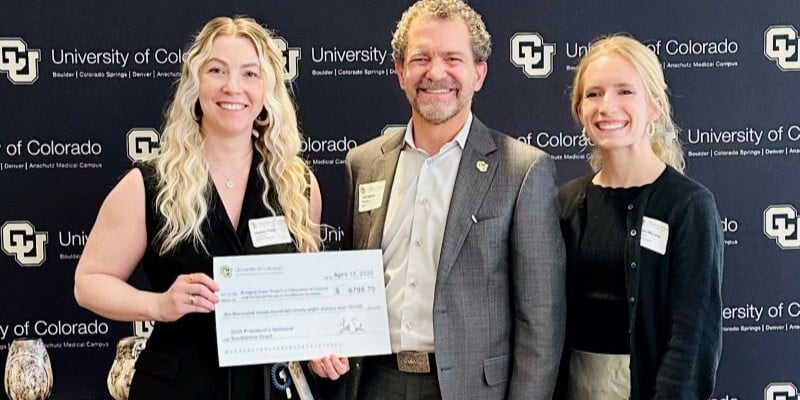
On April 17, 2025, Chelsey Patten, DBe, HEC-C, and Gianna Morales, MH, of the Center for Bioethics and Humanities, were recognized at a University of Colorado awards ceremony as recipients of the CU President’s Inclusive Excellence Grant. The honor reflects the University’s commitment to advancing inclusivity across the CU system—and celebrates bold, innovative projects that bring these values to life.
A Critical Challenge in Healthcare
Patten, director of clinical ethics, and Morales, clinical ethicist and lead educator for the Clinical Ethics Ambassador Program, received the grant for their project: “Bridging Gaps: Proactive Integration of Cultural and Personal Values in Healthcare Systems.” The initiative responds to a critical challenge in everyday healthcare: ensuring that patients’ deeply held cultural, religious, and personal values are meaningfully integrated into their care.
“Too often, care teams rely on demographic assumptions or miss opportunities to invite value-based conversations with patients and families,” said Patten. “That gap creates distress—for everyone involved—and can erode the trust that’s fundamental to ethical, patient-centered care.”
Patten and Morales propose a novel, two-pronged approach. The first involves community and provider education, designed to spark dialogue and build cultural humility among healthcare professionals. The second centers on the development of a proposed feature within the electronic health record (EHR) that would proactively flag patient-identified preferences related to culture, faith, or personal beliefs that may impact medical decisions.
Working with Local Faith Communities
The project will include six in-person dialogue sessions—four with local faith communities and two with healthcare providers—plus two virtual gatherings. These sessions are intended not only to educate and elicit feedback that will inform both the EHR design and the broader effort to make culturally humble care more actionable.
“We know that patients’ values don’t exist in a vacuum. They’re shaped by lived experiences, community norms, and spiritual traditions,” Morales explained. “This project is about recognizing that complexity and building tools that honor it in real time—during actual care delivery.”
Designing a Model Program for System-Wide Change
Both Patten and Morales have led prior initiatives at the intersection of ethics and inclusion. From providing ethics consultations to hosting real-time continuing education programs for clinicians, their work consistently seeks to elevate patient voices and reduce systemic barriers.
This project builds on that foundation, offering a replicable model that could eventually be adopted across the health systems. The team also plans to partner with faculty in the School of Medicine, a graduate student, members of the CU Office of Inclusive Excellence, and local community and faith leaders to ensure broad representation in both process and outcome.
“This is an example of what happens when you bring the right people to the table—and ask the right questions,” said Patten. “It’s not just about training or tech; it’s about listening, iterating, and designing care systems that reflect real human diversity.”
The President’s Inclusive Excellence Grant program was established to support CU faculty and staff who are advancing meaningful inclusivity work across all four campuses. Grant recipients were honored at a special ceremony hosted by CU President Todd Saliman. A photo of Patten and Morales with President Saliman, taken during the event, is featured above.
As the project moves into its implementation phase, Patten and Morales hope it will serve as a steppingstone toward system-wide change. They envision a future where values-based alerts are just as routine—and respected—as allergy alerts or code status indicators.
Until then, they remain focused on building the bridge: One conversation, one patient, one alert at a time.
Disclosure: The views expressed in this article are those of the authors and do not necessarily represent those of the University of Colorado or UCHealth.