




The number of illnesses and deaths in central Africa caused by Ebola virus disease (EVD) continues to mount. As of June 6, the disease had sickened 534 people and claimed 93 lives.
The outbreak, which began in late April, is for now confined to the Democratic Republic of the Congo (DRC) – specifically the politically unstable northeastern Ituri Province, an area of dense rainforests and gold reserves – and Uganda, but containing it should be a goal for all countries, said Daniel Pastula, MD, MHS, professor of Neurology, Infectious Diseases, and Epidemiology at the University of Colorado Anschutz School of Medicine and Colorado School of Public Health.
Pastula emphasized that EVD, which can cause severe gastrointestinal symptoms, bleeding, and potentially multiorgan failure and death, poses a low risk for people in the United States, including Colorado, where there are no known people currently who could transmit the virus.
The Centers for Disease Control and Prevention (CDC) has imposed restrictions, including enhanced public health screening, for travelers to the U.S. from the DRC, Uganda, and South Sudan. No one suspected of being infected with Ebola may travel on a commercial flight to the U.S.
Precautions do not preclude risk
In spite of these precautions, the risk of Ebola entering the U.S. or any other country may increase if the outbreak in Africa continues to spread, Pastula said. That’s the reality of a world in which many people move freely between regions and countries and traverse thousands of miles in a day or two of plane rides.
For example, 11 Americans contracted Ebola in the last major outbreak, which began in 2014 in West Africa and resulted in more than 28,000 cases and more than 11,000 deaths.
Africa bore the vast majority of the suffering, but the disease spread to four countries outside the continent, including the United States, where two patients died in American medical facilities. The virus also nonfatally infected two nurses in a Dallas hospital who cared for patients sickened with the disease.
“Viruses do not respect borders,” Pastula said. “The longer an outbreak continues and the bigger it gets, it’s very possible that someone who had contact with someone with Ebola could travel here. For our own best interests, it is better for the outbreak to end soon.”
The need for collaborative disease defense
Countries will need to work together to minimize illness and loss of life from EVD, which attacks humans aggressively, Pastula said.
“It’s a scary disease,” he said. The Bundibugyo virus, which triggered the present outbreak, has a mortality rate of 30% to 50%, and at present there is no treatment for it or vaccine to protect against it.
The Zaire virus, which caused the West African and other pandemics, is deadlier, with a mortality rate of 60% to 90%, although infected patients can be treated with two monoclonal antibodies and receive a vaccine to protect against it.
These sobering numbers command that nations collaborate to wall off the virus, Pastula said.
“It’s incumbent on all of us to have an appropriate response and collectively work to eradicate outbreaks such as [this one] in a coordinated fashion.”
Building a biodefense strategy
The fundamentals required for a response to this public health threat are possible, Pastula said.
“We know how to control these outbreaks through lessons from past outbreaks,” he said. The necessities, which center on strong surveillance to detect disease and minimize risk, include:
- Isolation of people infected with the virus
- Contact tracing to find others who are closely associated with those who were infected to find out who they are and where they are
- Quarantine and/or monitor close contacts identified via tracing to ensure that these individuals do not develop symptoms and come in close contact with others
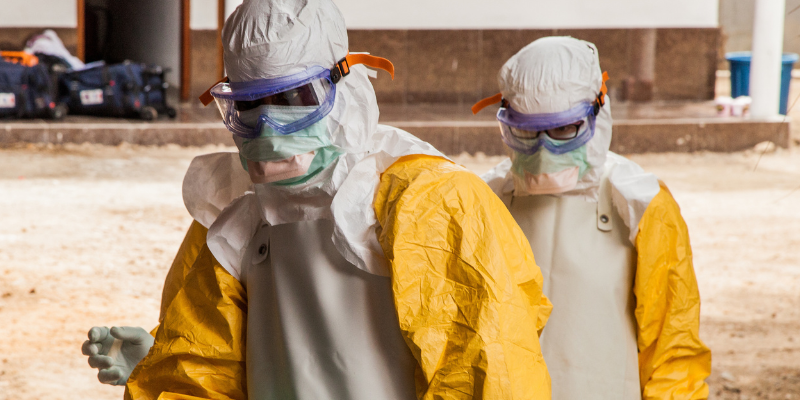
- Medical facilities with appropriate personal protective equipment, including masks, gloves, goggles, and staff trained to treat patients safely
- Coordination and free flow of public health information between local, regional, national, and international health partners
- Robust vaccine, diagnostic, and treatment development pipelines.
These basics of biodefense succeed only through a team effort and with high levels of trust between providers, healthcare facilities, organizations, and governments, Pastula said.
“It takes a lot of work and support,” he said. A mixture of factors makes containing EVD particularly difficult, he added.
A tough virus to contain
The disease spreads through “spillover events,” mainly caused by interactions with fruit bats, which Pastula described as flying viral reservoirs. The virus transmits to humans and other primates through bodily fluids.
If a human, say, eats a piece of fruit partially consumed by a bat or the meat of an infected wild animal – bush meat is a primary source of protein in some areas of Africa and other parts of the world – the virus finds its opening.
It incubates for 2 to 21 days, during which the infected individual is not contagious. That lag time, along with around four days of “dry symptoms,” such as a fever and runny nose that could be mistaken for many other viral ailments, complicates the containment problem.
The disease ultimately unleashes the “wet symptoms,” including diarrhea, vomiting, sweating, bleeding, and others, that spawn human-to-human transmission through the nose, mouth, cuts, or any other opening.
The risk is especially high for caregivers who come in close contact to the ill and those who bury the dead. These workers often lack sufficient personal protective equipment, especially in resource-strapped communities like the Ituri Province, Pastula said.
“This outbreak is occurring in a poor area of the world that currently lacks capacity to handle a large outbreak,” he said.
In the Ituri Province, ethnic clashes, heavy migration from other areas, struggles over resources, and misinformation about Ebola all undermine efforts to contain the disease, he added.
“You combine all [of these factors], and you have the recipe for a disaster,” Pastula said. “No medical condition is solely an individual medical condition. All involve public health and population health at some level in terms of either disease prevention or response. This outbreak in particular requires a really robust public health surveillance system and response.”
Taking a proactive approach locally
The fight against the introduction and spread of Ebola and other dangerous infectious diseases begins at home, Pastula concluded.
“Hospitals and public health agencies need preparedness plans for any emerging infectious disease,” he said. “These plans need to have scalability with dollars attached to them, and they need to be detailed, but with flexibility to adjust to quickly changing circumstances.”
Pastula added that preparation and planning requires people committed to the work – an area that he believes needs bolstering, here and abroad. That’s a steep challenge during an era that has spread misinformation, disinformation, and mistrust in public health and science.
“The public health and medical workforce is not currently where it should be, not just here, but across the world,” he said. To correct that, “we need government, institutional, and community support for our biodefense.”