



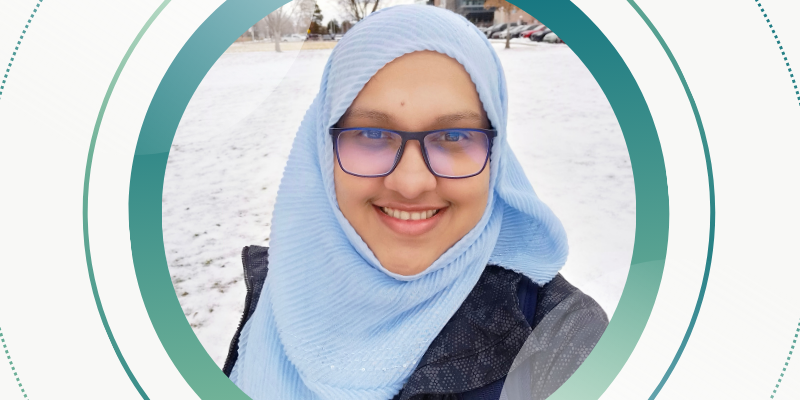
Mahfuza Haque Mahi is a PhD student in the Department of Biostatistics & Informatics at the Colorado School of Public Health, University of Colorado Anschutz Campus.
- M.S. in Statistics, University of Dhaka, Bangladesh
- B.Sc. in Statistics, University of Dhaka, Bangladesh
- Thesis adviser: Dr. Debashish Gosh
- Research interests: Causal inference, Machine learning, Genomics and Metabolomics.
What led you to choose the ColoradoSPH Biostatistics & Informatics Department for your PhD studies?
I chose ColoradoSPH because of its strong reputation in biostatistics, the collaborative research environment, and the opportunity to work on impactful health and biomedical research projects with supportive faculty mentors.
Why did you choose to study biostatistics?
I grew up in a country where I witnessed many people struggle with health-related challenges, which inspired me to pursue a career that could contribute to improving people's lives. Since statistics was my undergraduate major and I enjoyed quantitative problem-solving, biostatistics felt like the perfect way to combine my statistical skills with meaningful health research.
One of my professors used to say that "The people God loves most end up studying statistics." I smile when I think about that now because biostatistics has given me a way to combine my passion for data and analytical thinking with my desire to contribute to improving people's health and well-being.
What has been your favorite class so far?
My favorite class has been Advanced Mathematical Statistics I (BIOS 7731). I enjoyed learning the theoretical foundations behind statistical methods, including multivariate normal distributions, generalized linear models, asymptotic theory, and maximum likelihood estimation. The course strengthened my understanding of why statistical methods work and helped me develop a deeper appreciation for both the theory and application of biostatistics.
How would you describe the student community in the department?
The student community is supportive, collaborative, and welcoming. Students are always willing to share ideas, help each other solve problems, and celebrate each other's successes.
Tell us about a project you are currently working on that you are excited about.
I am currently working on a large-scale metabolomics project within the ECHO program, where my primary role is data cleaning, preprocessing, and preparing complex datasets for downstream analyses. The project involves integrating information from multiple databases, linking participant metadata, identifying repeated samples, assessing data quality, and harmonizing metabolomics measurements across cohorts. Because of the size and complexity of the data, I work in a secure remote computing environment through a VPN and collaborate with researchers from different disciplines.
What I enjoy most about this project is that it has exposed me to many new technologies, data management strategies, and real-world challenges that are not always covered in coursework. It has taught me how to carefully examine data, identify potential issues, and make informed decisions during the preprocessing stage. This experience has reinforced the importance of data quality, since high-quality analyses depend on well-prepared data. I believe the skills I am developing through this project will be valuable throughout my future career as a biostatistician.
What advice would you give to prospective students applying to this program?
Be curious, ask questions, and take advantage of opportunities to collaborate with faculty and fellow students. The program offers a wide range of research experiences, so staying open to new ideas can lead to exciting opportunities.
What do you like to do outside of research? Or What do you like about living in Colorado?
Outside of research, I love spending time with my little girl, as well as with my family and friends. Living in Colorado has been a wonderful experience because of the weather. Most of the year it is neither too hot nor too cold, and I especially enjoy the sunny winter days. I also love exploring Colorado’s beautiful scenery, including its mountains, lakes, and outdoor spaces. The natural beauty and opportunities for adventure make it a great place to live and work.