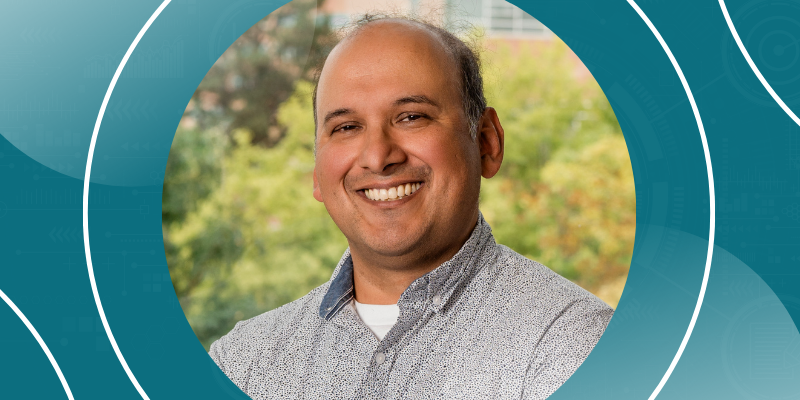





Dr. Yue Wang is an assistant professor in the Department of Biostatistics & Informatics at the Colorado School of Public Health, University of Colorado Anschutz Medical Campus.
He develops statistical/computational methods for integrating multi-omics data to address important biomedical questions.
Can you describe a research project where you applied biostatistical methods to address a real-world public health issue?
During my postdoctoral training, I had the opportunity to work on the “Carbohydrates and Related Biomarkers” (CARB) study, a randomized crossover feeding trial at the Fred Hutchinson Cancer Center that examined how low- versus high–glycemic-load diets influence metabolic health. One aim I led investigated a key mechanistic hypothesis: that interactions between gut microbes and bile acids mediate the benefits of a low–glycemic-load diet. Statistically, this was a mediation problem with a major challenge: hundreds of microbe and metabolite candidates, each contributing only weak individual signals. Because these biomarkers operate in coordinated pathways rather than in isolation, traditional one-at-a-time mediation analyses were insufficient.
To address this, we developed an approach that integrated canonical correlation analysis (CCA) with mediation modeling. CCA allowed us to extract components capturing the joint microbe–metabolite interplay, and these components served as biologically interpretable mediators, representing gut metabolic pathways, through which dietary intervention effects could be quantified more robustly than with single biomarkers alone. This project demonstrated how multivariate statistical methods can reveal mechanistic insights that are invisible to univariate approaches, ultimately helping clarify how dietary interventions shape health through the gut microbiome.
How do you engage students in biostatistics to ensure they grasp complex concepts?
I have taught BIOS 7731 (Advanced Mathematical Statistics) for the past three years, and one of the biggest challenges I’ve encountered is motivating students to appreciate theory in an era where biostatistics is increasingly computation-driven. For example, when we discuss asymptotic distributions, which are essential for constructing confidence intervals and p-values, students often ask why they should learn these results when resampling methods like the bootstrap or permutation tests can accomplish the same goals without heavy theory. I treat this question as a teaching opportunity. I show them that asymptotic theory is fundamentally about efficiency: if we understand the analytic distribution of a statistic, inference becomes instantaneous. In contrast, resampling methods can be computationally expensive, especially for models that require complex optimization. This contrast helps students see why asymptotics still matter in modern practice. At the same time, I acknowledge that computation will only get faster.
So I encourage students to think beyond “how to compute” and instead focus on “why a method works,” helping them see theory as a framework that deepens intuition, guides method development, and prevents misuse of algorithms. Ultimately, my goal is to adapt the curriculum so that students see theory not as an obstacle but as a tool that empowers better practice.
How do you stay updated with the latest advancements in biostatistics?
I check new preprints on arXiv and bioRxiv every couple of weeks; not to read every paper in depth, but to track emerging ideas, methodological trends, and new problem areas. I also make a point to attend major statistics and biostatistics conferences each year. Conferences are invaluable for hearing cutting-edge work, seeing how ideas evolve, and engaging directly with the research community.
What has been one of the biggest lessons you've learned in your academic or research career?
One of the most important lessons I’ve learned is the value of rigorous, comprehensive note-taking. Early in my career, I tended to record only key findings or polished results. Over time, I realized that real scientific progress depends just as much on documenting the “in-between” steps: every idea, attempted approach, failed experiment, unexpected result, and even informal conversations with collaborators.
Why did you choose biostatistics (or informatics/data science) as a field, and what keeps you passionate about your work?
I’ve always been deeply interested in biology. I was the kid reading college-level biology textbooks in high school. But I quickly learned that I wasn’t meant for the wet lab (I even managed to burn my shoes in one…!). Although I let go of the idea of becoming an experimental biologist, the passion never went away. Discovering biostatistics felt like finding the perfect bridge: I could still work on real biological problems, but through computation and quantitative reasoning. It allowed me to stay connected to the science I love while contributing in a way that fits my strengths.
What keeps me passionate is how fast the field evolves. In the past five years as an independent researcher, I’ve watched new technologies, especially in spatial and single-cell biology, generate entirely new types of data at incredible scales. Each new dataset opens up questions we’ve never been able to ask before. Being part of the process of translating complex biological data into insights about health and disease is genuinely exciting to me, and it keeps me eager to learn and innovate every day.
Learn More
To read more about Dr. Yue Wang work, visit his faculty profile on the Colorado School of Public Health website.
Stay tuned for more features in our Get to Know Your B&I Faculty series!