



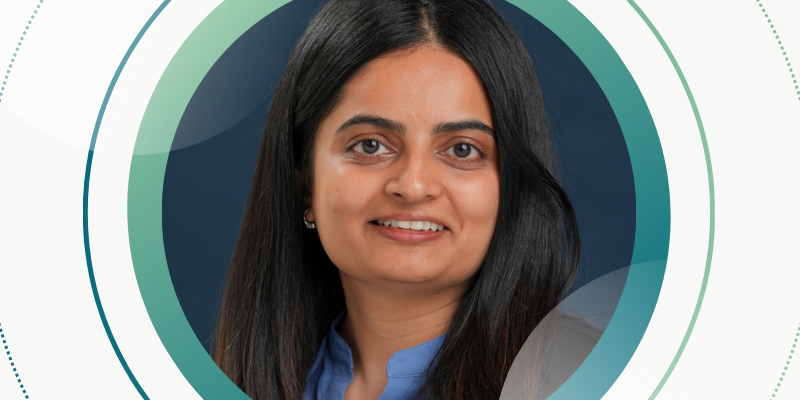
Jinal Shah is a PhD student in the Department of Biostatistics & Informatics at the Colorado School of Public Health, University of Colorado Anschutz Campus.
- Previous Degrees Earned: MPH with concentration in biostatistics from New York University and BS in Mathematics with minor in Criminal justice from University of Massachusetts Boston
- Advisor: Dr. Ryan Peterson & Dr. Yue Wang
- Research Interests: Model selection, Post-selection Inference, Spatial Transcriptomics, Reproducibility
What led you to choose the ColoradoSPH Biostatistics & Informatics Department for your PhD studies?
I chose this program because it offered the balance I was looking for: strong theoretical training paired with meaningful applied research. When I visited, the faculty and students created such a welcoming and supportive environment that I could genuinely picture myself thriving here. The availability of competitive funding also played an important role in my decision.
Why did you choose to study biostatistics?
For me, biostatistics sits at the perfect intersection of my interests in mathematics, public health, and translational research. I loved math as an undergraduate, but after college I struggled to see how I could apply it in a way that felt meaningful. Discovering biostatistics bridged that gap for me. It lets me engage with rigorous statistical thinking while contributing to impactful scientific and public health questions that are interesting to me.
What has been your favorite class so far?
It’s hard to choose just one! Methods II with Dr. Wrobel and Theory II with Dr. Mawhinney have been two highlights. Methods II stood out because it tied together so many applied tools from linear regression to mixed models to survival analysis in a very intuitive and fun way. Theory II deepened my understanding of how statistical theory connects to practice, especially around optimal estimators and confidence intervals. I also really enjoyed the survival analysis course, which introduced me to joint modeling and dynamic prediction, topics I hadn’t encountered before and found genuinely exciting.
How would you describe the student community in the department?
The early years of a PhD are often shaped so much by one’s cohort, and mine has been incredibly supportive. Because the program is small, we’ve built close relationships and relied on each other both academically and personally. In recent years, I’ve also noticed more connection across cohorts, contributing to a broader and more collaborative student community.
Tell us about a project you are currently working on that you are excited about.
I’m currently working on two projects that I’m really excited about. The first focuses on post‑selection inference, where I’m reviewing existing methods and developing an R package to make them more accessible. I enjoy work that helps bridge the gap between methodological advances and real‑world use.
The second project is in spatial transcriptomics, where we’re developing interpretable dimension‑reduction methods to improve downstream analyses such as denoising, identifying spatially variable genes, and detecting spatial domains. I love that this project combines rigorous methodological development with cutting‑edge biological applications.
What advice would you give to prospective students applying to this program?
I’d encourage prospective students to think carefully about what they want from a PhD, whether that’s a balance of theory and application, specific research interests, or a certain kind of community and then see how this program aligns with those goals. I’d also strongly recommend reaching out to current students and faculty. It’s something I wish I had done more, and it really helps you get a feel for the environment.
What do you like to do outside of research? Or What do you like about living in Colorado?
Outside of research, I enjoy dancing, hiking, watching crime dramas, and experimenting with new recipes in the kitchen. Living in Colorado has been great - having such easy access to the outdoors provides a really nice balance to the intensity of PhD life.