



The underlying message of Colorado School of Public Health’s Research Day Symposium April 15 at the Don Elliman Conference Center in the Anschutz Health Sciences Building could be summed up as, what a difference a year makes.
The annual event showcased the work of students and faculty at ColoradoSPH’s Centers for Health, Work and Environment (CHWE), the Department of Environmental and Occupational Health, and the Mountain & Plains Education and Research Center. Community and industry supporters also attended.
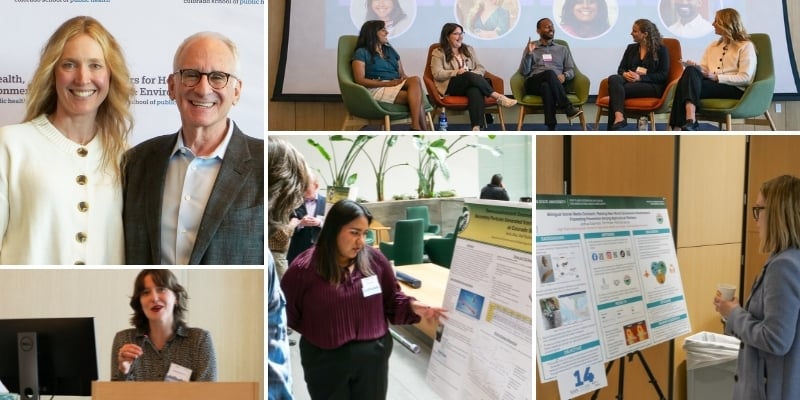
The theme of the gathering – Training Today’s Researchers for Tomorrow’s Work – underscored the contributions of ColoradoSPH students who contributed more than 30 poster presentations of projects that investigated issues related to worker health and safety in Colorado and beyond.
One year later, a much brighter research picture
“My hope is derived from students,” said Dr. Lee Newman, MD, MA, distinguished professor and director of the CHWE, in welcoming attendees who filled most of the Don Elliman Conference Center’s large ballroom.
“You are and continue to be the future of advancing and promoting the health and wellbeing of workers and community members who face environmental and work-related changes.”
Newman noted that his tone was far different at last year’s symposium, when “introduced chaos” in the form of drastic cuts to funding for the National Institute for Occupational Safety and Health (NIOSH) and other organizations threatened the mission of research and education in worker health.
For example, NIOSH supports the Mountain & Plains Education and Research Center, one of 18 institutions nationally that maintains the pipeline of occupational health and safety workers, develops partnerships with communities, and promotes research.
“We were in serious trouble,” Newman recalled. “I thought then that we were holding the last of these events.” He asked people in the audience to raise their hands if they were there for his “doom and gloom speech.”
One year later, Newman said, his message was far different. “We’re back,” he said, as is funding for NIOSH.
“We’re in a very different place than we were a year ago,” Newman said, while acknowledging that challenges remain. “I feel so much better.”
A commitment to translating research into practice
Dr. Cathy Bradley, PhD, ColoradoSPH Dean and deputy director of the University of Colorado Anschutz Cancer Center, echoed Newman’s optimism after the previous “tumultuous year.” She noted that the ColoradoSPH recently ranked 14th in the 2026 U.S. News and World Report rankings of schools of public health – up from 19th the previous year.
Bradley went on to emphasize the importance of CHWE’s work that “showcases” the translation of research into real-world solutions. She mentioned an important part of her own research, which focuses on the financial impacts of cancer on people who work, an interest fueled in part by her own experience of growing up without health insurance.
“That informed my research agenda,” Bradley said.
She went on to team up with CHWE and the Cancer Center to develop the Wellbeing and Cancer at Work (WeCanWork) program, now being implemented nationwide. The initiative assists cancer survivors in continuing to work and maintaining their financial stability while they pursue treatment and learn to adapt to physical and emotional challenges from their disease. The WeCanWork program gives oncologists a way to refer their patients to occupational medicine specialists for help with those issues.
Bradley called CHWE’s work “research that moves beyond the school, beyond publications and beyond the state of Colorado and the Rocky Mountain region.”
Highlights from the symposium include:
-
Keynote address by Nick Williams, CEO of the American Subcontractors Association of Colorado and president & CEO of R.I.S.E LLC, which provides consultation and training to raise awareness of and prevent suicide, depression, and overdose among workers – an issue he said has not been sufficiently addressed. Williams is a graduate of CHWE’s Total Worker Health certificate program.
-
Two rounds of platform presentations of research into topics affecting workers, including wildfire smoke monitoring; participation in team discussions; shift worker strain and ways to address it; pressures on high school teachers at five Colorado schools; mindfulness-oriented rest breaks for construction workers to prevent heat strain; and methods of measuring background levels of radiation in Colorado.
-
“Quick takes” on ways to improve the effectiveness of wellness and weight-loss programs; heat exposure and kidney function in greenhouse workers in Mexico; and methods of using social media to bring science to wildland firefighters.
-
A panel discussion, led by Dr. Liliana Tenney, DrPH, MPH, associate director for Outreach and Programs at CHWE, with four ColoradoSPH alumni. The panelists described to Tenney and the audience various ways that they bring their public health training to their current positions with UCHealth, the Colorado Department of Public Health and Environment, Ball Corporation, National Jewish Health, and Rocky Mountain Regional VA Medical Center.
Morning and afternoon breaks gave attendees opportunities to view poster presentations of research into various aspects of worker health, meet the presenters, and learn more about their work.
“The posters and presentations inspired us,” Newman said in his closing remarks. “We don’t know the future, but we have hope for the future. We’ve seen generations of what people like you have done after leaving this room and doing the training that you are doing now.”