
AURORA, Colo. (Jan. 28, 2025) – A new study published today in JAMA Network Open explores the effects of both recent and lifetime cannabis use on brain function during cognitive tasks.
The study “Brain Function Outcomes of Recent and Lifetime Cannabis Use,” the largest of its kind ever to be completed, examined the effects of cannabis use on over 1,000 young adults aged 22 to 36 using brain imaging technology. The researchers found that 63% of heavy lifetime cannabis users exhibited reduced brain activity during a working memory task, while 68% of recent users also demonstrated a similar impact.
Reduced brain activity was linked to poorer performance on working memory tasks. For example, working memory allows a person to follow instructions they’ve just been given or to mentally visualize and manipulate information, like solving a math problem.
Who participated in the study?
“As cannabis use continues to grow globally, studying its effects on human health has become increasingly important. By doing so, we can provide a well-rounded understanding of both the benefits and risks of cannabis use, empowering people to make informed decisions and fully comprehend the potential consequences," said the study’s first author Joshua Gowin, PhD, assistant professor of radiology at the University of Colorado Anschutz School of Medicine, who studies substance use and brain imaging.
In the study, heavy users are considered young adults who’ve used cannabis more than 1000 times over their lifetime. Whereas, using 10 to 999 times was considered a moderate user and less than 10 times was considered a nonuser.
Researchers used magnetic resonance imaging (MRI) brain scans while participants completed seven cognitive tasks to measure brain activity. The tasks tested working memory, reward, emotion, language, motor skills – such as tapping a finger to map brain control, relational assessment and theory of mind.
What the findings mean
The researchers found that cannabis had a statistically significant effect on brain function during working memory tasks, meaning the observed impact is very unlikely to be due to random chance. Researchers observed similar effects among both recent cannabis users and heavy lifetime users. The impact was less significant for the other tasks.
Participant categories:
- Heavy users: More than 1,000 lifetime uses
- Moderate users: 10-999 lifetime uses
- Nonusers: Fewer than 10 lifetime uses
"We applied the highest standards to our research, setting rigorous thresholds for statistical significance across all seven cognitive function tests. To minimize the risk of false positives, we employed false discovery rate (FDR) correction. While some of the other tasks indicated potential cognitive impairment, only the working memory task showed a statistically significant impact,” adds Gowin.
During working memory tasks, the researchers found heavy cannabis use appeared to reduce brain activity in certain areas of the brain (dorsolateral prefrontal cortex, dorsomedial prefrontal cortex and anterior insula). These regions of the brain are involved in important cognitive functions such as decision-making, memory, attention and emotional processing.

However, Gowin mentions their research also suggests that abstaining from using cannabis before doing a cognitive task could help to improve performance. “People need to be aware of their relationship with cannabis since abstaining cold turkey could disrupt their cognition as well. For example, heavy users may need to be more cautious,” Gowin says.
He adds, “There are a lot of questions we still need answers to regarding how cannabis impacts the brain. Large, long-term studies are needed next to understand whether cannabis use directly changes brain function, how long these effects last and the impact on different age groups.”
Key points:
- More than 1,000 young adults participated.
- 63% of heavy lifetime cannabis users showed reduced brain activity during working memory tasks.
- 68% of recent cannabis users showed similar effects.
- Reduced brain activity was associated with poorer working memory performance.
About the University of Colorado Anschutz
The University of Colorado Anschutz is a world-class medical destination at the forefront of transformative science, medicine, education and patient care. The campus encompasses the University of Colorado health professional schools, more than 60 centers and institutes and two nationally ranked independent hospitals – UCHealth University of Colorado Hospital and Children's Hospital Colorado – which see more than two adult and pediatric patient visits yearly. Innovative, interconnected and highly collaborative, the CU Anschutz Medical Campus delivers life-changing treatments, patient care and professional training and conducts world-renowned research fueled by $910 million in annual research funding, including $757 million in sponsored awards and $153 million in philanthropic gifts.
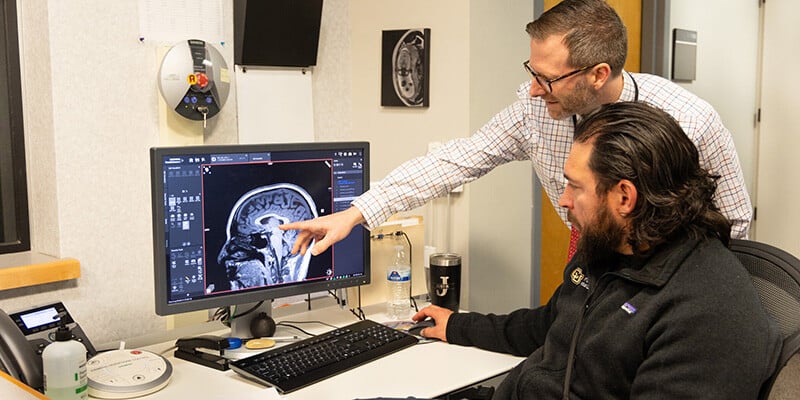
Photo at top: Joshua Gowin, PhD, assistant professor of radiology, and Justin Juvera, senior professional research assistant and MRI manager, look at a brain scan of a participant in Gowin's current study, which follows the study on the effect of cannabis use on brain function during memory working tasks.