

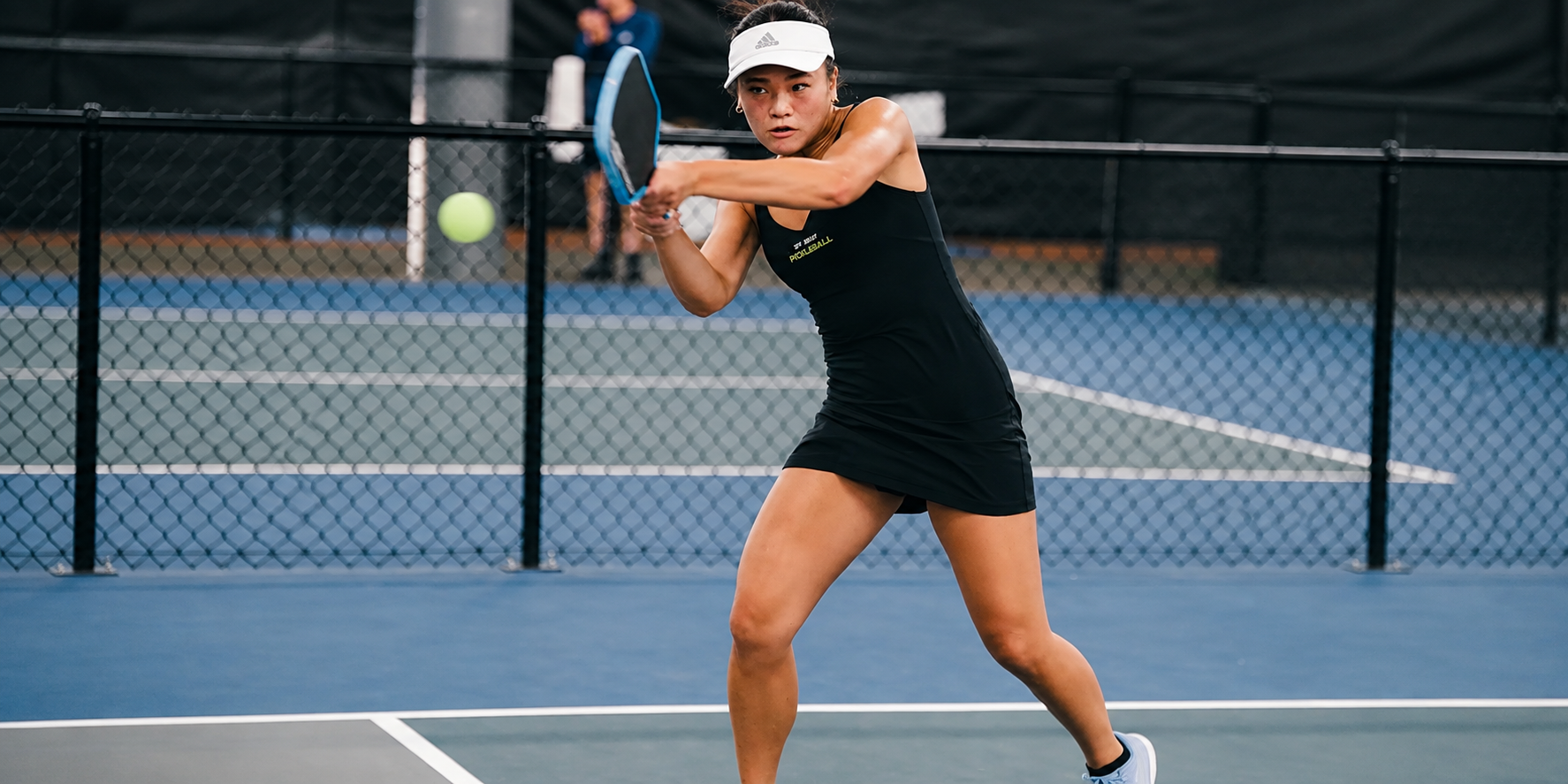
After earning admission to the University of Colorado School of Dental Medicine, Eileen Tran made a PowerPoint presentation. It was not for a class, an internship, or an admissions interview. It was for her parents.
Tran had been offered a chance to delay dental school for a year and pursue professional pickleball. At first, she said no. Her parents, Vietnamese immigrants who had built their lives around hard work, education, and stability, understandably saw a professional sports detour as unfamiliar territory. So, Tran did what an analytical future dentist might do: she laid out the pros and cons, made her case, and convinced them that one unconventional year did not mean abandoning the future she had worked toward.
The decision says a lot about Tran: disciplined enough to earn a near-perfect GPA, focused enough to secure a place in dental school and curious enough to make room for an opportunity she may never have again. It also reflects qualities Christian Valtierra, UPP Program Coordinator, saw throughout her time in the Undergraduate Pre-Health Program (UPP), part of the Office for Educational Outreach and Pathway Initiatives within the Office of Access and Engagement. "Eileen doesn't simply attend - she contributes with depth and intentionality," Valtierra wrote in his recommendation for dental school.
For those hearing about UPP for the first time, the program is a two-year undergraduate pathway at CU Anschutz that expands access to health and research career exploration while preparing students for graduate and professional education through sustained academic, professional, and experiential learning. Each cohort includes up to 15 students interested in fields ranging from medicine and dentistry to pharmacy, nursing, public health, physical therapy, physician assistant studies, research, and other graduate programs.
UPP is intentionally small and cohort-based. That matters, Valtierra said, because students who take initiative and are truly present make the learning stronger for everyone around them. The program combines academic and professional preparation with mentorship, community engagement, and repeated opportunities to examine healthcare in a broader social context.
That approach reflects the larger mission of the Office for Educational Outreach and Pathway Initiatives: to provide sustained, comprehensive programming across educational levels that promotes access and expands participation in healthcare, STEAM, and research professions. Its values include holistic student engagement, addressing gaps in health outcomes and access to care, strengthening cultural sensitivity and responsiveness, building mentorship and leadership through community involvement, and increasing the social capital students can draw on as they move through higher education and into professional life.
UPP puts those values into a structured experience. In Track I, students begin with orientation and continue through hybrid Saturday Academies during the academic year. Faculty, staff, students, and community partners engage students in a progressive curriculum focused on research, professionalism, career readiness, health disparities and current issues in healthcare. Through collaboration with the Department of Anesthesiology, students are also introduced to basic, clinical, and translational research, with faculty and research professionals sharing their work and illustrating how different approaches to research contribute to advancing science and patient care. The first year culminates in a two-week summer intensive that includes career exploration across CU Anschutz programs, service learning through teaching and mentoring middle school students in the CU Pre-Health Scholars (CUPS) program, and hands-on training in wilderness medicine and outdoor leadership.
Track II builds on this foundation with an increased focus on graduate and professional school readiness, including application preparation, entrance-exam resources, mentorship and continued professional development. The experience culminates in a paid summer placement in a research, clinical, or other health-related setting, allowing students to apply what they have learned while gaining hands-on experience, mentorship, and professional exposure. Across the two years, students also build connections with faculty, healthcare professionals, graduate, and professional programs, and the broader UPP alumni network.
For Tran, the program's impact was both practical and personal. In UPP discussions, she wrestled with ethical questions raised by The Immortal Life of Henrietta Lacks and participated in conversations about health disparities. Valtierra said she consistently brought insight, empathy, and a willingness to challenge assumptions. Tran has credited UPP's rigor and support with strengthening her confidence, professional accountability, communication, and critical-thinking skills. During her UPP internship, those skills moved from discussion into practice.
She also used the program the way pathway programs are meant to be used: not as a checklist, but as a network. Through CU Anschutz, she built relationships with administrators, faculty, alumni and students and learned to seek guidance, apply feedback, and connect short-term decisions to long-term goals. Her younger brother is now in UPP as well, extending the program's reach within the Tran family.


Tran's resume is formidable. At CU Boulder, she studied integrative physiology and gained hands-on experience as a dental assistant. She co-founded and led an Ortho Club to support peers exploring specialized healthcare careers. She is bilingual in English and Vietnamese, grew up playing piano, is a certified yoga instructor and has remained deeply engaged in her community. At Queen of Vietnamese Martyrs Church, she has participated in fundraising efforts for church programs and activities by running game booths, selling food, and helping with trash pickup around the community, with 100% of the proceeds donated back to the church.
But Valtierra is quick to point beyond the accomplishments. He describes Tran as humble, community-minded and among the top students he has mentored in 15 years of higher education.
Some of that drive comes from a family history shaped by upheaval and rebuilding. Tran has shared that her grandfather served in the South Vietnamese army and was imprisoned for 9 years by the North Vietnamese after the war. Later, her grandfather’s brother was able to help family members in Vietnam come to the United States. They arrived without speaking English, learned the language and worked hard to build stability. Tran says that survival instinct, work ethic and emphasis on education were passed down to her and her younger brother and helped make both siblings fiercely competitive.
For Tran, competition found an early home on a tennis court. She captained her high school team and later competed through CU Boulder's affiliate club tennis program, making the small group of 4 women (out of 50-100) selected to represent the university at nationals all four years. By the time she graduated high school, she was ranked No. 4 in Colorado in women’s tennis. Her high school career also brought recognition: she was elected captain and named MVP of the girls varsity tennis team, earned student-athlete excellence honors all four years and received an Academic All-State First Team Award. In 2022, she received Colorado Tennis Hall of Fame recognition for sportsmanship, leadership, and achievement.
She also turned the sport outward. Tran coached youth tennis at Denver Tennis Park and worked with SERVES, a program that grew out of USTA Colorado's Star Search initiative. SERVES was built to make tennis instruction and leadership development more accessible to young people from culturally diverse communities who might not otherwise have the resources or access for coaching or indeed to the sport itself. Its name stands for Success, Education, Respect, Values, Excellence and Self-Confidence. For Tran, teaching tennis in schools and community settings offered another way to put service, mentorship and access into practice.
Those experiences echo the same values UPP emphasizes: professional development is not separate from community responsibility.

Tran did not always know dentistry would be the destination. She was drawn to both business and medicine, specifically the analytical, problem-solving aspects of each, and, in business, the possibility of building something of her own. Her interest in business was also shaped by her involvement in Alpha Kappa Psi, a co-ed business fraternity at CU Boulder, where she remained an active member through graduation. Dentistry eventually clicked because it brought the two together, what she describes as a "perfect bridge between medicine and business." The profession also appealed to someone who had played piano growing up and liked working with her hands.
Then pickleball entered the picture. Tran was invited to join CU Boulder's pickleball team, and the tennis skills transferred quickly. She competed for CU Boulder at the collegiate pickleball national championships, where she and her partner defeated the nation’s No. 1-ranked team from Florida Atlantic University, and earned sponsorship that covered the costs of competing professionally. She competes in singles, doubles and mixed doubles and is now appearing in professional tour events.
That is why, after initially turning down the idea of a deferral, Tran reconsidered. Dental school will demand years of focus. Professional sports offer a much narrower window. The PowerPoint to her parents was, in its own way, another example of the intentionality Valtierra saw in UPP: gather the information, weigh the tradeoffs, communicate clearly and make a decision that aligns with the bigger picture.
That bigger picture still leads back to CU Anschutz.
In fall 2027, Tran is expected to begin classes at the University of Colorado School of Dental Medicine on the same campus where UPP helped her sharpen her goals, build a professional network and think more deeply about the kind of healthcare professional she wants to become. For colleagues across CU Anschutz who have helped build and sustain programs like UPP, her return will be especially meaningful: a former UPP student coming back not for a Saturday Academy or summer experience, but as a dental student preparing to care for patients.
And she will arrive with more than an impressive list of accomplishments. She will bring the perspective of someone raised in an immigrant family, a mentor who has worked to make tennis more accessible, a competitor who has represented CU Boulder on a national stage, and a future dentist who has already learned that there can be more than one way to move purposefully toward a goal.
That is the promise of UPP at its best: helping talented students see the road ahead more clearly and providing the experiences, connections and community that help them confidently make that road their own.

