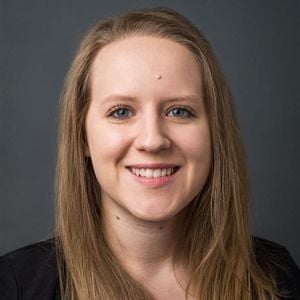
Catherine “Katie” Derington, PharmD, MS, assistant professor of cardiology at University of Colorado Anschutz School of Medicine and Adult and Child Center for Outcomes Research and Delivery Science (ACCORDS) investigator, attended a workshop a few years ago where a speaker said you won’t burn out in your career if you always center your work around what breaks your heart and frustrates you. Those inspirational words remain with her to this day.
“That was very eye-opening for me. The things I really care about are when the system is too difficult for people to get the outcomes they need,” says Derington, a pharmacist by training who spent years as a clinician before turning to health services research after witnessing first-hand the challenges the health care system presents to people, even those who navigate it from both sides of the coin. Together with Larry Allen, MD, professor of cardiology, she co-directs the Colorado Cardiovascular Outcomes Research (CCOR) group, where multidisciplinary faculty investigators across the Denver metro area convene for mentorship, works-in-progress, and collaborations.
Derington’s determination to break the pattern of frustration with the health care system is what led her to realign her career towards health services research. In addition to her background in pharmacy and experience conducting pharmacoepidemiology research, she’s now integrating new skills in qualitative research methods, advanced causal inference methods, and pragmatic intervention design thanks to a K01 grant from the National Institutes of Health (NIH). These new skills will help Derington create a pilot program helping her catalyze change in how people are initially treated for hypertension.
“This project focuses on that very first blood pressure regimen that we put people on at the very start of their hypertension journey, and makes sure that regimen is the most durable, safe, and acceptable to people, while fitting within the context of our health care system,” says Derington.
Reexamining the common practice
She’s honed in on the initial regimen people start when diagnosed with high blood pressure and is reexamining the common practice of starting patients on one medication. “We know that most people who have hypertension will need two or three medicines to control their blood pressure. We call this combination therapy. But most people aren’t started on combination therapy, they’re started on just one medicine, meaning we are relying on appropriate follow-up in the future to get people from one to two or three medicines. That process takes too long and may leave them with uncontrolled blood pressure during a time where we should be proactively controlling their risk. While it’s great to minimize medication use and dose by starting with one medicine, if we start people on two medicines at the lowest dose possible, it’s more effective and it’s safer than our traditional, stepped care approach.” As part of the NIH grant, she will survey clinicians and patients as they navigate those two different approaches to see how they feel about the process, what their outcomes were, how a patient felt about starting two medicines compared to one, and tapping into those real-world lived experiences from both patients and providers.
“It’s important that we optimize blood pressure control for everybody who has hypertension. And as a pharmacist, I’m uniquely positioned because I’m thinking about meds every single day along with how I treat people and how I research them,” Derington explains.
Closing gaps in health care systems
This project marks the first time in her career that Derington will not only identify gaps and their impacts on patients, but she will be working to close them as well. “The system is so complicated, even for us as clinicians moving through it, that for the everyday person, it has to be nearly insurmountable at times to get what they need in order to feel better,” she notes. “When people don’t feel supported enough in their journey and what they’re going through, they will turn to other sources.” While those sources of support like the internet and social media are readily accessible, they might not be the most reliable sources of information for patients.
“There’s so much that has to happen to get someone feeling better and ensuring the process they go through is smooth and simple. It breaks my heart when people don’t feel like the system is for them to get what they need,” says Derington. “That’s what my work is grounded in.”