Photo credit: Angel Tran
Elizabeth Metz and Tarek Chacra hope a new photo exhibition and speaker series at CU Anschutz will raise awareness that obsessive-compulsive disorder, often referred to as OCD, is a not a personality quirk or a weakness. It’s a widely misunderstood brain disorder that researchers are still trying to understand. Tragically, it can lead to severe depression, self-harm, and even suicide if not detected.
Ryyan Chacra, the son of Metz and Tarek Chacra, was a gifted photographer who captured ordinary sights of unexpected textures that reflect the tension between familiarity and unease in daily life. He was also quietly struggling with OCD. In May 2024, at just 28 years old, Chacra died by suicide.
A mission to reduce stigma
“Love, Anything,” presented by the Ryyan Chacra Foundation in partnership with the University of Colorado Anschutz OCD Program and the Center for Bioethics and Humanities, honors Ryyan Chacra’s life and shares his creative legacy. The exhibition and speaker series are designed to create a safe space for conversations about OCD that can inform, connect, and reduce stigma. It also aims to empower those who live with the disorder and their loved ones find help as early as possible.
Elizabeth Metz and Tarek Chacra founded the Ryyan Chacra Foundation in part to help young people open up about their own struggles. OCD and related issues like depression, self-harm, and anxiety can touch anyone--in any family, in any community.
Opening night
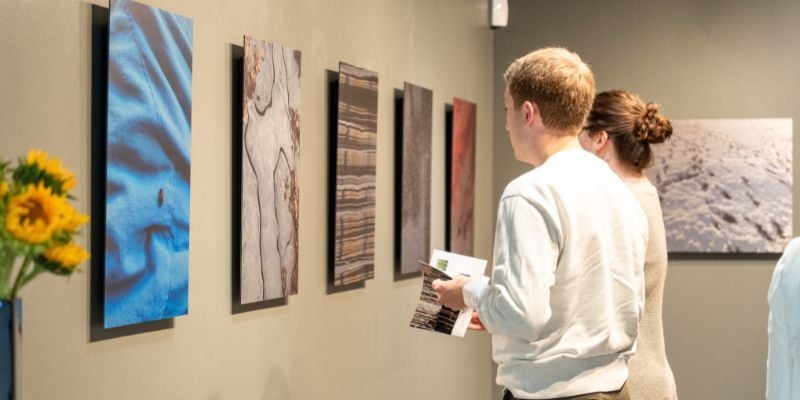
On Friday, April 10, the opening reception for the “Love, Anything: 28 Expressions for 28 Luminous Years,” drew over 120 attendees to the Fulginiti Pavilion for Bioethics and Humanities. Friends and family of Ryyan Chacra joined CU Anschutz faculty, staff, clinicians, and community members. Guests viewed 28 photographs by Chacra—one for each year of his life. The exhibit also showcases select entries from hand-written journals with the words “Love, Anything” often lingering at their conclusions, as if warmly awating subsequent words and thoughts to appear.
Attendees made new connections and caught up with old ones as they shared thoughts on the photographs, experiencing the images through Chacra's unique lens as a photographer and a person who lived with OCD. An exhibit guidebook created by Metz and Tarek Chacra provided additional context to the art work.
Seeing the world through a different lens
For Metz and Chacra, seeing their son’s work exhibited in the Art Gallery at the Fulginiti was emotional and affirming. For Metz, the exhibition is an opportunity to honor her son as an artist and a person.
“He wanted his work to be seen,” she said, “and he wanted people to find joy in the everyday, quotidian experiences of life.”
Tarek Chacra added that the Art Gallery at the Fulginiti Pavilion for Biothics and Humanities allows viewers to engage with the work in the way Ryyan had envisioned.
Creating space for hard conversations


The opening reception also kicked off a four-part speaker series running through June 18. The opening talk, “The Lens of OCD: The Brilliance and the Burden of Seeing Everything,” featured Rachel Davis, MD, head of the OCD Program in the CU Anschutz Department of Psychiatry and a key partner in bringing the exhibition and speaker series to campus.
Both parents spoke about why partnering with CU Anschutz—and particularly Davis, was so important. From the beginning, they hoped Chacra’s photography could be shown in direct conversation with his experience of OCD. “Staging the exhibition at the Fulginiti would not have been possible without Dr. Davis,” Tarek Chacra said. “Her support and commitment were fundamental.”
"The pairing of the gallery space and speaker forum creates the ideal setting to explore OCD not as a personality quirk—as often portrayed in the media— or as a weakness of character, but as a serious brain disorder rooted in biology, chemistry, and physiology."
This reframing is central to the speaker series’ mission. Metz emphasized how easy it was for her son's struggle to remain hidden. He was highly accomplished, social, and kind—“the child we never worried about,” she said. His OCD went undiagnosed until four months before his death, a reality his parents hope will motivate others to pay closer attention and speak more openly.
“The brain is an organ, just like any other organ—only more complex,” Metz said. “By talking about OCD, we hope those who are suffering will feel less alone.”


For the series' first talk, Davis modeled exactly the openness the Ryyan Chacra Foundation hopes to encourage by sharing her own deeply personal experiences growing up with undiagnosed OCD, including an attempt at raising increasingly multiplying pigeons on her balcony and driving to excessive—and potentially dangerous—lengths to help a stranger in need.
“I made a conscious choice to push past my own discomfort because it felt so important to honor Ryyan,” she said. “It’s uncomfortable to be that open, and it’s not easy to stay close to the emotional reality of suffering. But I believe sharing our own experiences is one of the most effective ways to reduce stigma and help people feel less alone.”
How Ryyan Chacra captured beauty all around us
The exhibition offers new ways of seeing Chacra's art itself. His preference for extreme close-ups and brushed aluminum panels—chosen for their light-reflective qualities and sustainability—has taken on deeper meaning through conversations about OCD. Considering his son’s work and artistic legacy, Chacra said, “He effortlessly elevated what he saw to symphonic canvases turning the particular into a rich and complete statement. I see daring brilliance in this. He did it natively and without artifice.”
Metz added that while her son's work is beautiful, there is often a quiet emptiness or loneliness present—something that, in hindsight, may reflect how alone he felt in his struggle. “Perhaps,” she said, “there are things we walk by every day without really looking at that are worth noticing.”
Gallery hours and upcoming events
Love, Anything will be on view April 10 through June 26, 2026 at the Fulginiti Pavilion for Bioethic and Humanities at CU Anschutz. The gallery is open to the public Monday-Friday from 11:30-5:00 pm.
Additional speakers will continue throughout the spring and early summer addressing topics such as the physiology of OCD, recent research on Deep Brain Stimulation, anxiety, grief, and the power of language to heal and connect. Community members, parents, health professionals, and especially young people who may know someone with OCD are encouraged to RSVP and learn more at ryyanchacrafoundation.org.
If you or someone you love is experiencing a mental health crisis, help is available. Please call 911, or contact the Suicide and Crisis Lifeline by calling or texting 988. You can also reach the Crisis Text Line by texting HOME to 741741.