


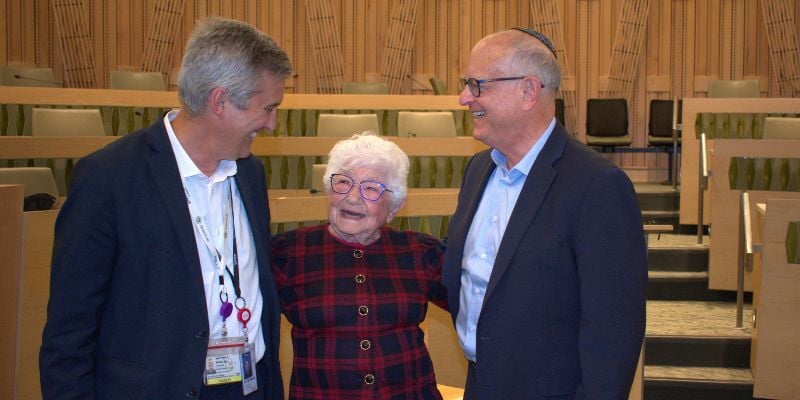
From left to right: Center Director Matt Wynia, MD, Helen Morris, MD, and Bruce Feldstein, MD, BCC. Photo credit: Natascha Palmer
Existential questions
On May 4, Bruce Feldstein, MD, BCC, came to CU Anschutz with some big questions.
“Who am I? Who are we? Why are we here? What is the story of what makes us, ‘us,’ and where did it start?”
Feldstein's visit was part of the Cultural Influences on Bioethics and Health program (CIBH) at the CU Anschutz Center for Bioethics and Humanities. The program was founded with a generous gift by Helen Morris, MD, who recently celebrated her 94th birthday. Morris graduated from the University of Colorado School of Medicine in 1956, at a time when only 5 women and 10 Jewish people were allowed to attend each year due to quota practices common in the early to mid-20th century. These often unofficial and sometimes clandestine admissions practices were designed to limit the number of women and individuals who were Jewish or Black, in line with broader efforts to maintain a majority of white, Protestant men in medical education.
As Feldstein began to address a room of students, staff, faculty, community members, and Zoom attendees, he thanked Morris for her vision and bringing everyone together. “She’s a national treasure,” he said, before turning to a broader reflection on life itself.
“We belong to life,” said Feldstein. “It's not life that belongs to us. Life was here first, and then we showed up in the middle of it.”
Feldstein sees humanity as a universal culture of simply being a biological, social, feeling, acting living being. In addition, there are cultures upon cultures layered inside us. Yet health sciences professionals are generally not trained to see them.
Being human is being finite
We are finite. Parts of our interdependent webs will unravel and break loose as new ones come together to bolster the fragile gaps and torn threads. We are born, we get sick, and we die. In medicine, Feldstein reminds us that we are humans first. Medical education, at its core, is about learning to understand the human body and becoming proficient in the many “ologies”—cardiology, neurology, pathology, pharmacology, histology, epidemiology. The list goes on.
Feldstein acknowledges the vital importance of the “ologies” driving health care, but warns that medicine’s spotlight on knowledge, accuracy and data can create a shadow in which emotional, spiritual, and existential realities are overlooked.
Feldstein says there's something missing. “Where is the class on being human? Isn't medicine human beings caring for human beings? Where’s the class on lived experience?”
Feldstein defines cultural care as seeing the whole person. He advocates for healthcare providers to look closely, listen, and notice elements that shape how patients experience illness. By “making the invisible visible” clinicians attend to what matters most to the patient, not just what is measurable. This knowing comes by asking questions.
Good medicine
When Feldstein was a chaplain, he cared for an elderly woman with end-stage heart disease who was transitioning to comfort care. When her daughter requested a feeding tube, the medical team refused based on clinical guidelines.
“But it’s important,” said the daughter.
It wasn’t safe.
“But it’s important.”
It wasn’t appropriate.
“It’s important.”
It wasn’t protocol.
Then the daughter leaned toward Feldstein and said, “It’s important. She survived Babi Yar.”
In that moment, Feldstein grasped the chilling magnitude of the request.
The patient survived Babi Yar, one of the most horrific massacres of the Holocaust, in which over 33,000 Jews were murdered by Nazi forces in September of 1941 in Ukraine. The victims were taken to Babi Yar, a ravine outside of Kiev in Ukraine with a promise of safety and resettlement. Instead, they were brutally shot, the ravine becoming a mass grave. There were rare survivors. The patient, just a child at the time, was one of those survivors.
“And she survived not only the murdering,” Feldstein continued, “but she also survived the intentional starvation.” Her daughter promised her that she would never die hungry.
Feldstein talked to the attending physician. This patient wasn’t just a patient. She was a survivor.
Then something happened. The physician seemed to absorb the immensity of her past. After a brief period of consideration, he provided the feeding tube, granting the patient and her family autonomy and dignity at the end of life.
In that moment, Feldstein saw the physician become “a human being caring for what really matters most. This is making the invisible visible. This is changing the spotlight to include the lived experience of this woman. This is good medicine.”
Faith as worldview
Feldstein sees faith as more than just what you believe, whether that be as part of a religious community or as part of a scientific community.
“In my work, I've also learned that faith is something prior to all that,” Feldstein said. “Faith can be worldview, the lens that we already have.” This lens informs our culture which goes beyond ethnicity or tradition. It includes relationships, history, and identity.
“We're living, embodied beings who are biological and relational. We're in language, we're in history. All of these elements are all true all at the same time. We're vulnerable, we're interdependent, we're finite.”
For Feldstein, spirituality is universal. Spirituality is meaning, purpose, connection, and dignity.
The power of acknowledging fear and pain
When Feldstein was an emergency physician, a patient arrived by ambulance with symptoms consistent with a heart attack. Before discussing the results from the patient's EKG, Feldstein paused to ask why the patient called the ambulance. He responded that he was afraid because his uncle died of a heart attack with similar pain. Feldstein acknowledged the man's fear and told him that his EKG looked normal. “It’s likely musculoskeletal pain, which is very painful,” he said, along with “I’m here to take care of you.”
The physiological symptoms immediately dissipated. The patient’s racing heart rate returned to 80, and he stopped sweating. There was a deep human concern behind the patient’s chief complaint. When Feldstein asked, it became visible. Then, by acknowledging and addressing it, the patient’s condition stabilized.
Feldstein closes by returning to his unifying theme. We are human first, and we share that humanity through many facets of living culture.
He suggests that better outcomes are possible when clinicians look beyond what is measurable to discover what matters most to the patient. To find that, they have to listen.
The chaplain in Feldstein finishes the talk. He tells us that no visit is complete without a blessing.
“So what can I wish for you?” He looks around the room. “We all have wishes and hopes. What do I wish for you? I’m taking a look, and I really mean this for each of you, each in your own way. Whatever you wish for yourself. That's what I wish for. Even if we can't put it all into words.”