A new exhibit at CU Anschutz celebrates the life and achievements of Theodore Puck, PhD (1916-2005), one of the most influential biomedical scientists of the 20th century and a recipient of the prestigious Albert Lasker Award for Basic Medical Research.
Now on display on the first floor of the Fitzsimons Building, the two-year exhibit features archival materials honoring Puck's groundbreaking contributions to biomedical science and his nearly five-decade career at the University of Colorado Anschutz School of Medicine.
Puck received the Albert Lasker Award for Basic Medical Research in 1958 for his pioneering work in mammalian cell culture, which helped lay the foundation for advances in genetics, cancer research and the understanding of cellular function.
Puck joined our school of medicine in 1948, establishing the Department of Biophysics and beginning a remarkable career that spanned nearly five decades. His research advanced the study of genetic mutations and carcinogens, and he made significant contributions to genetics, including helping establish that human cells contain 46 chromosomes. He retired in 1995.
Bringing Scientific History to Campus
The exhibit was made possible through a collaboration between CU Anschutz and the National Library of Medicine (NLM), which houses approximately 10 boxes of Puck's personal papers and research materials donated by his family.
After Tom Flaig, MD, vice chancellor for research, expressed interest in bringing materials honoring Puck's scientific achievements to campus, Melissa De Santis, MLIS, AHIP, assistant vice chancellor for libraries, connected with the NLM to explore the possibility.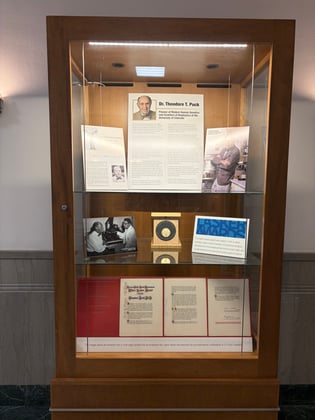
NLM staff identified a commemorative medallion associated with Puck's Lasker Award recognition, along with a photograph, certificate and program from the 1958 ceremony. The accompanying archival materials were shared digitally to preserve the originals.
De Santis worked with teams from Strauss Health Sciences Library and Facilities Management, along with Terri Carrothers, executive vice chancellor for administration and finance and chief financial officer, to secure a formal agreement allowing CU Anschutz to display the medallion for two years.
"As with most libraries, the NLM wants its collection to be utilized by the public," De Santis said. "They were great to work with and happy to agree to the long-term loan request."
For Flaig, the exhibit is an opportunity to honor a scientist whose discoveries helped shape modern biomedical research and whose legacy remains deeply connected to CU Anschutz.
"As a history buff, it's a pleasure to work on a campus that is steeped in such fascinating history," said Flaig. "Displaying the exhibit on the CU Anschutz campus is an honor and a befitting tribute to Dr. Puck, who left an indelible mark – nearly half a century – on the campus' history and several areas of biomedical research."
The exhibit offers faculty, staff and students an opportunity to connect with an important chapter in the university's scientific history and celebrate a legacy of discovery that continues to influence biomedical research today.
Visit the exhibit on the first floor of the Fitzsimons Building, just outside the Chancellor's Office, to explore the life and scientific achievements of Theodore Puck.