On a clear September night, Bryan Bonner and Bob Lewis of the Rocky Mountain Paranormal Research Society camped out on the eighth floor of the historic Fitzsimons Building at the University of Colorado Anschutz. Armed with miles of wires, monitoring equipment and more than a few energy drinks, they set out to explain decades of unexplained – and creepy – occurrences.
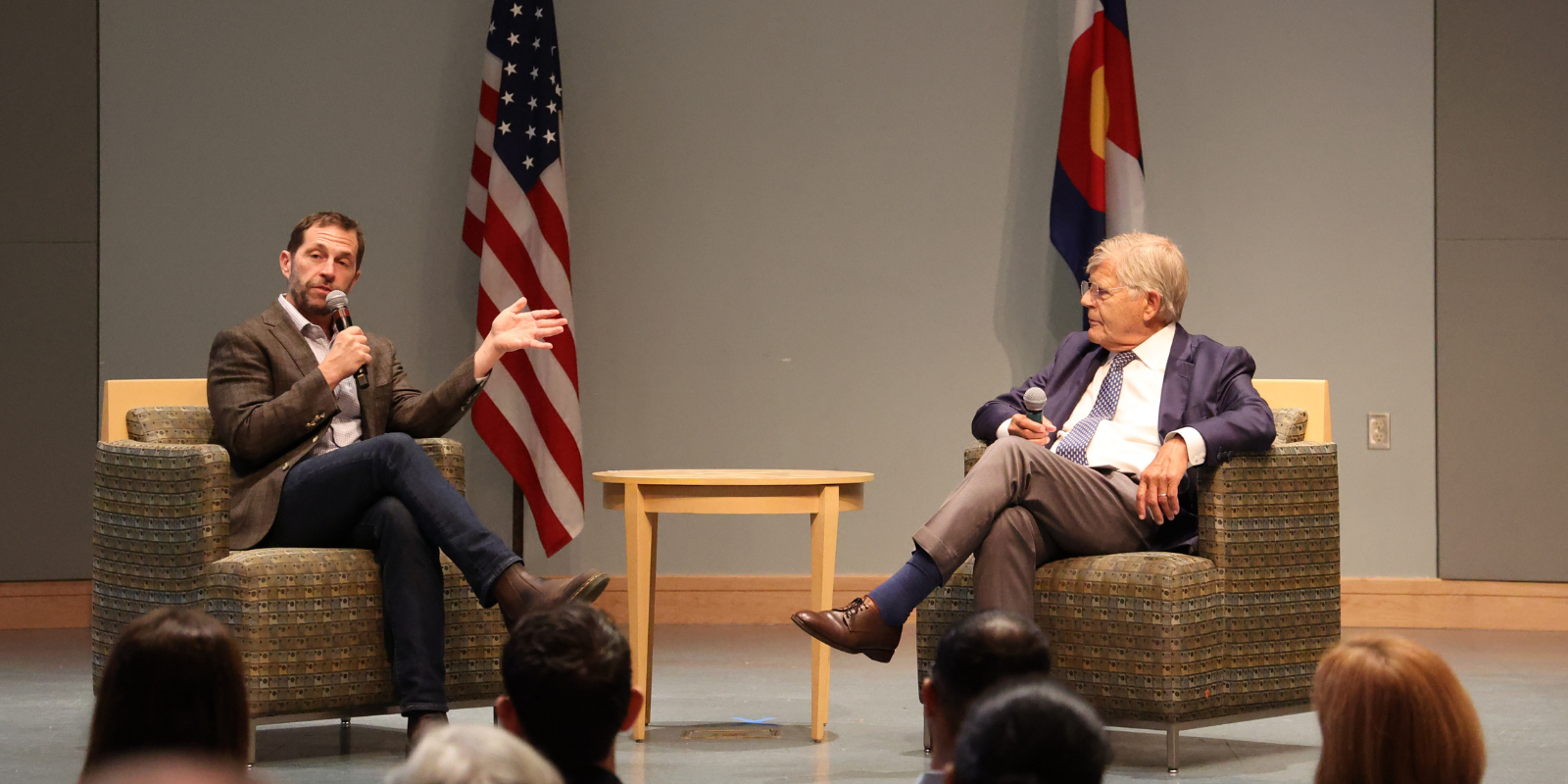
The duo returned to campus on a rainy October evening to share their findings with nearly 250 curious faculty, staff and community members. But comment during the final Q&A suggested their investigation may have raised more questions than answers.
First, a look at how they investigated the mysteries of Fitzsimons.
A haunted history?
Over the past 20 years, Bonner and Lewis have led investigations of all things spooky across the Rocky Mountain region. They aim not to prove the paranormal, but to provide data and context to help draw conclusions about the places and spaces where ghostly activities are said to occur.
They call themselves “accidental historians.” As such, they’ve encountered pieces of history that have gone otherwise undocumented.
Researching the history that came before the former Army hospital-turned-administrative-building at CU Anschutz, the duo found newspaper clippings detailing robberies, prison escapes, murder by “Army soap in woolen socks” and arrests over card games at the hospital flagpole.
They also detailed Fitzsimons’ history of treating enemy prisoners of war suffering from tuberculosis, including 100 German, 75 Italian and three Japanese POWs.
Bonner and Lewis noted that places where “ghosts” tend to appear also often tend to share the characteristic of having “long periods of illness, death, stress and uncertainty.”
“And then, we get a little weirdness.” – Bob Lewis, Rocky Mountain Paranormal Research Society, on what a microphone in Bushnell Auditorium picked up
Where history meets mystery
Over the decades, many people who have spent time in Fitzsimons have shared stories of encounters. Whether it's the sound of babies crying from the former maternity wards or doors opening without elevators being called, shadowy stories float around the offices formerly known as Building 500.
Despite the significant lore, Bonner and Lewis knew the odds were against them to experience a ghostly encounter. They had only 12 hours and were two people camped out in a 480,000-square-foot building. After examining the stories and looking for patterns, they selected two small areas to monitor: Bushnell Auditorium and the Eisenhower Suite, both on the building’s top floor.
Bushnell Auditorium has long been a source of eerie experiences, including feelings of being watched, unexplained headaches and sightings of a shadowy figure on a ninth-floor catwalk. They also monitored the historic Eisenhower Suite, the room in which President Dwight D. Eisenhower spent seven weeks recovering from a heart attack in 1955. Employees of Fitzsimons report that the secured doors of the “Western White House” are repeatedly found mysteriously open.
Related: We're not saying the Fitzsimons Building is haunted, but...
Putting the paranormal to the test
Using video and audio recorders, thermal cameras, motion sensors and instruments measuring temperature, vibrations and electromagnetic fields, Bonner and Lewis collected hours of footage and environmental data.
They also individually documented their own movements and activities, so when they listen to and watch the footage, they can be sure that they were not the cause of the commotion.
Bonner and Lewis specifically monitor vibrations and electromagnetic fields, as certain people can experience these environmental factors as hallucinations or unexplained entities. They try to keep their investigations as “scientific as possible” and have been specially trained to use all the monitoring equipment they use for its actual intended, non-paranormal use.
Speaking in front of an audience of scientists and science enthusiasts, the duo is quick to note that they always “question our own evidence.”
What the recordings revealed
Bonner and Lewis spent the entire night on the eighth floor, joined by two members of the facilities team who worked in shifts – one from 5 to 10 p.m. and the other from 10 p.m. to 4 a.m. The experience yielded much of what they expected:
They didn’t see or hear anything unusual. The temperature was consistent with the outside temperature falling.
Nothing moved. No doors opened unexpectedly. No sounds of babies crying or elevator doors opening and shutting. Low-frequency vibrations were noted at various times, but nothing outside of the normal cycles of the HVAC system.
In fact, Bonner noted that the most exciting thing about the experience came when he drove away and hopped on I-70 and the electrical system of his car completely failed.
(It should be noted that as he told this part of the story, his lapel microphone completely failed. Coincidence?)
Later, upon review of the audio, Bonner and Lewis isolated two moments. Occurring sometime about 2 a.m., they captured the incidents with noises they cannot explain.
“I really don’t know what they are,” Bonner said, referencing a story he told earlier in the night about the facilities team hearing keys jingling. “It could be that. And some whistling. We weren’t whistling.”
“The first one is subtle,” Lewis said, explaining that the low hum came from the HVAC.
A subtle, but distinct whistling sound filled the auditorium.
They played the second clip, recorded in the auditorium. Two taps. Then a woman’s voice speaks. “Shi su (shee-soo).”
“The only people on the floor at the time were three grown men.” Lewis laughs. “It wasn’t us.”


A chilling twist
As Bonner and Lewis opened the floor to questions, they again reiterated that they thought the odds of catching anything on the recordings were “exactly zero.” Given the size of the building, they didn’t have high hopes.
As audience members shared their thoughts on what the audio clips meant to them, one comment stands out.
The “whistling” recording struck a deeply personal chord. The audience members said their father used to whistle an old military tune called “The Army Goes Rolling Along.”
“I haven’t heard him whistle or sing it for over a decade now since his COPD has gotten so bad, but the second I heard the clip I could hear the lyrics in my head.”
So, is the Fitzsimons Building haunted?
After a night spent monitoring its historic halls, Bonner and Lewis aren't ready to say. While their investigation offered no definitive evidence of paranormal activity, two unexplained recordings – and an unexpected connection raised by an audience member – have given them more to explore. For now, the building's century-old history continues to inspire questions and curiosity for our community and beyond.
Special thanks to CU Anschutz Staff Council for bringing this event to our campus community.