Tyrosine kinase inhibitors (TKIs) — targeted cancer therapies that block specific proteins responsible for cancer cell growth and division — are effective in treating lung cancers driven by the HER2 genetic mutation, but when treatment is complete, a small amount of residual cancer cells remain, adapting to resist the effect of the TKIs.
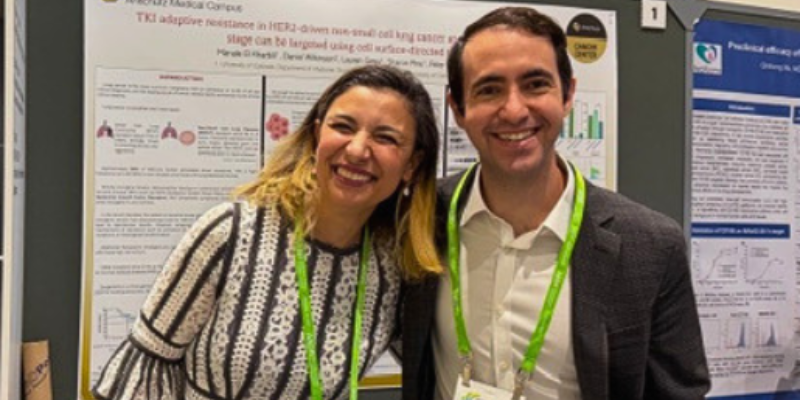
Targeting those resistant cells is a primary research interest of University of Colorado Anschutz Cancer Center member Kyle Concannon, MD, who, along with his team, presented his latest work on the problem at the annual meeting of the American Association for Cancer Research this week in San Diego. Assistant Research Professor Manale El Kharbili, PhD, led the scientific portion of the research.
Finding a target
“What we looked at is how the expression of known targets on these cells change over treatment time — when cells become resistant and maybe they're not growing, but they're surviving the therapy,” says Concannon, assistant professor of medical oncology in the CU Anschutz School of Medicine. “Then, how does that change once they become fully resistant and they are growing? Are there certain important time points that you might use one strategy versus another strategy? And what might those strategies be?”
If cancer cells upregulate — or increase the number of — certain receptors or proteins on the cell surface in order to evade TKI therapy, can those upregulated factors be targeted? “We want to target the way they're trying to adapt and survive and make that resistance into a vulnerability,” Concannon says.
Enter the CAR T
One of the most promising ways to do that is via CAR T-cell therapy, a method of removing and re-engineering a patient’s immune cells to attack specific targets on a cell’s surface.
“We have a very promising CAR T candidate that we want to use, and the purpose of our current research is to better define when we should give this medicine, and would this medicine work best in this type of mutation, or if there are other mutations that are more likely to respond,” Concannon says.
Concannon says the most likely sequence is that patients with HER2-positive lung cancer, or other mutation-driven lung cancers, would first receive a TKI like zongertinib, which would kill 98% to 99% of the cancer, then receive the CAR T drug to kill the remaining resistant cells to prevent spread and recurrence.
“This seems like a particularly vulnerable state for the cancer, not only in terms of what the cells are expressing, but also, there are fewer of them left to kill,” he says. “That strategy has been used in leukemia and lymphomas, where after another therapy has killed most of the cells, these CAR T cells have been curative. We want to adopt that paradigm in lung cancer and hopefully start achieving cures for our patients, too.”
Meeting an unmet need
Targeting the residual cells after TKI treatment is an unmet need in treatment for HER2-positive lung cancer, Concannon says. Because the remaining cells aren’t yet growing or dividing, they aren’t able to be treated with chemotherapy or TKIs, which focus on rapidly dividing cells. He and his team hope to move their research into the preclinical stage, then work with the Food and Drug Administration to create a clinical trial.
“The question of how best to target these resistor cells is an important question that the field is very interested in right now, so having some insight into how cells adapt to treatment is urgently needed,” Concannon says. “In addition to our research, we want to provide ideas and options for other researchers in the field. We don't have to be the only people working on this problem. We're eager to share our data and let people run with it, in hopes that we can target this residual disease in a number of ways.”
Winning collaboration
Concannon notes that the research is being done in collaboration with the lab of his fellow CU Anschutz Cancer Center member Peter Fecci, MD, PhD, professor and chair of neurosurgery, which is creating the CAR T cells Concannon is using in his study.
“They are the immunology folks; we’re the lung cancer folks,” he says. “It’s a good example of how the PIs at the University of Colorado work together. I came here nine months ago, and the ability of this institution to work well together, to work nimbly and move quickly, is really unique, and it's really special. It's great to be at an institution where things are so well oiled.”
Featured image: Kyle Concannon, MD, and Manale El Kharbili, PhD, pose with their research poster at the annual meeting of the American Association for Cancer Research.