



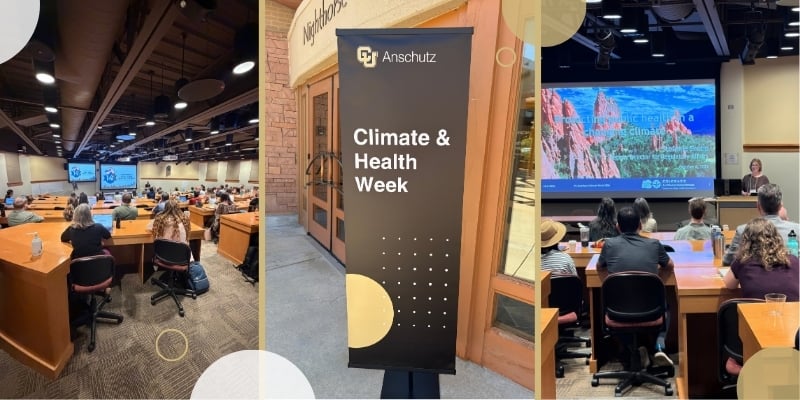
The varied effects of climate change – heatwaves, drought, floods, wildfires, air and water pollution – are present around the globe. During the week of October 5-8, the University of Colorado Anschutz Campus was one corner of the world that drew people intent on working together to probe health-related effects of climate change and explore solutions to mitigate it.
A key event of the four-day CU Anschutz Climate and Health Week was Public Health Day, held October 6 in the Nighthorse Campbell Native Health Building.
Elizabeth Carlton, PhD, MS, chair of the Department of Environmental and Occupational Health at Colorado School of Public Health, co-hosted the event with Jay Lemery, MD, professor of Emergency Medicine at the University of Colorado Anschutz School of Medicine. Lemery also directs the School of Medicine’s Climate and Health Program.
The diverse audience of around 100 people included representatives from both schools, the Colorado Department of Public Health and Environment (CDPHE), local public health agencies, community groups, and more.
In welcoming the attendees, Carlton said she hoped the event would help to “energize” their efforts to protect health in a changing climate and build connections so that groups can work together to find innovative ways to solve climate-related health issues.
Indeed, climate change demands an interdisciplinary approach, ColoradoSPH Dean Cathy Bradley, PhD, emphasized in her remarks.
“This issue is incredibly important to all of us,” she said. “I’m especially pleased that we are bringing people together. We cannot solve climate-related problems from one discipline, certainly not from one profession.”
A variety of viewpoints
The day featured a mix of presentations and panel discussions on climate-related policy issues, case studies, and possible paths to protecting communities from climate change-related health threats in the state including wildfires, heat, ozone, and emerging infectious diseases.
Stefanie Shoup, deputy director of Regulatory Affairs for CDPHE, delivered the keynote address. She detailed the complicated task of addressing climate change and improving air quality in Colorado. Climate-warming gas emissions often accompany releases of other air pollutants, fine particulates, and volatile organic compounds. The result: increased risk of heart attacks, cancer, and asthma flare-ups.
She also highlighted the importance of understanding how the regulatory process works, starting with identifying an issue through monitoring and measuring air samples and conducting studies and scientific research. Addressing the issue then requires writing statutes and managing and enforcing the programs they mandate.
Shoup noted that the legislature has passed 30 climate and air quality bills since 2019, including six major ones. But she emphasized that the rules “mean nothing until they are complied with and implemented.” That’s a complicated task that requires balancing competing public interests, from businesses to disproportionately impacted communities like those in north Denver and southern Adams County.
In some areas, the state has successfully reduced emissions of climate-warming gases and improved air quality and public health in Colorado, Shoup said. She pointed, for example, declining levels of methane. However, the process takes time and challenges remain, notably reducing ozone levels, which are among the highest in the nation in Denver and the northern Front Range.
“Public health and government is a long game,” she said. “It requires patience, diligence, sticking with it, and being creative.”
A toxic topic
Shoup later joined a spirited panel discussion titled, “Protecting Communities from Air Toxics: From Community-Based Advocacy to Policymaking.” The panel showcased the policy-making process, a key part of reducing climate-warming emissions and promoting public health in a changing climate.
Other panelists included:
- Tehya Stockman, PhD, air quality policy and program specialist with Adams County
- Wyatt Sassman, associate professor with the University of Denver Sturm College of Law
- Harmony Cummings, executive director of the Green House Connection Center (GHCC), which supports efforts by disproportionately impacted communities to address climate- and health-related challenges
Michael Booth, a Pulitzer Prize-winning environment and climate reporter with the Colorado Sun, moderated.
Shoup explained that air toxics are those with the potential to cause cancer and other medical conditions. She credited public input with driving studies that led to a statute calling for monitoring and regulation of five priority toxic air contaminants (PTACs).
Sassman said he and his students represent industry-heavy communities in north Denver and Commerce City seeking a role in decreasing exposure to emissions from air toxics.
Cummings, who worked for eight years in the oil and gas industry, noted efforts by GHCC and the Latino-led community organization Cultivando to form the Communities Organized for Clean Air, which helped to persuade the Air Quality Control Commission to adopt the five PTACs. Three of those, benzene, hydrogen sulfide, and formaldehyde, are present in the north Denver Globeville neighborhood, Commerce City, and surrounding areas.
“We will do whatever it takes to meaningfully decrease pollution and improve health,” Cummings said. She urged state agencies to continue to have listening tours and conversations with community members advocating for environmental justice.
“Their stories are what counts,” Sassman said, in translating community concerns about environmental threats into changes in the rules that protect health.
Stockman agreed that more “in-person time” with community members is needed and that public health and other leaders should listen more than talk. But she added that air quality control commissioners approach environmental and climate issues from “data-driven perspective,” not “one-off stories.”
Shoup agreed that “data drives decision-making” while adding that “there is a real need to grapple with the needs of the community and deliver our messages effectively. We hope for ongoing conversations.”
Clearing the smoke
Another panel discussion, “Engaging Communities on Climate and Health: A Case Study of Wildfires,” also featured voices from a variety of perspectives. The panelists discussed climate change’s contributions to recent hot, dry summers and intense wildfires in Colorado and focused on how to protect communities from wildfire smoke other harms.
- Katie Dickinson, PhD, MS, associate professor in the Department of Environmental and Occupational Health at Colorado SPH, discussed her work as lead researcher with the Marshall Fire Recovery & Resilience Working Group, which formed in the wake of the December 30, 2021, disaster. The work included conducting surveys to understand the health impacts of smoke and ash and studying steps taken to improve community resilience. Dickinson said she and her colleagues are applying lessons gleaned from the Marshall Fire response to this summer’s devastating Aspen Acres fire.
- Doug Eccher, a 7-12 grade teacher with Montrose Public Schools, said he works to engage students in learning how the environment affects their community. He and his students installed air quality monitors inside and outside their classrooms and, with the help of University of Colorado Anschutz, tested the effectiveness of the air filtration systems. The testing revealed a carbon dioxide problem in the school building. “Kids feel better if they aren’t helpless,” Eccher said.
- Annareli Morales, PhD, air quality policy analyst with the Weld County Department of Public Health, called smoke “the biggest impact” on Weld County communities. One resource for residents to understand the health risks of smoke exposure is a county-hosted website that links to CDPHE’s Wildfire Smoke Preparedness Program, she noted.
- Dan Welsh, air quality meteorologist with CDPHE, helps to monitor the spread of smoke from all sources, including prescribed burns, which his agency regulates. CDPHE also sponsors the Partner Education and Training Network, which assists in educating students and community members about the risks of wildfire smoke exposure and ways to effectively mitigate it.
The panel covered an array of topics, including strategies for communicating risks of smoke exposure to the public and preparing for responding to it.
“Wildfire smoke is not a matter of if, but when,” Welsh said.
“We need to understand who will be most affected by it,” Dickinson added, “and bring groups together to respond.”
An additional highlight was an “Impact Showcase” of three-minute presentations from people in public health who are “working to solve climate and health challenges.”
After the seven presentations, judges awarded three participants for their work:
- Tehya Stockman: As a person who suffers from asthma, she led an initiative to determine the effectiveness of air cleaners as an intervention for asthma and air pollution.
- Chelsea Warren: As marketing manager for Denver's Office of Climate Action, Sustainability and Resiliency, she led the Denver Climate Project, which helped to convince significant numbers of people to say they would take a new action to improve the climate.
- Kristen Steffes: As climate and health coordinator for CDPHE, she explored extreme heat and poor air quality as a compound health hazard. High ozone levels worsen the multiple effects.
By the end of the event, the complexity of climate change and its effects on human health were starkly evident. But so too was the will to build solutions, Carlton said.
“I am inspired by the energy in the room. We heard about policies and programs that are reducing climate harms. My hope is that we can use the momentum from today to continue to make Colorado healthier,” she concluded.