



Sonia Chowdhury was in the midst of building a career in human resources about a decade ago when she decided to pursue a Master of Public Health degree from the Colorado School of Public Health at Colorado State University. What might have seemed a detour to some made perfect sense to her.
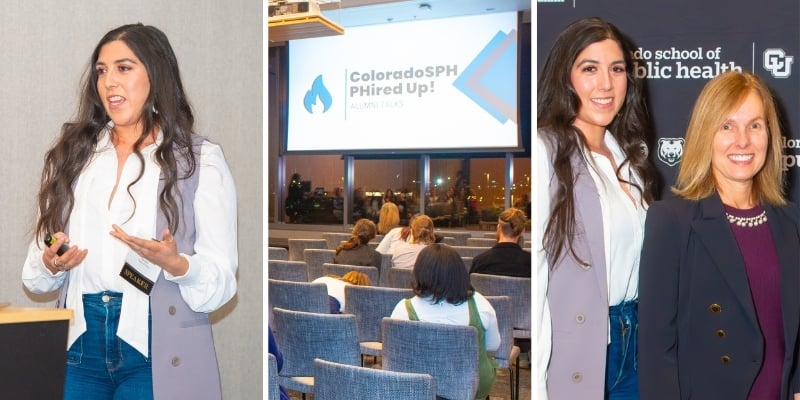
Chowdhury, MPH ’19, had a chance to explain the career choice February 25 at the 2026 ColoradoSPH Career Connections and PHired Up! Alumni Talks, held in the Donald M. Elliman Conference Center on the University of Colorado Anschutz Medical Campus.
The annual event features brief talks by alumni about public health issues they have encountered in their work. ColoradoSPH Professor and Dean Dr. Cathy Bradley also spoke to the attendees, informing them about developments at the school.
Chowdhury had an interesting employment story to tell. After earning her MPH, she went on to earn a Juris Doctor and a certificate in Employment and Workplace Law from the University of Denver Sturm College of Law. She now combines her public health training and legal skills as corporate counsel in employment law at Terumo Blood and Cell Technologies, a global medical device company based in Lakewood, Colorado. More on that later.
Combining interests in health, wellness, employment, and public health
In her talk, Chowdhury explained that her decision to pursue a public health degree in 2017 intersected with her longstanding interest in fitness – she’s been an instructor for 14 years – and employee health and wellness as a key component of job satisfaction and productivity.
“I had some opportunities to do some workplace wellness programs and teach fitness classes for companies that I worked for and other companies in the area,” Chowdhury said. “I wanted to build workplaces where people could be successful. That led me into exploring the public health avenue.”
She did so with an MPH concentration in physical activities and healthy lifestyles. For her capstone project, Chowdhury developed research at Children’s Hospital Colorado on the Anschutz Campus into how to create a healthy workplace. As part of the work, she shadowed the hospital’s benefits and employee health and wellness teams.
Her idea was to investigate whether a formal return-to-work program could produce a positive return on investment in the form of lower workers’ compensation claims, lower turnover rates, and improved patient health outcomes.
For example, if a nurse broke their wrist, they might not be able to go back to working full 12-hour shifts for weeks. But keeping them engaged with other meaningful jobs, like administrative work, could have big payoffs, and not only in financial savings, Chowdhury reasoned.
“We know that when your hospital staff is more engaged and feels supported in the workplace, they are able to better support patients and their health,” Chowdhury said.
At the conclusion of the project, she demonstrated that a return-to-work program could produce not only major cost savings, but also improved morale and an enhanced reputation for the hospital.
A public health take on employment law
Chowdhury joined Terumo in her current role about 15 months ago. The job requires close partnership with the company’s benefits team and programs, including family and medical leave, short-term disability, workers’ compensation, transition to work or T2W, and more, she said. She works with the company’s human resources partners around the globe to ensure that workers receive fair and equitable treatment.
“I partner with our benefits vendors, benefits team, and HR business partners to administer leave and benefits and to support our associates in staying engaged in the workplace even when they are ill and injured,” Chowdhury said.
Those responsibilities may seem distant from her public health background. But in fact, her work with T2W – as just one example – happens to align nicely with her capstone project at Children’s Colorado.
T2W offers injured workers a safe path back to their positions in production, manufacturing, and other areas, Chowdhury said. The idea aims to benefit both employees and the company in a way that also complies with the law.
“The program keeps workers engaged in the workplace and keeps them invested in their own health and health outcomes,” Chowdhury said.
For example, if an employee is not yet cleared to return to work, the T2W program might work with an external vendor to find part-time volunteer or nonprofit work as a way for them to stay connected and productive, she said.
An emphasis on prevention rather than reaction
While she doesn’t practice in the public health field, Chowdhury said her MPH studies gave her another important insight that she applies to her work in employee law at Terumo.
“Public health at its core is really about prevention,” she said, adding that she, in turn, tries to take a preventive approach to practicing law. That means building practices at the company that not only comport with the law but “lead to good employee experiences” and head off problems before they lead to litigation or other conflicts, she said.
“That’s very much how I’ve incorporated public health into my practice,” Chowdhury said.
Facing a changing public health environment
In her talk to the PhiredUp! attendees, Chowdhury touched on her “non-traditional or unique” use of her MPH. She believes that going forward, students will increasingly find it necessary to find new kinds of employment niches, as she did.
“Public health has always been underfunded, and even more so now,” Chowdhury said. “Some of the more traditional public health department or research roles are drying up.”
But even if a public health degree offers an uncertain future, Chowdhury said, people who commit to pursuing one can incorporate their knowledge in many kinds of companies and organizations.
“Workplaces don’t exist in a vacuum,” she said. “They have to exist in partnership or in collaboration with the communities that they are trying to serve, and that is where they will draw their workforce population from.”
At the same time, Chowdhury said she appreciated hearing Dr. Bradley’s updates on new programs and research at ColoradoSPH and interacting with students. The entire event reignited the passion for learning that had driven her during her MPH work, she said.
“It gave me that feeling that this is part of something that you love, and that your brain and your heart really enjoys.”