




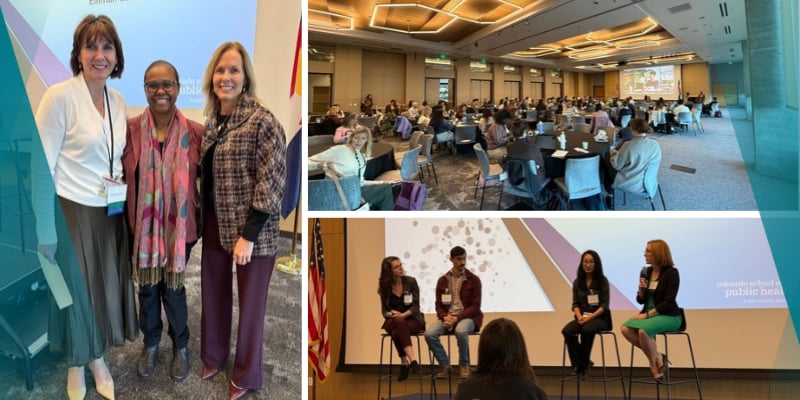
The fifth annual 2026 Colorado School of Public Research Exchange featured plenty of statistics, bar and line graphs, data points, and analysis. That was as expected. But presenters and panelists discussing how to make their research meaningful to people’s lives repeatedly returned to three words: communication, community, and collaboration.
Some 180 people from all three ColoradoSPH campuses and undergraduates from the University of Colorado Boulder attended the November 13 event in the Anschutz Health Sciences Building. The event also featured more than 35 poster presentations by ColoradoSPH student researchers, many of whom answered questions about their work during a busy lunch hour.
ColoradoSPH Dean of Research Dana Dabelea, MD, PhD, emphasized collaboration in her opening remarks. She called the event an “opportunity to celebrate the great work of our colleagues and to “share and trade ideas,” and “build bridges” between the school’s campuses.
Creating paths to bring research to the public
The speakers in each of the day’s sessions presented plenty of rich information about their research and studies. The presentation titles signaled their intent to describe how they took their work to a broader audience.
- Keynote speaker Tamarra James-Todd, PhD, MPH, professor of environmental reproductive epidemiology at the Harvard T.H. Chan School of Public Health, set the tone for the gathering in her address, “Behind the Label: Strategies for Integrating Science Communication in Environmental Women’s Health.”
- Four ColoradoSPH faculty discussed techniques researchers can use to translate complex concepts to the public in a panel discussion titled, “Beyond the Manuscript: Strategies for Real World Research for Communication Impact.”
- Three ColoradoSPH alumni discussed ways they brought their research to communities, policymakers, and other scientists through collaboration in “Science that Travels: How CSPH Alumni Share Evidence Beyond.”
The final session demonstrated how artificial intelligence avatars can help public health students practice and improve their communication skills to different audiences, journalists, skeptical community, and policymakers. Three attendees took turns interacting with the avatars, who then offered feedback on their communication skills.
Lee Newman, MD, MA, distinguished professor and director of the Centers for Health, Work and Environment (CHWE), who worked with Clint Carlson, MS, instructor with the University of Colorado Anschutz School of Dental Medicine to develop the avatars, led the presentation. Newman said he and his colleagues will pilot them in communication classes with master’s and PhD students this spring.
Newman said the avatars promise to increase the amount of time for students to practice their communication skills, a challenge with crowded class schedules.
“We created all these different avatars, not with the intention of replacing what we do but for creating cycles for people to practice their oral communication skills in typical public health situations,” he said.
Keynote address: improve communication
It is vital that researchers learn these skills, James-Todd emphasized in her address. Their hard work may fall flat if they fail to communicate its importance to a wider and sometimes skeptical audience.
“We have to rethink our values to regain scientific trust,” she added. “Communication needs to be a core competency in public health.”
People don’t want to be swamped with jargon or overwhelmed with study statistics, James-Todd said. They want to know in concise terms that the information they receive will make them safer, that they can use it in their daily lives, and that it can make them healthier.
“Information overload won’t change behavior,” she said. “If we can’t communicate, it undermines public trust.”
Emphasis on health literacy
James-Todd then described the importance of “environmental health literacy,” which focuses on improving messages to people about the risks of exposures to chemicals and other potentially harmful substances and helping them make informed choices to limit their risk.
She described the example of a woman experiencing multiple pregnancy losses who questioned the safety of using hair products.
James-Todd pointed out that 13 hair products for women contain 114 chemicals. Hair braids, for example, contain volatile organic compounds (VOCs) and toxic metals, including lead. The risk of exposure in these and other hair products is especially high for women and people of color, she added.
Some of these products contain “endocrine disrupting chemicals” that are associated with pregnancy loss, polycystic ovarian syndrome, preterm birth, lower birth weight, and many other gynecologic and pregnancy outcomes, James-Todd said.
James-Todd showed the complex research and science that provide evidence of those risks. But how to communicate the problem about products that make up a multi-billion dollar market and that people rely on in their jobs and as part of their culture? She pointed to a workshop in Boston called “Crowned in Care,” which offered information and demonstrations about how hair products can affect health.
“We helped people make changes in real time and made science real for people,” James-Todd said.
Bringing data off the page
Researchers and scientists rightfully can become enmeshed in the details of their work, many presenters acknowledged. But Tran Doan, PhD, MPH, assistant professor in ColoradoSPH’s Department of Health Systems, Management, and Policy, reminded the audience that data springs from the lives of people and the issues they face.
“Data are more than numbers,” Doan said during the “move beyond the manuscript” panel discussion. “They tell stories about people and communities.”
Researchers can shape and communicate those stories by collaborating with community members and organizations, Doan noted. She stressed the importance of “data equity,” which ensures that researchers share data with community members and involve them in decisions about using the information to address their needs.
“When communities help shape the questions we ask, the data we collect, and how we interpret what we find, we create research that more accurately reflects their experiences and priorities,” Doan said.
Research offers a boon to Baby Bonds
Doan brought that approach to research aimed at addressing Colorado’s significant wealth gap.
As principal investigator for ColoradoSPH’s Systems for Equity and Economic Dignity Colorado (SEED CO) team, Doan worked on a study commissioned by the Colorado Fiscal Institute and the Denver-based nonprofit Soul 2 Soul Sisters that explored the feasibility of closing the gap with a publicly funded Baby Bonds program, established for eligible children at birth and continued through adulthood.
Community members and policymakers joined SEED CO in gathering and disseminating data about the program. The efforts produced a detailed report and contributed to a “sustainable funding approach” that included funds from the voter-approved Amendment 87, which establishes a graduated income tax in Colorado.
Drop the titles and engage
Throughout the day, the presenters urged the audience to leave aside their titles and academic standing in favor of connecting directly with the public.
- Doan recalled interacting with community members along Federal Boulevard in Denver and feeling that her PhD “created a distance.” She wished her Vietnamese mother had been with her to help establish trust.
- Katherine Harvey (MPH ’23), who works on ways to reduce firearm violence in rural communities, told the audience “we work in a pluralistic ecosystem. It becomes valuable to build bridges as an outsider.” She discounted the importance of her titles. “People want someone to understand what they are going through and how you can help them.”
- Olivia Zarella, DrPH, MPH, research associate for implementation science with CHWE, played an important role in a successful campaign to restore NIOSH Mining Program staff to their jobs after a 2025 reduction in force. She was not an expert in mining safety, but educated herself on its standing as “the most dangerous occupation in America,” and worked with others to develop effective communication about the importance of the NIOSH Mining Program’s work. “Take a breath and listen,” she said.
- Kyla Bauer (PhD, ’25), who discussed the challenges of communicating with other scientists, advised the audience to bring their life experiences to all interactions. “Talk about the things you really care about,” she said.
“We need genuine curiosity about people and their lives to build consistent relationships with them over time,” Harvey concluded.
Poster recognition
Prior to the discussions, Dabelea announced the students who were awarded prizes for their poster presentations:
- Billy Lor (MPH )
- Julia Pangalagan (Post-Doctoral)
- Lorenzo Pla Serrano (MS)
- Portia Mensah (DrPH)
- Zainab Siddiq (PhD)