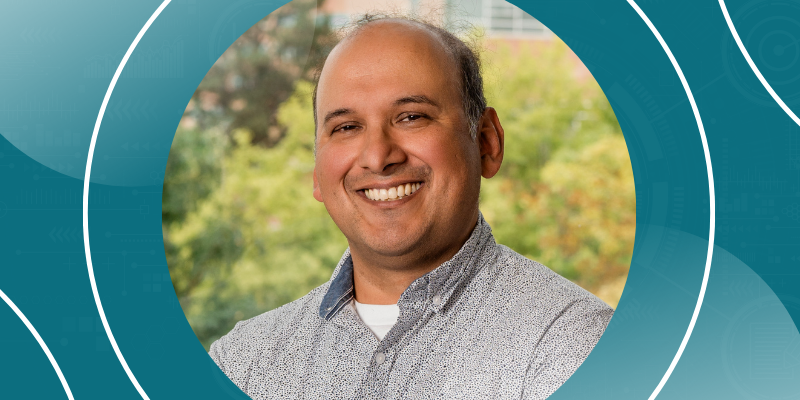




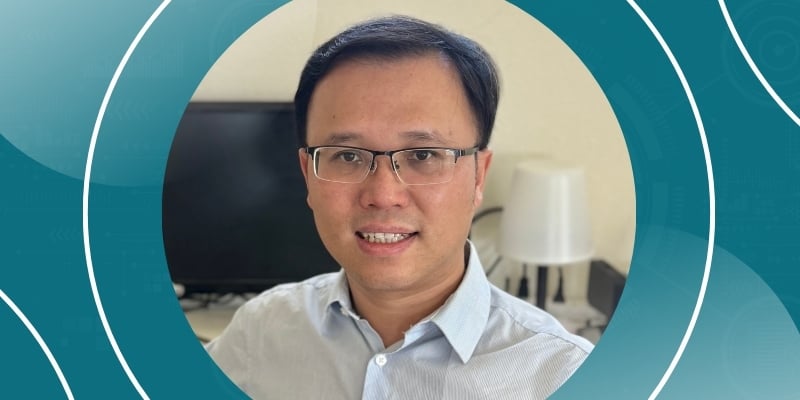
Dr. Fuyong Xing is an Associate Professor in the Department of Biostatistics and Informatics at Colorado School of Public Health at the University of Colorado Anschutz Campus. His research focuses on artificial intelligence (AI) for healthcare, particularly for medical image computing and imaging informatics.
Can you describe a research project where you applied biostatistical methods to address a real-world public health issue?
One example is our work on developing artificial intelligence (AI) and deep learning methods to improve detection and assessment of cancer based on medical images. For example, one recent project is to use AI algorithms to analyze 68Ga-Ga-DOTATATE PET/CT images and identify neuroendocrine tumors or lesions that may be difficult to detect manually. We have also worked on improving the generalizability of these AI models across different imaging settings and datasets. This project has real clinical stakes, e.g., better, more consistent lesion detection can accelerate diagnosis and help guide treatment decisions for cancer patients.
I've done similar work in digital pathology, building AI-based methods for automated nucleus detection and Ki-67 scoring in neuroendocrine tumor tissue, which supports pathologists in better quantifying proliferation markers than manual assessment. Traditionally, pathologists may need to manually count and classify cells or nuclei on tissue slides, which can be time-consuming and subject to variability. Our goal is to use deep learning to make this process more efficient, objective, and reproducible.
How do you engage students in biostatistics to ensure they grasp complex concepts?
When teaching courses or mentoring students, I try to connect theoretical concepts to real-world problems if possible. When students understand why a particular method or model is needed and what scientific question it is trying to answer, the mathematics and algorithms become much easier to understand.
In my recent Machine Learning and Python for Data Science courses, students work hands-on with biomedical data, which are kinds of datasets they'd actually encounter in research or clinical settings. When students see how a method solves a concrete problem, they understand the underlying mathematical or computational concepts faster.
How do you stay updated with the latest advancements in biostatistics?
Because my research is at the intersection of AI/machine learning and healthcare, staying updated with the latest advancements requires looking across several fields. I regularly read new papers and follow developments in machine learning, computer vision, medical imaging, and biomedical informatics. I participate in relevant conferences such as MICCAI, CVPR, and other meetings related to medical imaging and AI. I have also served as an Area Chair and reviewer for some of these conferences, which gives me the opportunity to see emerging research in the community.
What has been one of the biggest lessons you've learned in your academic or research career?
One of the biggest lessons I have learned is the importance of being adaptable. Research may not proceed exactly as planned. A method may not work as expected, and a dataset may have unexpected limitations. In health AI and medical imaging, this happens frequently because real-world data are much more complicated than idealized datasets.
Why did you choose biostatistics (or informatics/data science) as a field, and what keeps you passionate about your work?
I came to biostatistics and informatics through engineering. My PhD work was in computer engineering and focused on computer vision, and I found myself increasingly drawn to healthcare applications where those methods could have a real human impact. Medical image computing sits at this exciting intersection of computer engineering and clinical medicine, and I like that our department gave me the chance to keep developing rigorous AI methods while staying grounded in real health outcomes.
What keeps me passionate is seeing that work translate, e.g., whether it's a model that helps a radiologist catch a lesion faster or a pathology tool that makes tumor scoring more consistent.
Learn More
To read more about Dr. Fuyong Xing, visit his faculty profile on the Colorado School of Public Health website.
Stay tuned for more features in our Get to Know Your B&I Faculty series!