




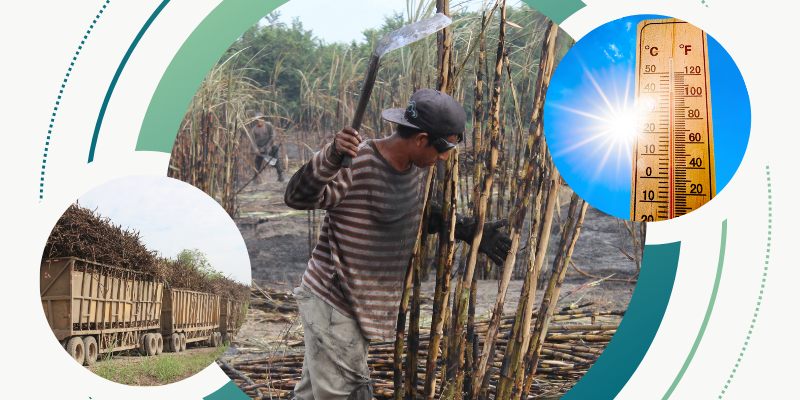
Workers face many dangers in their jobs. A study by a team of Colorado School of Public Health researchers points to an often-ignored global threat to worker health that is pervasive and growing: heat.
The research, begun a decade ago, focused on laborers in the sugarcane fields of southwest Guatemala. Their work to harvest tons of sugarcane during long, sweltering days exposed a risk to their health and ability to make a living: high rates of chronic kidney disease of unknown origin, or CKDu.
These workers had high rates of kidney injury that were not related to established risk factors like diabetes or high blood pressure. Instead, the suspected culprit was prolonged stints in unrelenting heat that sticks stubbornly near 100 degrees Fahrenheit and higher.
The steady heat exposures can raise core body temperatures (CBTs). That’s a dangerous situation for the kidneys, which the researchers demonstrated by measuring levels of creatinine in the workers’ blood. Creatinine is a waste material from metabolism that the kidneys filter. Higher levels of creatinine are a sign that the kidneys are injured and may be struggling to do their job
“Sugarcane workers in Latin America face disproportionately high CKDu risk, due to the combination of intense manual labor, prolonged environmental heat exposure, dehydration, and fluid loss,” the authors wrote in their study, published in the January 2026 edition of Environment International.
An academic-business partnership to reduce worker risk
The ColoradoSPH team collaborated with the Guatemalan agribusiness Grupo Pantaleon in an effort to understand why so many sugarcane workers were working in the fields for a season or less, then not returning. Were there safety risks, like injuries from machetes used to chop the sugar cane? Were there toxic substances in the drinking water? Was the work dangerously depleting workers’ electrolyte levels? Did they need more rest breaks and shade? Did environmental exposures outside of work add to the risk?
The researchers did not discount any of these factors but ultimately pointed to the burden that heat places on kidneys and other organs.
“Our findings indicate that a considerable proportion of sugarcane workers reach or exceed the recommended CBT limits, leading to cross-shift declines in kidney function,” the authors concluded.
“As our work continued, we came to recognize that heat is a hazard multiplier,” said study co-author Dr. Lee Newman, MD, MA, distinguished professor and director of the Center for Health, Work and Environment (CHWE) at ColoradoSPH. He noted that the World Health Organization estimates that 2.4 billion workers worldwide are overexposed to heat and that sugarcane workers are but one of many occupations that place people at risk
“Whatever you are worried about affecting your workers – work-related injuries, people’s ability to think clearly, problems with kidney function – add on heat and hard work and it becomes much more challenging to solve those problems,” Newman said.
The problem of heat exposure beyond Guatemala
Those health issues should concern employers in the United States, said study lead Dr. Jaime Butler-Dawson, MPH, PhD, adjunct assistant professor with the Department of Environmental and Occupational Health at ColoradoSPH.
“These findings are directly relevant to U.S. outdoor workers,” Butler-Dawson said. “They are in the same conditions in Florida, the southern United States, and Colorado. It gets so hot and we don’t have protections in place.”
The study in Guatemala goes a long way towards expanding understanding of the public health risks of prolonged heat exposure and the need to address them, Butler-Dawson said.
“When we think about heat-related illnesses, we think about you’re dizzy and you need to hydrate,” she said. “We’re not thinking about other processes in the body, like kidney injury, and we don’t have thresholds for that.”
Work to quantify the effects of prolonged work in the heat
The work in Guatemala could help to change that. The ColoradoSPH research team, which included researchers from the University of Colorado Anschutz schools of Medicine and Pharmacy, collaborated with medical staff from Pantaleon to collect data from workers during two harvest seasons in 2021-2022 and 2022-2023. The measurements included:
- Ambient heat exposure and relative humidity.
- Exposure to particulate matter, measured with vests workers wear to periodically collect air samples.
- Workday practices, such as water and electrolyte intake, number of rest breaks and amount of sugarcane workers cut.
- Core body temperature, measured by capsules with sensors that the workers swallowed.
- Urine and blood biomarkers to assess hydration and levels of creatinine, before and after shifts.
- Pre- and post-shift questionnaires and clinical data on blood pressure, body mass index, medications, cigarette smoking, and other health-related factors.
After lengthy analysis, the study found that workers experienced a median heat index – a measure that combines temperature and humidity to estimate what the environment feels like to the body – of 100 degrees Fahrenheit. The median maximum was a withering 115 degrees Fahrenheit. These numbers represented “high” and “very high to extreme” heat risk, according to the U.S. Occupational and Safety Health Administration, the authors noted.
In addition, researchers found a significant percentage of workers with core body temperatures above 100 degrees Fahrenheit, putting them at risk for kidney injury because of increases in creatinine levels.
To put that heat stress in perspective, Butler-Dawson said that these sugarcane workers run the equivalent of a marathon in stifling heat every day for six months. The result is repeated acute “hits” to the kidney that cumulatively produce chronic disease.
An important part of the research effort was to help Pantaleon find interventions that are “feasible and sustainable,” Butler-Dawson said.
“Putting more light on what’s happening with this workforce was really important,” she said.
Changes to protect workers
In cooperation with the research team, the company adjusted many of its practices to help protect workers. For example, they provided powdered electrolytes for workers to add to their water containers during cutting – a more practical alternative to giving them heavier bags of electrolytes in liquid form.
The team and the company also worked on ways to provide more shade and allow workers more frequent rest breaks. Start and end times to the work shift were adjusted to try to reduce the amount of work done during the hottest parts of the day, Newman added.
Another change placed a cap on the maximum number of tons of sugarcane a worker could cut, he said. The strategy discourages workers from pushing their labor to the limit and risking losing their ability to work because of kidney damage in favor of preserving their health and ability to work consistently.
He added that an important lesson from the fieldwork in Guatemala is that changes to protect workers’ health “can’t be fancy.” They must instead be relatively easy to implement and adapt to other workforces.
“You can put cooling vests on people and use sophisticated technology that gives you all kinds of feedback,” Newman said. “A lot of those technologies are not going to be available in low- and middle-income countries.”
The project in Guatemala has had far-reaching results, Newman noted. “The practices that were started more than 10 years ago at Pantaleon have been disseminated at all 10 major sugar companies in Guatemala,” he said. “They have also been taken to the international trade groups and government policymakers as best practices.”
The efforts to protect workers from dangerous heat exposures continues to spread, Newman added.
“The work that we started in Guatemala has led us to be invited to do similar things in Nicaragua, Mexico, and Vietnam,” he said. “We’re also extending it to other industries, including banana production in Guatemala and tomato- and pepper-growing greenhouses in Mexico.”
Addressing airborne threats
The just-published study also considered particulates from the burning that precedes sugarcane cutting as a possible source of kidney injury. Butler-Dawson described thick billows of smoke and ash generated from the burning fields. Workers entering the fields to cut inhale particles of ash that they stir up as they toil.
The study did not establish a firm connection between the particulate levels and kidney injury, Butler-Dawson said, but it is a subject for further investigation.
“We’ll be looking at the interactions of all these hits to the kidney with particulate matter,” she said.
The idea is to study workers’ exposure to the materials over time and determine if workers’ health declines during the course of the harvest. The work will also include studying what is in those particles that workers inhale, she said.
“We’ll take a deeper dive into the particulate matter for these future studies,” Butler-Dawson said.
The goal of the work by ColoradoSPH researchers in Guatemala and elsewhere is not only to identify threats to workers’ health, but also to collaborate with businesses to find viable solutions, Newman concluded.
“We’re at the point where we no longer want to observe. We want to intervene,” he said. He described current and future research work as “essentially like clinical trials in the field, testing solutions that are practical for trying to reduce the impact of heat on worker health and the health of multiple organs.”