



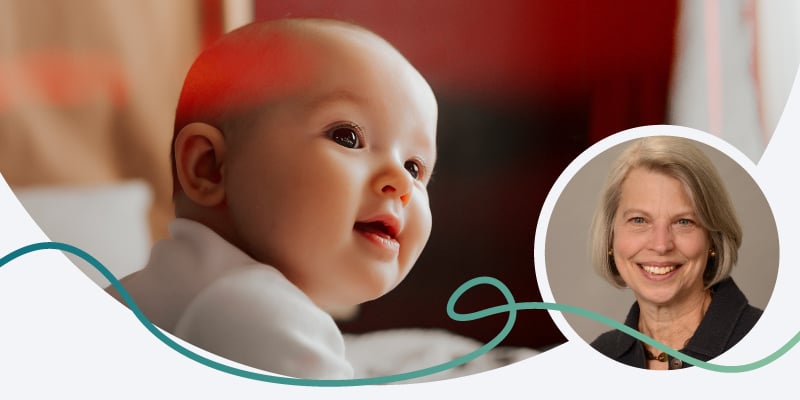
The keynote speaker for the First Annual Susan Niermeyer Lectureship at the Colorado School of Public Health began her address with a simple question to the audience.
“How many of you began life as a newborn?” asked Susan Niermeyer, MD, MPH ’09,, emeritus professor at ColoradoSPH’s Center for Global Health and pediatric perinatal researcher with the University of Colorado Anschutz School of Medicine.
Of course, all those assembled in the room at the Nighthorse Campbell Native Health Building shared that universal experience. But the circumstances of births differ widely, and Niermeyer’s talk focused on why newborn health matters, in the United States and globally.
“Each of us is here because of the care that we received on the day of our birth,” Niermeyer said. That immediate attention to health allowed the adults listening to her talk to develop and thrive. In contrast, millions around the world never get the same chance to grow, she said.
The heavy toll of newborn mortality
Niermeyer illustrated the point with a grim statistic. In 2022, 2.3 million newborns around the world died from infections, complications, congenital issues, or simply being born too soon or too small.
People may be numb to this “statistical anesthesia,” she said, but the number is the equivalent of the entire populations of Denver, Adams, Arapahoe, and Douglas counties being wiped out every year.
Niermeyer emphasized that educational programs and public health advancements over the past three-plus decades have helped to drive childhood mortality to a “historic low.” But she added that babies who die in the first 28 days of life still account for nearly half of all deaths under the age of five.
That mortality measure represents a tragic loss of life, but is also “an indicator of the status of the whole health system,” Niermeyer said. “It reflects gender equity, the status and education of women, our regard for vulnerable members of the population, and the policy environment.”
In light of that, the health systems of dozens of countries are in dire need of help, Niermeyer said. She noted that 60 countries, many of them in Africa and Asia, are at risk of missing the United Nations goal of 12 or fewer neonatal deaths per 1,000 live births by 2030.
Hard work and education helps to save newborn lives
“So what can be done?” Niermeyer asked before she discussed in detail three important global interventions launched over a quarter century that helped to sharply reduce the number of neonatal deaths. The continued success of these initiatives rests on working with people in communities around the world to implement them, she said.
The programs she outlined are:
- The Neonatal Resuscitation Program from the American Academy of Pediatrics (AAP), which began in 1987 and had been implemented in 125 countries by 2009. It focuses on an evidence- and team-based approach to newborn care. The keys: providing warmth to newborns, managing their airways and other steps immediately after birth.
- Helping Babies Breathe, another AAP program, which focuses on teaching providers the steps to take in the crucial 60 seconds after birth, or the “golden minute.” The keys include providing drying and ventilating newborns, delaying cord-clamping, and allowing for breastfeeding and skin-to-skin contact between mother and baby. The program also uses simulation to train providers on these steps and looks for ways to improve quality. Midwives and other community providers play an important role in implementing the approach.
- Essential Care for Every Baby, which was developed by AAP with input from USAID and the National Institute of Child Health and Human Development. It applies the core components of Helping Babies Breathe, but extends the steps to the daily care newborns need to maintain their health to the time they are discharged.
Niermeyer said that while these programs can have the greatest impact in countries in Sub-Saharan Africa and South Asia, “the global north can learn from the global south.” For example, she noted that the United States has “deserts” where women lack access to obstetric/gynecologic care. Midwives address that problem to a much greater extent in other parts of the world than in the U.S., Niermeyer said.
Input from experts across the healthcare system
A panel discussion followed Niermeyer’s address. The panelists, who represented a wide range of disciplines, discussed their work and issues they see as vital to improving the health of mothers are babies.
- Jed Lampe, PhD, Department of Pharmaceutical Sciences, discussed the risk to newborns from exposure to PFAS toxins.
- Bruce Dye, DDS, School of Dental Medicine, emphasized the importance of encouraging mothers to get dental care, which they may postpone because of fears of fluoride.
- Jini Puma, PhD, ColoradoSPH Department of Community and Behavioral Health, underscored that treating “downstream symptoms” caused by lack of healthy eating and physical activity in early childhood, could undermine the “upstream” benefits of prevention.
- Maureen Cunningham, MD '07, MPH '14, Children’s Hospital Colorado, expressed concerns that cuts in investments in the National Institutes of Health and USAID could negatively impact childhood morbidity and mortality.
- Kelly Bogaert, MD, ColoradoSPH Center for Global Health and Denver Health, addressed births by cesarean section, noting that improved access to the procedure should be accompanied by efforts to show women that they are not always necessary.
- Shannon Pirrie '10, MS '15, DNP '21, University of Colorado Anschutz College of Nursing, has worked as a midwife in Guatemala. She emphasized that those providers who want to make “sustainable impact in global health” must know when to follow the people in the communities they wish to serve. “The folks doing the work on the ground know what needs to be done, and our role is to show up as a resource and work alongside them and trust local leaders,” she said.
The Susan Niermeyer Lectureship was sponsored by University of Colorado Anschutz School of Medicine pediatrician and psychologist Bonnie Camp, MD, and hosted by the ColoradoSPH Center for Global Health. The theme was “From Pregnancy to Early Childhood: Equity, Innovation, and Collaboration Across Systems and Settings.”