



A little over a year ago, the Colorado Department of Law announced the distribution of $17.4 million for government organizations, schools and non-profit groups committed to discouraging vaping by young people. The funds were the fruits of a settlement reached by Attorney General Phil Weiser with e-cigarette company Juul Labs, Inc.
One of the recipients of the settlement money was UpRISE, a program backed by the Center for Public Health Practice (CPHP) at the Colorado School of Public Health. UpRISE, founded in 2018, is a statewide movement, led by young people, that aims to identify the root causes of nicotine use by their peers and engage in policy education or advocacy to address it.
On July 17, representatives of UpRISE joined organizations and leaders from around the state at Empower Field at Mile High for “Teaming up for Youth,” a “huddle” sponsored by Weiser and the Department of Law that focused on strategies to protect mental health and well-being in young people.
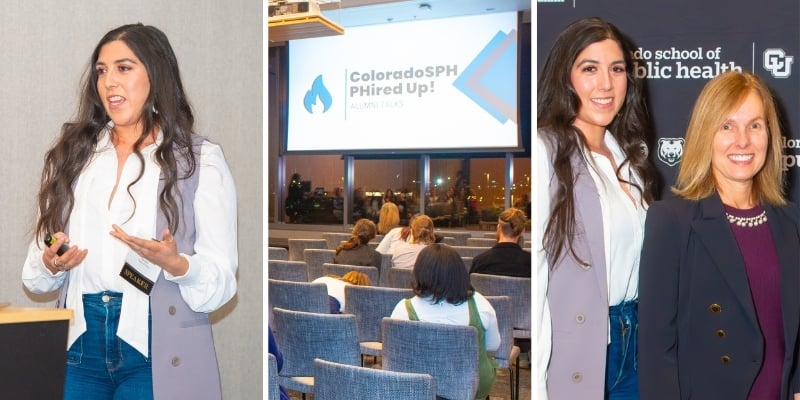
Event attendees heard from two UpRISE representatives, Dionisio Taitano-Samora and Gabrielle Cooper, MPH, ’23, who gave an “Ignite Talk” on how UpRISE put its Juul settlement funds to good use with a tool to promote safe spaces for young people to mingle and exchange experiences.
Taitano-Samora, a student at Colorado State University Pueblo, sits on the seven-member UpRISE Youth Action Board, which represents young people in communities around the state in pinpointing priorities for projects and policy changes. Cooper, a senior project coordinator with CPHP, is an adult facilitator who works closely with the board as it makes its decisions.
Third places: a first priority for youth
The five-minute talk focused on “third places,” which are safe environments – community centers, libraries, parks, or coffee houses, for example – for people to gather outside of home and work. In May, UpRISE held a youth-led town hall that identified third places as one antidote for social isolation and alienation, which can drive mental stress and nicotine and other substance misuse.
After the town hall, UpRISE consulted with Danielle Littman, PhD, at the University of Utah College of Social Work, who created “The Future of Third Places Game” to better serve young people who had experienced homelessness. In Littman’s words, the game “asks players to reimagine third places (community settings) which center young people's support, affirmation, and wellbeing.”
From the meeting with Littman, UpRISE helped to develop an online, downloadable version of The Future of Third Places Game that is designed specifically for young people in Colorado. Taitano-Samora and Cooper explained the idea of the game and the importance of third places during their Ignite Talk.
“Third places can be spaces for young people to find belonging and support,” said Taitano-Samora, who added that he was unaware of the concept until he got involved with UpRISE. He said his first encounter with a youth center during a visit to Denver in 2024 heightened his interest.
“I had no idea there was an affirming space for like-minded youth to congregate," Taitano-Samora said.
A need to belong to counter stress
The Youth Action Board-led town hall, which Taitano-Samora co-facilitated with Cooper, showed him he wasn’t alone in seeking safe places to gather and talk with others without fear of judgment or condemnation. A common theme emerged from participants in very different communities: a lack of belonging can be one of the root causes of mental stress and nicotine misuse in young people.
“A third place can be a great option to address that need,” Taitano-Samora said.
Cooper said the game works to fire the imaginations of both young people and adults by transporting them into the future and asking them to take on designing an ideal third place for their entire community or for a specific building, like a community center or school.
“People can think, ‘what can we do with this building or around this building to make it a more youth-focused third place?’,” Cooper said.
The brief Ignite Talk didn’t allow for questions and answers, but Cooper said she and Taitano-Samora later heard plenty of people express interest and excitement about the game. That included members of the Department of Law’s outreach team and Weiser himself, who met and spoke briefly with both of them about the game.
Uplifting UpRISE
The event also helped to raise awareness of UpRISE and what it can offer to communities, said the program’s founder, Heather Kennedy, PhD, clinical assistant professor in ColoradoSPH’s Department of Community & Behavioral Health and program manager for the Hub for Justice-Centered Youth Engagement at the CPHP.
“Our goal is to amplify the voices of young people to create health equality,” Kennedy said. “That’s our vision, written by our youth board.” Many adults lack the knowledge and skills to accomplish that goal without some guidance, she added, but The Future of Third Places Game can be an important aid.
“It’s concrete, it’s tangible, and it gives adults the tools they need to be able to center young people’s voices and generate ideas for third places in their communities,” Kennedy said. “We know that if a community is going to design a space for young people, that young people must be included.”
Kennedy said UpRISE has 25 mini grants available next academic year for schools and organizations interested in working with young people to creatively combat nicotine misuse. Adult facilitators like Cooper provide help with coaching and instructional materials.
Channeling and promoting positive social behavior by young people
Kennedy noted this summer’s disruptive “teen takeover” events in the Denver area generated understandable negative publicity and public safety concerns. But she maintained that the chaotic gatherings only underscore the need for positive places for young people and adults to connect.
“Autonomy and increasing independence over adolescence is a developmental need,” Kennedy said. “Young people will seek out and satisfy that need, either through pro-social ways, like participating in UpRISE and other programs like it, or engaging in behavior that can create harm.”
Taitano-Samora said his work with UpRISE and the Youth Action Board has cemented his commitment to advocacy work on behalf of those who face barriers to acceptance and success. Looking forward, he said he wants to find more “hands-on opportunities” for young people interested in STEM (science, technology, engineering, and mathematics).
“I think there are a lot of barriers when it comes to higher education, like mental health and financials,” Taitano-Samora said. “I want to figure out how I can break that down. UpRISE is a great way of getting at some of those root causes that also intersect with barriers to higher education.”
Cooper said “a big future goal” is to keep expanding the reach of UpRISE coalitions throughout Colorado and recruiting more young people to the Youth Action Board.
“We’d love to recruit new members and continue working on third places in a more focused way,” she said.