Digital dentistry is entering a new phase. What was once considered emerging technology is increasingly becoming standard practice, connecting diagnosis, treatment planning and restoration through seamless digital workflows.
This transformation was the focus of two continuing education presentations at the CU Anschutz All Alumni Weekend, where School of Dental Medicine faculty experts David Gozalo, DDS, MS, and Jeffrey Stansbury, PhD, explored how advances in scanning, software, artificial intelligence and additive manufacturing are reshaping the profession.
The New Era of Digital Dentistry
For years, dentists have adopted digital tools one technology at a time. Today, the profession is moving toward fully integrated workflows that connect patient scans, treatment planning, design software and production systems. That shift is making digital dentistry faster, more efficient and easier to implement across a growing range of procedures.
Gozalo said the profession has already crossed an important threshold: "Digital dentistry is no longer 'the future' — it is happening now."
At the same time, Stansbury sees momentum continuing to build as both technology and adoption mature. He said, "Many digital dentistry changes are already here, with more coming, and likely sooner than many may be expecting."
Several factors are driving that growth, including improved technology, streamlined workflows, expanding clinical applications and growing familiarity among both providers and patients. Digital approaches are increasingly used for restorative dentistry, implant treatment, aligner therapy and removable prosthetics, creating a more connected model of care.
AI and Connected Workflows
As digital tools become more sophisticated, software is beginning to play a larger role than hardware alone. "The biggest value comes from connecting acquisition, design and production into one efficient digital workflow," Gozalo said.
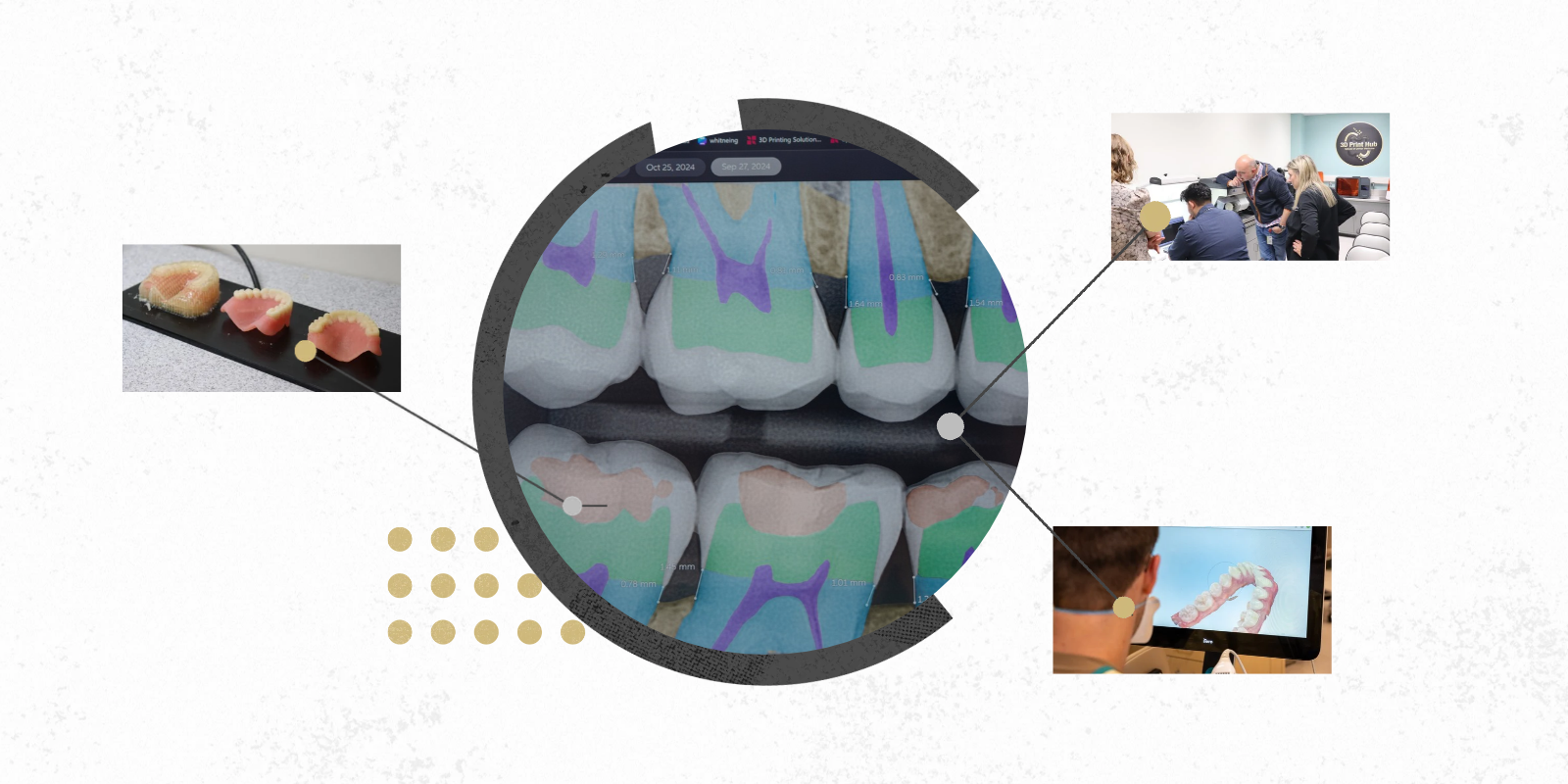
One of the clearest examples is the evolution of the intraoral scanner. Once viewed primarily as a replacement for traditional impressions, modern scanners are increasingly serving as diagnostic and communication tools. New software platforms can help clinicians identify and monitor changes such as occlusal caries, tooth wear, gingival recession, plaque accumulation and proximal caries while comparing scans over time.
The result is a shift from simply capturing an image of a patient's teeth to creating a longitudinal digital record that supports diagnosis, monitoring and patient education.
Artificial intelligence in clinical settings is accelerating that transition. AI-assisted applications are beginning to support diagnostic interpretation, treatment planning and restorative design, helping clinicians work more efficiently while enhancing communication with patients.
At the same time, cloud-based systems are making it easier to connect practices, specialists, laboratories and manufacturers through shared digital workflows. Digital case files can move seamlessly across the care continuum, reducing friction and improving collaboration.
Gozalo noted that the next major advances in digital dentistry are likely to come from the combination of AI, software and connectivity. As these systems become more integrated, dentistry has the potential to become more predictable, visual, efficient and patient-centered.
The Next Frontier: 3D Printing and Advanced Materials
While digital workflows continue to expand, researchers are already looking beyond today's capabilities.
A major focus is the continued shift from traditional subtractive manufacturing, in which restorations are milled from larger blocks of material, toward additive manufacturing technologies such as 3D printing.
According to Stansbury, advances in materials and manufacturing processes are helping drive that transition. Researchers at the CU Anschutz School of Dental Medicine are exploring new approaches to producing complete and partial dentures, crowns and other restorations through additive manufacturing.
One area of investigation involves inkjet-based multimaterial printing, which could enable monolithic prostheses to be produced with enhanced functional properties. Researchers are also working to address material limitations that have historically slowed the adoption of 3D-printed dental restorations.
"Advances that address today's material limitations will continue to accelerate the adoption of digital dentistry," Stansbury said. "Hardware and software options continue to evolve, which will further enhance the integration of 3D printing within the larger move toward digital dentistry."
Strategic partnerships are also helping accelerate the path from research to clinical application. By combining innovations in materials science, manufacturing processes and industry collaboration, researchers hope to bring new technologies to the dental marketplace and expand the possibilities of digital care.
Looking Ahead
The future of digital dentistry is being shaped by three interconnected trends: wider adoption of digital workflows, growing use of AI-powered software and rapid advances in additive manufacturing.
Many of these changes are already visible in dental practices today. Others are still emerging from research laboratories and development pipelines. Together, they point toward a future in which digital technologies are more deeply integrated into every stage of patient care.
At CU Anschutz Dental, that future is being shaped not only through education and clinical implementation but also through ongoing research designed to expand what digital dentistry can achieve.