When the Society for Leukocyte Biology presented Elizabeth Kovacs, PhD, with its Legacy Award at its annual meeting in late October, it was in part a recognition of her long history with the organization.
“I joined the society in 1987, during the last millennium,” says Kovacs, vice chair of research and professor of GI, trauma, and endocrine surgery in the University of Colorado Anschutz Department of Surgery. “I quickly fell in love with the society because the members care a lot about trainees and career development. It’s a small society with relatively small meetings, where the trainees have the opportunity to meet professors.
“It fits well with my philosophy of ‘lower-archy,’ the opposite of hierarchy,” she adds. “Everybody learns from everybody else, which is the way academia should be.”
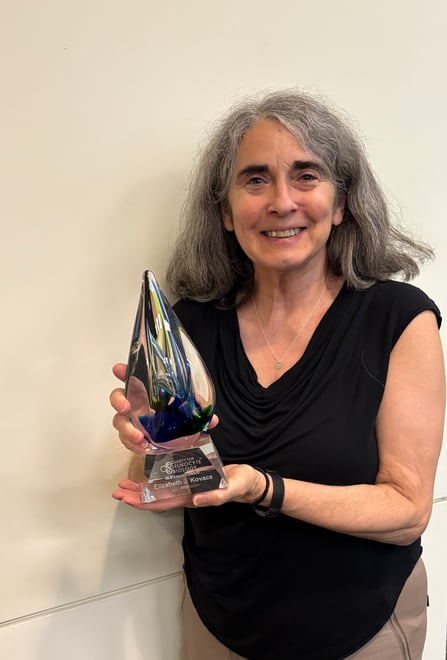 Kovacs with her Legacy Award.
Louis Justement, president of the Society for Leukocyte Biology, says the organization is honored to celebrate the contributions Kovacs has made by giving her the Legacy Award.
“Liz epitomizes everything that SLB stands for and values, including promoting outstanding science, contributing to the next generation of researchers, and creating an engaging and welcoming environment to foster the success of the members,” Justement says. “Through her numerous volunteer leadership roles at SLB, Liz has done just that.”
Leukocyte researcher
The Society for Leukocyte Biology is dedicated to promoting research of leukocyte biology — the study of white blood cells and how they interact with each other and other cells.
“Leukocytes interact with cells that line organs, like epithelial cells in the gut and the lung,” Kovacs says. “This set of cells can control how the immune system works or doesn't work. Sometimes there’s too much inflammation, or too little inflammation, or not enough activation of leukocytes. When there is not enough activation, for example, infections can get out of control. These leukocytes can cause tissue damage if they go to the wrong place at the wrong time, and that can be problematic.”
Kovacs has spent much of her career researching the activity of leukocytes in inflammation related to aging, alcohol consumption, and burn injury — the keynote speech she delivered at the conference, when accepting her award, was titled “Inflamm-aging, Intoxication, and Injury: My Journey Through Leukocyte Biology.”
“During my presentation, I wanted to talk less about the actual research and more about the people who helped me during my career and when and where they stepped into my life,” she says. “I wanted to paint the big picture of how I became interested in these research areas and why I chose them.”
Legacy of mentorship
The Legacy Award is especially meaningful, Kovacs says, because it recognizes the mentorship she has provided to young scientists over the years.
“I've mentored over 130 people in my lab, and they have written over two dozen dissertations and theses and published lots of papers,” she says. “My lab mentees have also gotten numerous grants of their own, establishing their own independent academic careers. Over the years, many have gone on to mentor the next generation beyond themselves. Not only do I have lab children, I have lab grandchildren.”
The latest honor
The Legacy Award is just one of the recognitions Kovacs has received from the organization over the years.
“I joined this society when I was a postdoctoral trainee at the National Institutes of Health, and after a couple of years, when I became more comfortable with the group, I thought, ‘This is a society whose meetings I want to send all my trainees to, and I want to be president of it one day,’” she says. “I was president 15 years ago, and I've served on just about every committee they have over my career. A few years ago, they made me an honorary lifetime member.”
The Legacy Award, however, holds special meaning for Kovacs.
“It's a big deal; some of the people who've gotten this award in the past were my mentors and were leaders in the field,” she says. “It is a great honor to be recognized along with them.”