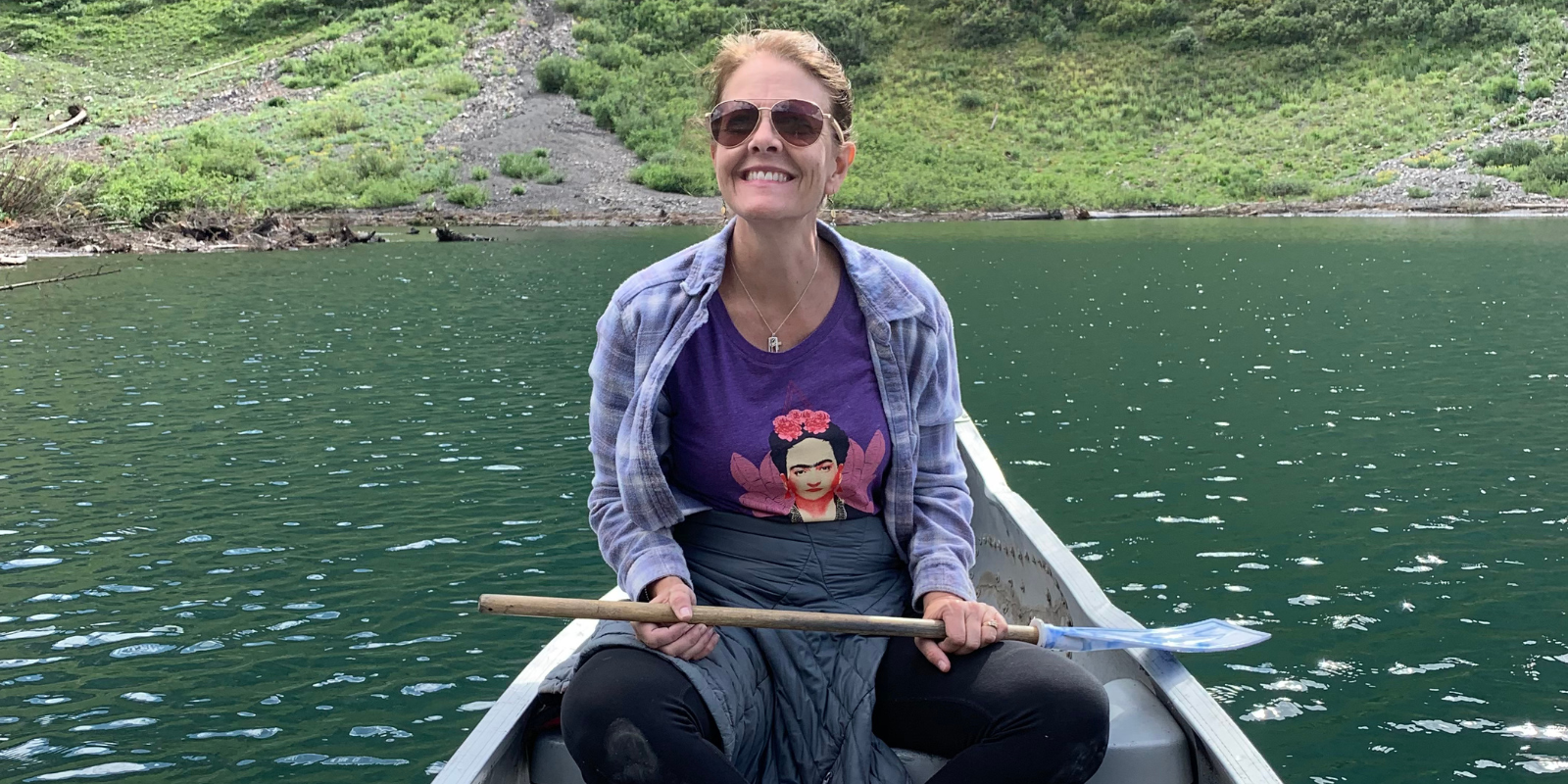
The day Mary Kolbenschlag was diagnosed with breast cancer turned out to be one of the luckiest days of her life.
Kolbenschlag’s mother and both of her grandmothers had breast cancer, so she and her sisters always figured it was a matter of when, not if, they would get it as well. Fortunately for Kolbenschlag, her breast cancer was diagnosed during a routine mammogram, before it had had the opportunity to spread to other parts of her body.
A mass is detected
The cancer required a lumpectomy — a surgery to remove the affected section of the breast and a small area surrounding it — followed by radiation therapy to help ensure the cancer wouldn’t return. It was during the preparation for radiation that Kolbenschlag received her second piece of life-saving news.
“When my radiology oncologist was mapping my chest for radiation, he came in and said, ‘Hey, I want to look at your CT scan with you,’” recalls Kolbenschlag, who lives in Superior, Colorado. “He said, ‘You have some masses on your lungs. Are you a smoker?’ And I said, ‘No, never have been.’ And he responded, ‘Well, they're concerning.’”
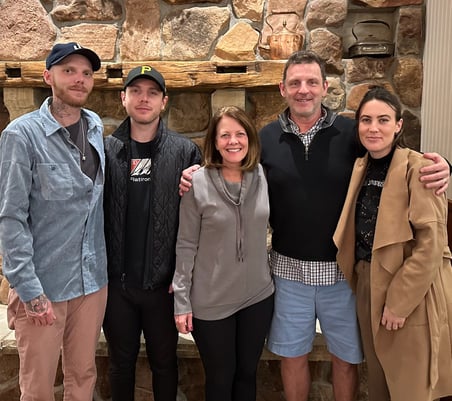 Kolbenschlag with her family.
Those concerning masses turned out to be a tumor on her right lung, and Kolbenschlag was soon connected with Robert Meguid, MD, MPH, FACS, professor of cardiothoracic surgery in the University of Colorado Anschutz Department of Surgery.
“Dr. Meguid told me, ‘Because you don't have nerves in the lungs, by the time you find something with lung cancer, it's usually stage four. It goes to your brain,’” Kolbenschlag remembers. “He said, ‘You are very lucky that we found this when we did, because it was stage one.’”
Surgery and recovery
Because of the tumor’s size, however, Meguid had to remove the upper lobe of the right lung, versus just removing the section of the lung that contained the tumor. Though the procedure was performed robotically, with small incisions, Kolbenschlag — an avid hiker — had a hard time dealing with the recovery, which included seven days in the hospital followed by a few months until she started feeling like herself again.
“I tried to do my normal hikes, and my body just would not respond. I could not catch my breath,” she says. “I used to be able to hike at a really fast pace and talk at the same time. Now I go out with my girlfriends, and I can hike or I can talk, but I can't do both.”
Radon awareness advocate
That’s slowly changing as her lungs begin to heal, Kolbenschlag says. And while she can’t be certain what caused her lung cancer — her house is in the area affected by the Marshall Fire in 2021, which may be a factor — she has become an advocate for testing for radon, an odorless gas that is known to cause lung cancer.
 Kolbenschlag and her sister in Vernazza, Italy.
“When I got home, I immediately sent an email to my block, and said, ‘Listen, this is what happened to me. If you've got your high schooler in the basement, if you're down in the basement working, you need to know what your radon level is,’” she says. “I'm friends with a couple of the Superior councilmen, and I’m talking to them about an awareness campaign as well.”
It's an effort that Meguid, who treats many lung cancer patients who never smoked, says is vitally important, especially in Colorado.
“Lung cancer can arise from numerous environmental exposures, and there can be a genetic component,” says Meguid, who recommends purchasing a radon monitor to continuously evaluate levels of the gas in the home. “Although they are lifelong never-smokers, patients like Mary may have secondhand smoke exposure, environmental exposure such as smoke and pollutants, and radon exposure. There is a significant preponderance of radon in the bedrock of Colorado, which results in patients getting exposed to radiation doses they are unaware of.”
Screening saves lives
Kolbenschlag, who works as a college counselor and navigator for underserved youth through Discover Pathwaze, a nonprofit she cofounded, also emphasizes the importance of breast cancer screening, both for its primary purpose and for its ability to also detect lung cancer.
“Breast cancer saved my life,” she says. “I wouldn't have gotten scanned for radiation had I not gotten breast cancer, and I rarely needed to see a doctor, other than my mammograms. So if you're like me, you may want to get a scan.”
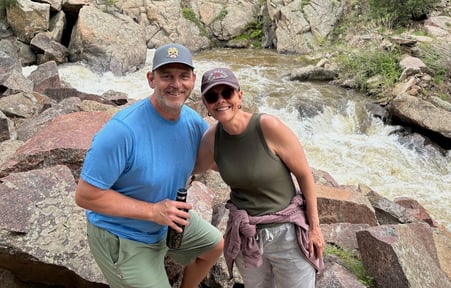 Kolbenschlag and her husband, Chris.
Meguid agrees, saying he often treats patients whose cancer was detected incidentally.
“We commonly see lung cancer detected on imaging obtained for other reasons such as mammography, CT scans done for other workup such as heart disease, chronic cough, after a car accident, or for another cancer workup,” Meguid says. “One of the important aspects of routine screening for breast cancer is the overlap it has with sometimes detecting lung cancer despite that not being the intent.”