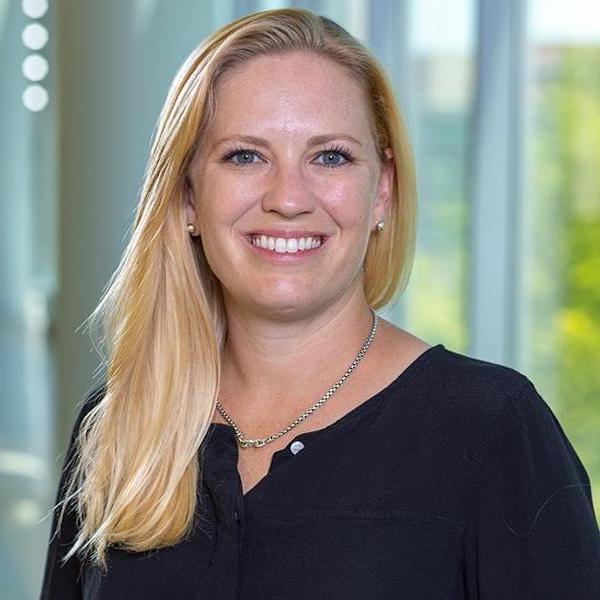
In combat, or even on a base, U.S. Air Force officers could find themselves dealing with a medical emergency requiring quick, effective action. That’s why Angela Wright, MD, a CU Anschutz Department of Emergency Medicine leader in emergency medical services (EMS), was asked to assist in an intensive training program at the United States Air Force Academy (USAFA).
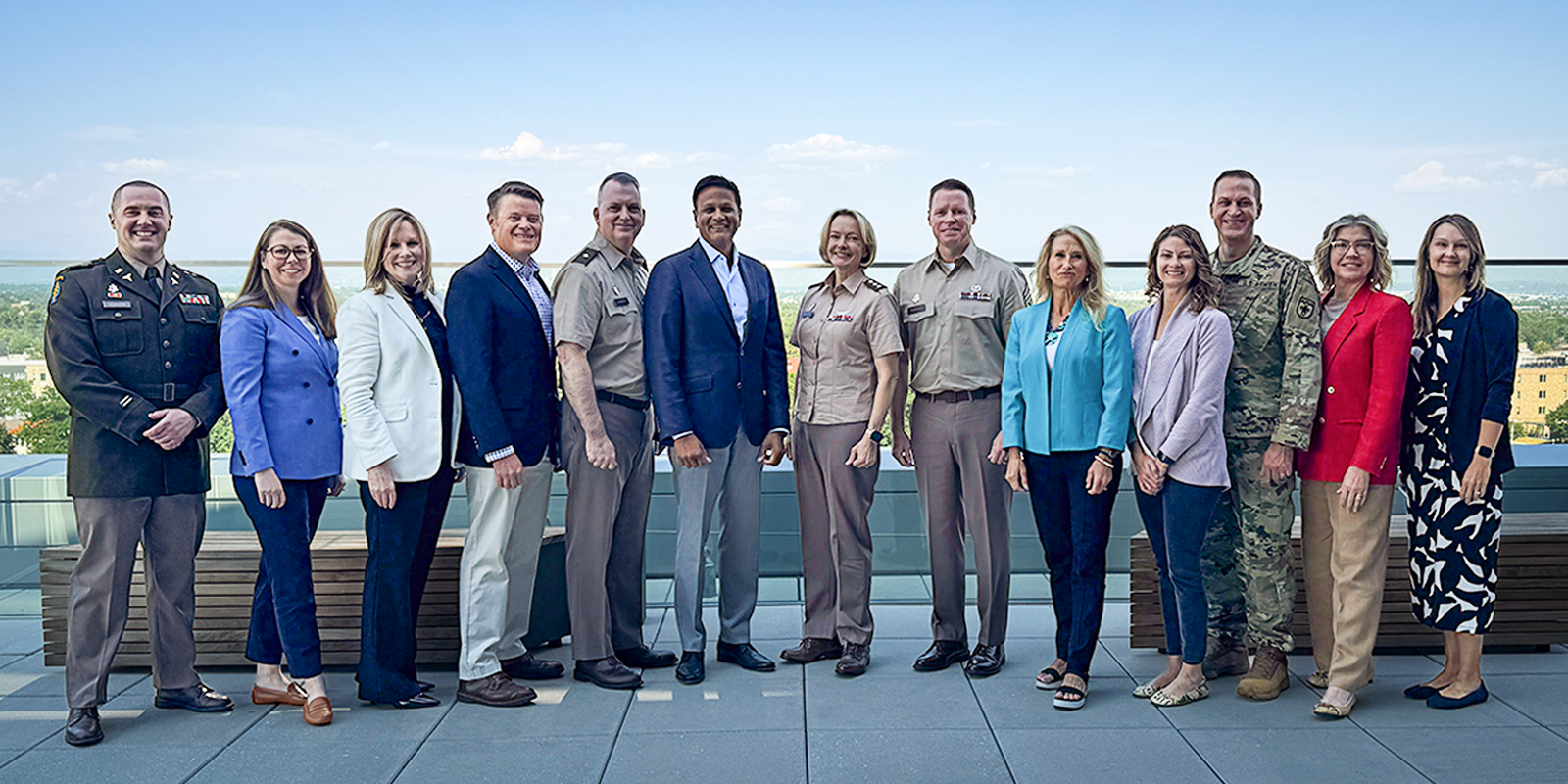
Wright and her team went to the USAFA campus outside Colorado Springs in late July to conduct part of a new two-week EMS training program for about 215 cadets. They worked with academy personnel as well as U.S. Army Special Forces medical trainers.
“It was dedicated groups of people with different approaches, working together, capitalizing on our various strengths and accomplishing a massive goal,” she says of her fellow trainers. “It was very fun to see.”
Wright is an associate professor of emergency medicine and leads the department’s Program for EMS and Prehospital Care, focused on education, research, and patient care initiatives. Like others on her team, she is dual trained in EMS and as an MD.
She is also the EMS medical director for UCHealth University of Colorado Hospital and other UCHealth centers in metro Denver.
Rapid deployment
USAFA officials had reached out for help with the training initiative to Vik Berbarta, MD, professor of emergency medicine and the department’s interim chair, and he tapped Wright for the project. Berbarta, a colonel in the U.S. Air Force Reserve, is a USAFA graduate.
“Dr. Berbarta has been my mentor and advisor in building and growing our program,” Wright says, “and he has a very good understanding of what our strengths are, so he came to me and said the academy needs us, could we help them?”
In military terms, it was a rapid deployment. Wright had two weeks to prepare before the training would begin.
“We met with their leadership structure that was executing the training,” she says. “This was a massive undertaking for the academy, and we would be a piece of it. We got an idea of what they were expecting, and we figured out where we could be useful. Then it was all hands on deck for our entire team – EMS educators, liaisons, managers, and clinical quality personnel. Our goal was to take our medical expertise and distill it down so we could train a large number of people very quickly.”
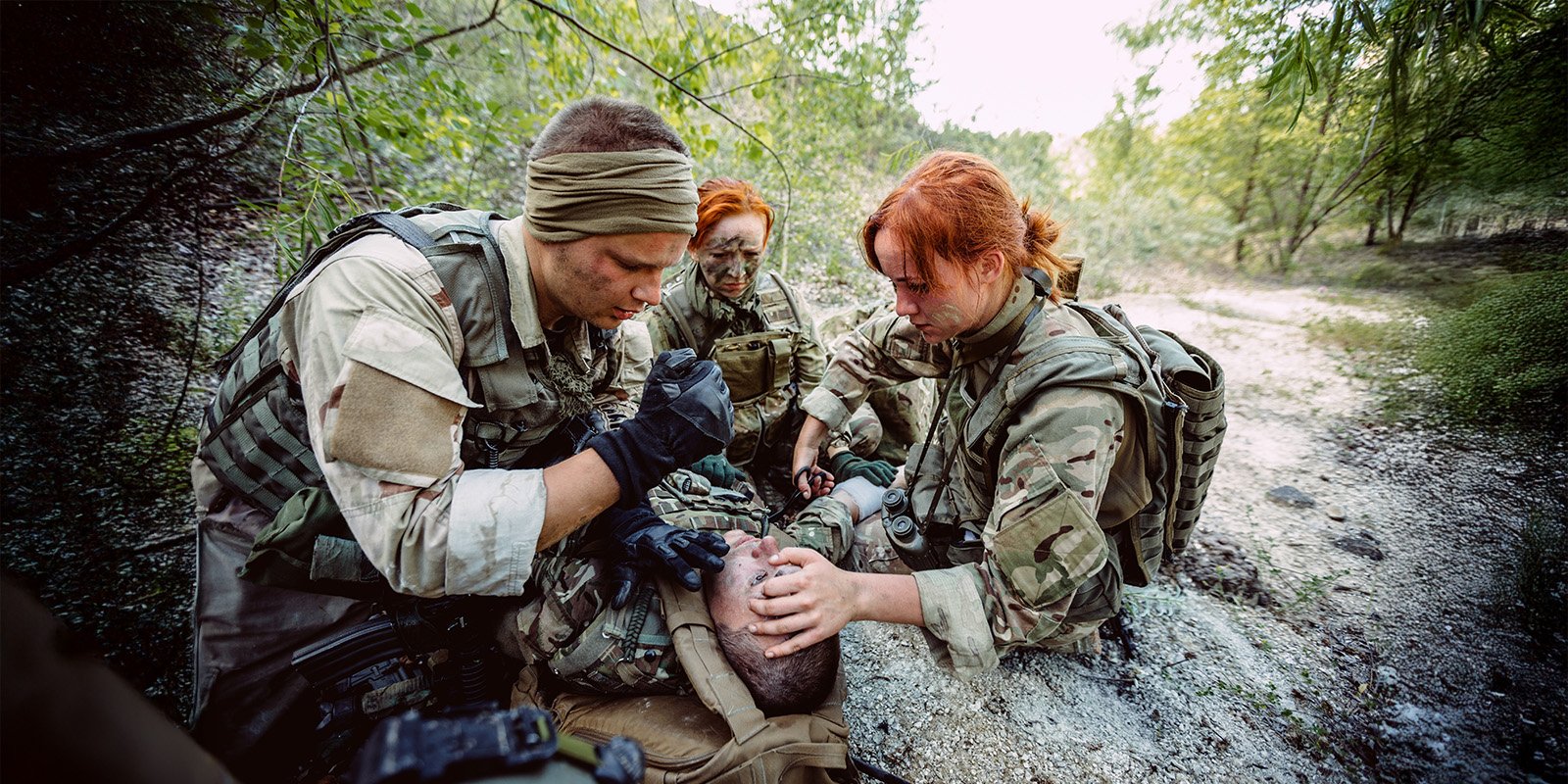
The overall training objective, Wright says, was to bring cadets up to what the military calls the Combat Lifesaver training level, “where you can provide the major, life-saving interventions as quickly as possible while you’re working to get that person to the next level of care. There’s a fair amount of military and civilian crossover when it comes to this type of care. Their goal was for everyone who puts on that uniform to have the skills to save someone’s life, whether it’s on a deployment or even in an office somewhere. The focus is on things like hemorrhage control, airway and breathing, managing hypothermia, and dealing with head injury.”
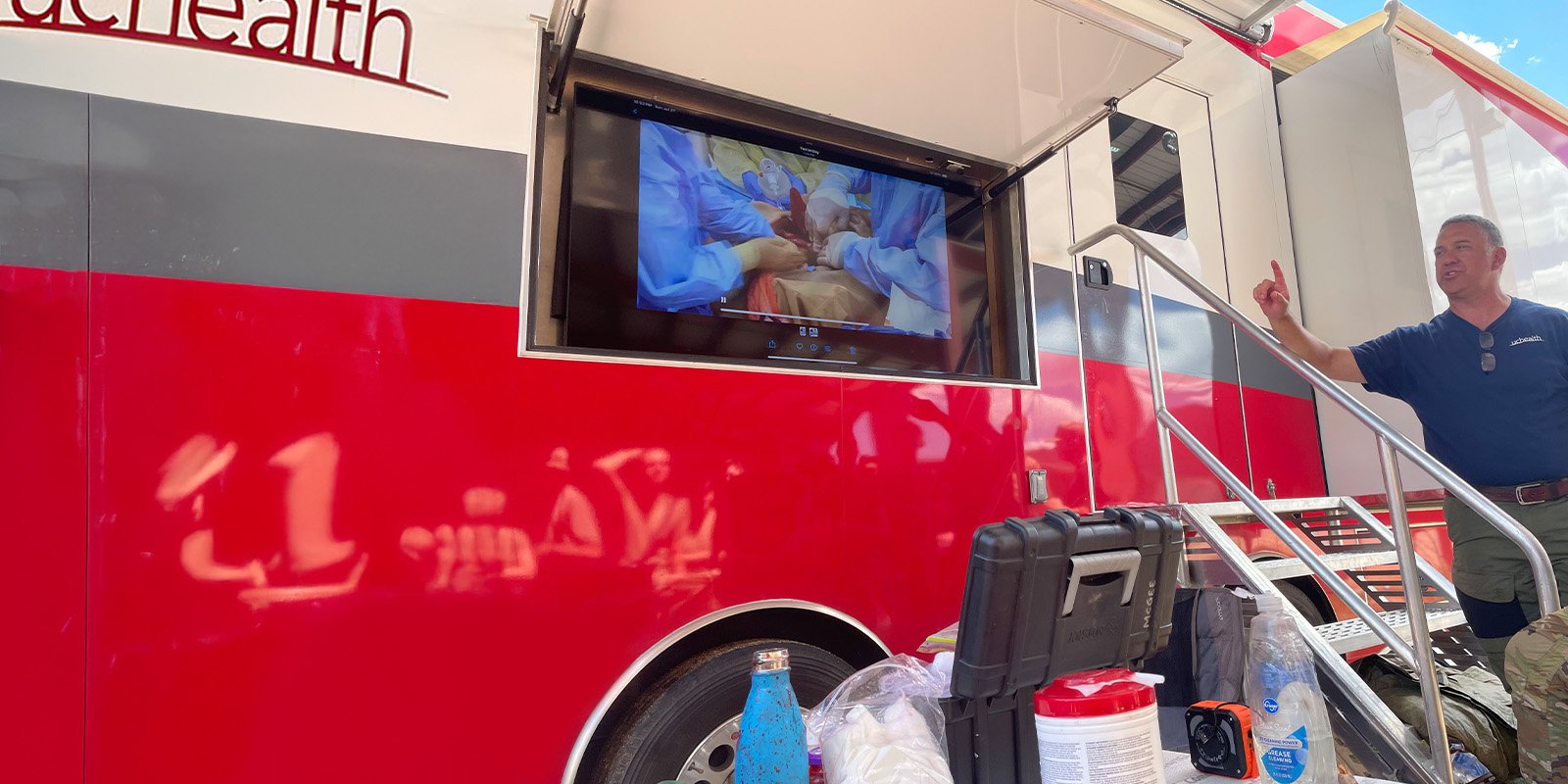
The UCHealth Mobile Simulation Unit is a 42-foot gooseneck trailer with two training areas that resemble an emergency trauma room and the back of an ambulance. An external screen live-streams the activity inside for larger audiences. Photo provided by Angela Wright, MD
A multiple casualty simulation
Accompanying Wright’s team at the academy was the UCHealth Mobile Simulation Unit, which she describes as “a gorgeous, large trailer with medical supplies and a specialized set of training and simulation equipment. Half of it is designed like a resuscitation bay in an emergency room, and the other half is like the back of an ambulance.”
In the first part of the two-week program, cadets were drilled in skills such as using a tourniquet, managing airways, and packing wounds with QuickClot combat gauze. The CU team supplied mannequins and other equipment for that phase of the training.
Then came a two-day full training exercise, or FTX, in which cadets were sent into the woods for an in-the-field scenario involving mass casualties. “We brought a moulage expert, someone who does fake makeup for injuries, and we moulaged about 14 casualties,” Wright says.
Cadets were told there had been an explosion and to go find casualties scattered in the woods. “They dispersed and had to use litters and carries to get the simulated patients back to me or our trauma surgeon. We were the forward clinic, essentially. We would simulate the next level of care for the patients so they could see what that continuum looks like.”
Wright and her team asked some of the cadets to “come into our fake operating room, where we had a cut suit, an advanced piece of training equipment with fake organs and fake blood, and you can actually do surgeries on this equipment. We had them scrub in and assist so they could see what the surgery would look like. The learning piece for them was, ‘This is why what you do matters, because if you can get them to us alive, here's what we can do to save their life.’”
‘Bring it on’
The cadets who participated in the training “were very engaged,” Wright says. “I think they recognized the importance and value of the training and got a lot out of it.”
Wright said her team members involved in the training had “a wonderful time doing something a little different, and feeling like what they were doing was impacting these folks. They are truly the hardest-working group of people.”
Wright added that the project “helped us to remember that we can train large groups of people and it doesn’t have to be that complex. We had short notice, and it was a huge lift, but this reminded us that we can do anything. If we have a mission and we’re aligned, then bring it on.”
Increasing collaboration
The Department of Emergency Medicine’s participation in the training came amid increasing collaboration between the USAFA and CU Anschutz.
In 2024, with much fanfare, the USAFA and the CU Anschutz School of Medicine signed an educational partnership agreement to facilitate academic collaborations and the creation of specialized joint training programs and seminars, advancing the missions of both institutions. The agreement was spearheaded by the CU Center for Combat Medicine and Battlefield (COMBAT) Research, which was founded by Berbarta.
Wright – who worked as an emergency medical technician before earning her MD – says that the training initiative also helps demonstrate the vital role that EMS personnel play in the health care ecosystem.
“A lot of the time, the public thinks of EMS people as a way to get to the hospital, kind of a fancy Uber,” she says. “This highlights that health care starts at first contact. These folks are highly trained and so dedicated to patients. They’re truly clinicians. They’re trained in anatomy and physiology, they give medications, they can do a lot of procedures, and they help our patients from the moment they walk into the patient’s home. They're the first link in the continuum of health care. It doesn’t start when the patient gets to the emergency department. It starts with our clinicians in the field.”