A research collaboration between the University of Colorado Anschutz and the nationally-ranked veterinary medical programs at Colorado State University in Fort Collins seeks better ways to care for trauma in both humans and dogs, in combat zones as well as at home.
It’s one facet of a long-standing CU Anschutz-CSU research partnership in a variety of medical fields, including emergency medicine as well as cancer.
The collaboration takes advantage of key biological similarities between humans and dogs. When dogs get seriously injured – hit by cars, attacked by other animals, or hurt while sniffing out explosives in battle zones – they may experience traumatic injuries similar to humans. Studying these injured animals can speed up the development of new treatments and techniques to help both animals and people.
An estimated 6 million trauma-related deaths occur worldwide each year, and it’s also a leading cause of death among dogs and other pet animals.
Tara Hendry-Hofer, MSN, RN, is a research scientist with the CU Anschutz Department of Emergency Medicine with 20 years of experience in drug development and translational research studies. She says the CU-CSU relationship helps “streamline the process” of moving preclinical discoveries into treatments.
“It’s way more cost-effective to do some steps of these studies in veterinary medicine as opposed to human medicine to inform future research and streamline the approval process for treatments,” she says.
Hendry-Hofer is preclinical research lead for CU’s Center for Combat Medicine and Battlefield (COMBAT) Research. She’s also program manager for the Translational Research, Innovation, & Antidote Development (TRIAD) lab, which collaborates with researchers and clinicians around the world to bring lifesaving, innovative discoveries to patients.
One CU-CSU collaborative project now underway is investigating the use of tranexamic acid (TXA) for trauma patients to control severe bleeding, particularly in a setting like a battlefield where care and blood supplies may be far away. TXA – which helps reinforce blood clots – is already approved by the FDA for managing heavy menstrual bleeding and for short-term use for people with hemophilia.
In particular, CU and CSU research teams want to determine if TXA can be effective in treating severe bleeding among people and dogs when injected deep into muscle tissue. Hendry-Hofer says that in a battle zone or other “austere environment,” or if a patient has hemorrhagic shock causing poor circulation, intramuscular injections are generally less challenging to administer than injecting drugs into a vein.
“We’ve done some preclinical work on this,” Hendry-Hofer says, “but to actually get it into a trauma patient using intramuscular administration is easier to do in a veterinary model versus a human clinical trial,” thereby potentially speeding up approval of that use of TXA in humans by the U.S. Food and Drug Administration (FDA).
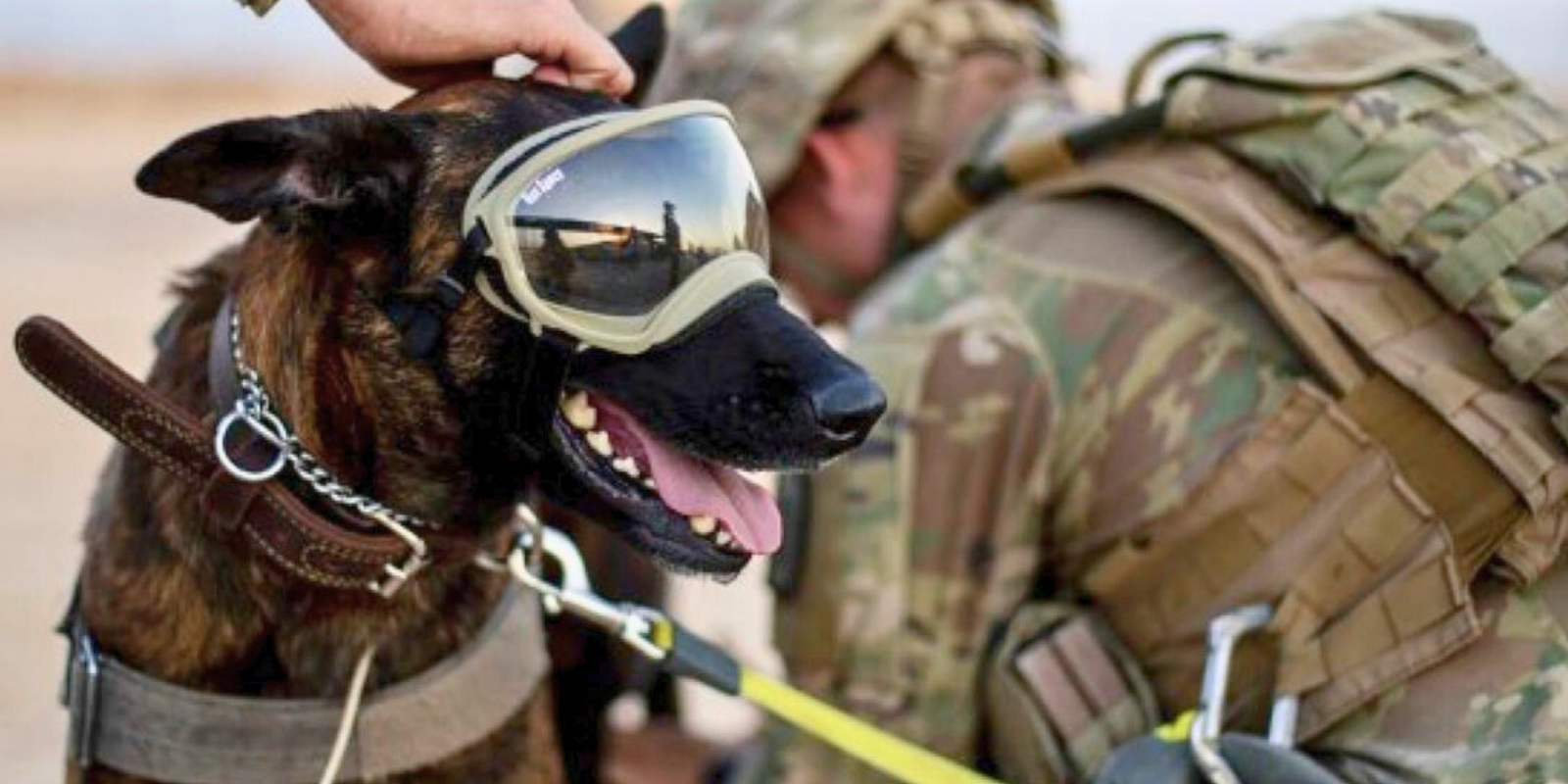
Photo at top: A U.S. Army military working dog receives protective equipment before training at Al Asad Airbase, Iraq. Photo credit: U.S. Army.
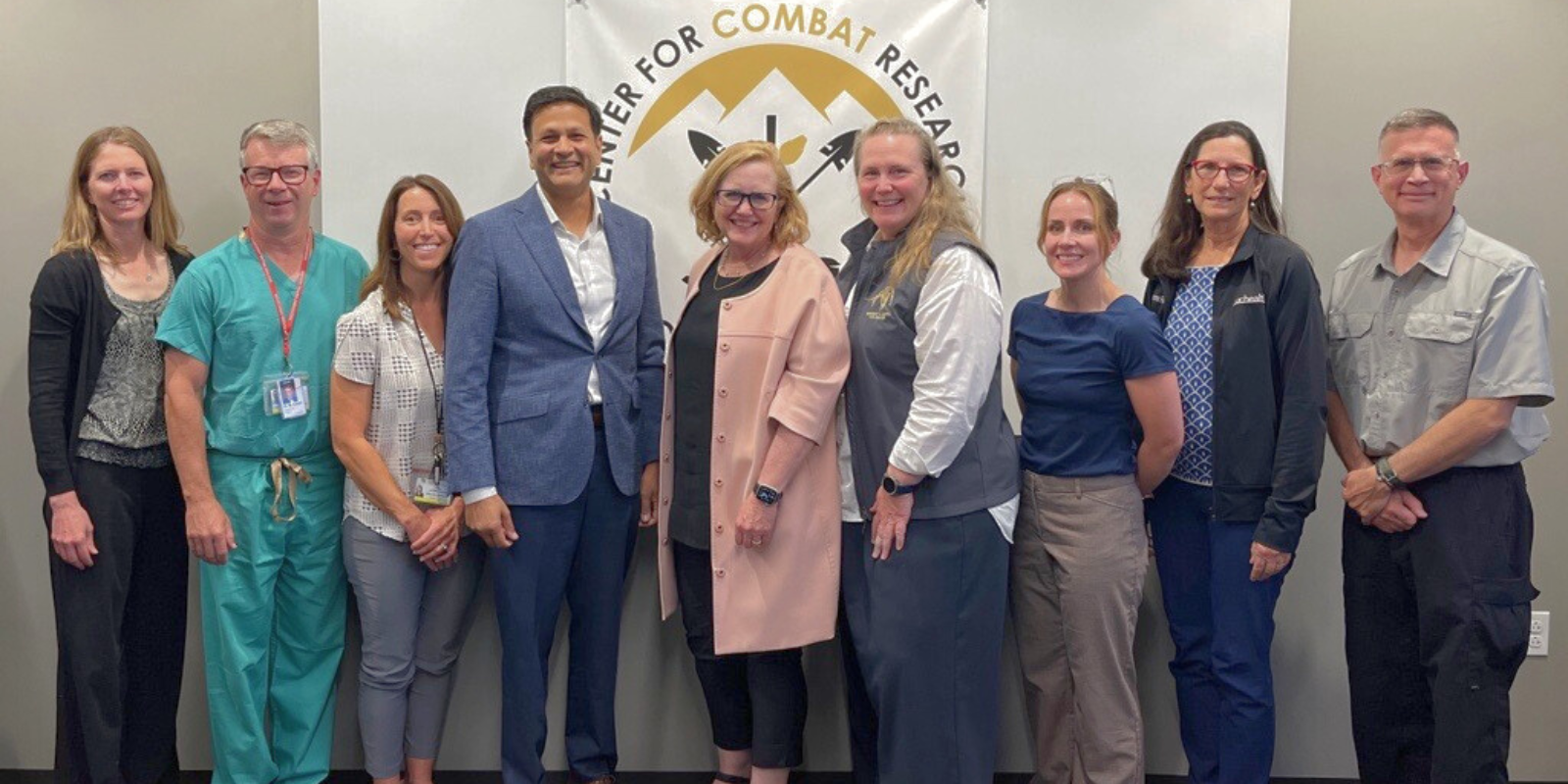
Members of a research collaborative team from Colorado State University visit CU Anschutz's Center for Combat Medicine and Battlefield (COMBAT) Research to discuss collaborative opportunities. From left: Tracy Webb, DVM (CSU); Mitchell Cohen, MD (CU Anschutz); Tara Hendry-Hofer, MSN, RN (CU Anschutz); Vik Bebarta, MD (CU Anschutz chair of medicine and founding director of COMBAT); Heather Pidcoke, MD, PhD (chief medical research officer, CSU); Kelly Hall, DVM, MS, DACVECC (CSU); Claire Tucker, DVM, MPH (CSU); Julie Dunn, MD (CU Anschutz); Kelly Mann, DVM (CSU). Photo courtesy of Kelly Hall.
Sharing a common interest
Hendry-Hofer and her colleagues are collaborating on TXA research with Kelly Hall, DVM, MS, DACVECC, a professor in emergency and critical care at CSU’s College of Veterinary Medicine and Biomedical Sciences. Hall is also executive director of the Veterinary Committee on Trauma (VetCOT) at the American College of Veterinary Emergency and Critical Care (ACVECC).
“We share a common interest around improving trauma outcome, both in pets and people, and figuring out how we do that along the research continuum,” Hall says. “People talk about translational research as ‘bench to bedside.’ We in the veterinary space like to call it ‘lab to Labrador.’”
Hall was lead author of an article published in 2024 in the Journal of Clinical and Translational Science that stated the case for leveraging veterinary trauma care to accelerate research translation to clinical care for pets and people.
Hall’s paper notes that the vast majority of new medical treatments that work in labs fail in human trials, and that much of that research relies on lab animals, such as mice, in controlled experiments that may not match real-life conditions.
The paper argues that trauma research involving pets injured in real accidents, who are exposed to the same environment as humans, and who may have similar underlying health problems, may better approximate human response to treatments than lab-animal models.
In particular, when humans and dogs lose a lot of blood quickly, their bodies respond in remarkably similar ways, suggesting that research on stopping bleeding can benefit both species.
As for the TXA research, Hall says: “In a battlefield situation, if dogs and humans are bleeding, our ultimate dream is that there’s something in the backpack that is stable and can be used for either species.”
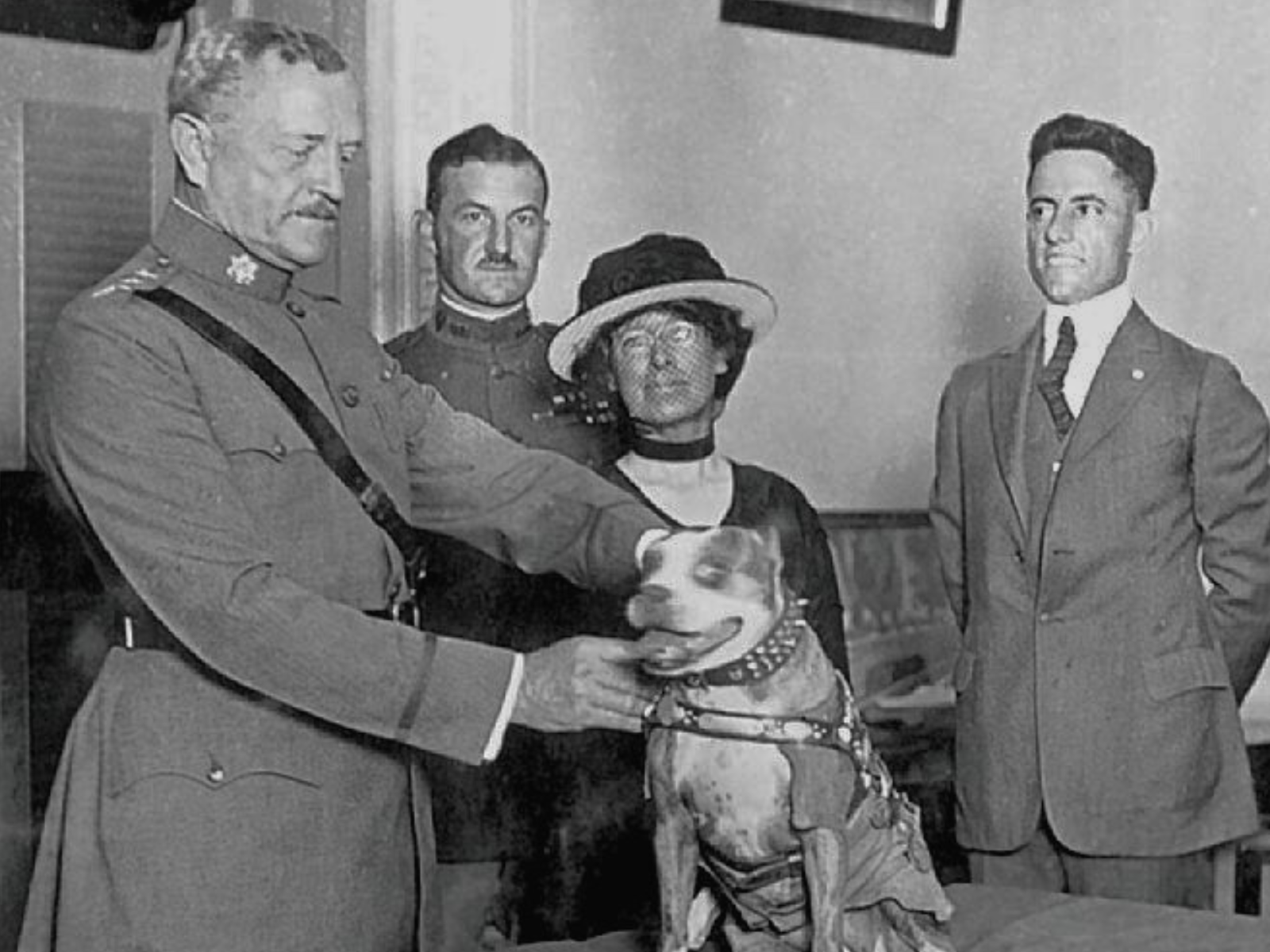
U.S. Army Gen. John Pershing, who commanded U.S. forces in World War I, awards military dog Stubby with a gold medal in 1921. Photo credit: Smithsonian Institution’s National Museum of American History.
Stubby, Chips, and Lucca
Dogs are often employed in military situations, including combat zones, for patrolling, scouting, sniffing out explosives, finding hidden traps, tracking combatants, searching for injured troops, and other tasks.
According to military histories, in World War I, a U.S. soldier’s dog, Stubby, alerted soldiers to gas attacks and even helped capture a German spy, and was given the honorary rank of sergeant. In World War II, during the Allied invasion of Sicily in 1943, a dog, Chips, attacked an enemy machine gun team firing at soldiers in his platoon. He sustained a scalp wound but was credited with saving the lives of his human teammates.
More recently, another dog, Lucca, was deployed with the U.S. Marine Corps to Iraq and Afghanistan over a six-year span, going on nearly 400 patrols and sniffing out about 40 improvised explosive devices before she lost a leg when a device detonated.
Currently, there are about 1,600 trained dogs working in the U.S. armed forces, procured either from breeders or born and trained at the military’s own breeding program at Joint Base San Antonio. Many of these “military working dogs” are Belgian Malinois, known for their high energy, speed, agility, drive, sniffing ability, and trainability.
There are also thousands of “operational canines” in civilian service in the U.S., assisting police and search-and-rescue teams. Like military working dogs, they are at risk of severe injury as they work alongside humans in dangerous settings.
Force multiplier
Hall says military and civilian working dogs are “a force multiplier” for their human partners. “Frequently they’re closer to the line of where harm can happen, because they are sent out first, because of their seeking abilities, their bomb sniffing, etc.”
There have been case reports that TXA has already been used experimentally “as a last resort” to control bleeding among humans in battle zones, Hendry-Hofer says. “So that’s an area that has linked us together. Can we take some of that military use experience with TXA, apply it to veterinary medicine, and work toward getting FDA approval for intramuscular TXA for trauma?”
CU Anschutz and CSU researchers have additional collaborative projects in the pipeline, including a veterinary version of a human training course on advanced trauma life support and a comparison of metabolic changes between dogs and humans across various levels of injuries that might inform future cross-species research.