

Groundbreaking research into recessive dystrophic epidermolysis bullosa (RDEB), a devastating, inherited skin disorder, began with planning, grit, and the commitment of a handful of scientists and clinicians at the University of Colorado Anschutz. RDEB, the most severe form of epidermolysis bullosa (EB), is caused by a mutation that disrupts the body's ability to make collagen, an essential protein that acts like glue, holding skin layers together. Research into the mutation began over a decade ago at the Gates Center for Regenerative Medicine – the forerunner of Gates Institute – and has been presented in an academic paper written by lead author Emily Warshauer, MD, published in September in the Journal of Medical Genetics. CU Anschutz collaborators include Dennis Roop, PhD, Ganna (Anya) Bilousova, PhD, and Igor Kogut, PhD, from the Gates Institute, along with Anna Bruckner, MD, and David Norris, MD, from the Department of Dermatology. Paul Maier, PhD, a population geneticist, made extensive contributions as second author on the paper.
Specifically, the paper shows that 85% of individuals with RDEB carrying the unique c.6527insC mutation were found to have Sephardic ancestry. This is an insight that illuminates not just advances in genetic research, but what is possible when world-class research infrastructure is coupled with translational vision.
The question that led to a global collaboration
The project began in earnest in 2016, when clinical curiosity merged with historical insight in a CU Anschutz dermatology lab. The initial spark came from conversations between Roop, associate director of the Gates Institute, and the late Stephen Berman, MD, founder of the EB Center of Excellence at Children’s Hospital Colorado. (Watch a video of Berman and Bruckner discussing EB patient experience below.)
They had been discussing EB patients from the San Luis Valley in southern Colorado, a region known for recessive diseases in individuals with a history of crypto-Jewish ancestry -- a term that refers to Spanish and Portuguese Jews who formally converted to Catholicism to escape persecution during the Spanish Inquisition in the 15th century. Berman speculated that these Colorado patients might have the same rare genetic variant found in patients from Spain and countries tied to the historical Sephardic Jewish migration. If true, it would suggest a “founder effect” where a genetic change is passed down through generations in a small population with limited genetic variation.
When Roop asked Warshauer, then a resident in the dermatology department, if she wanted to collaborate and spearhead the research into unique RDEB populations sharing this intriguing Jewish history, the answer was an immediate yes.
DNA samples from RDEB patients were collected from North America, South America, and Europe, creating the largest known cohort for a single RDEB mutation. The project’s challenges ranged from complex international regulations for sample collection from RDEB patients to the logistical hurdles of global collaborations and genuine, cultural sensitivity needed to build trust.
From the beginning, collaborations played a pivotal role in the project.
“Dr. Roop, Dr. Bilousova, and Dr. Kogut, all involved in ongoing research exploring EB treatments and potential cures at the Gates Institute, were consistently generous with their time and expertise, addressing challenges together, brainstorming possible solutions, and helping navigate hurdles,” said Warshauer, a dermatologist who is now in private practice with her father, Bruce L. Warshauer, MD. “It truly felt like the best possible place to do meaningful, groundbreaking research.”
.png?width=800&height=400&name=Untitled%20design%20(6).png)
(Left) Lead author Emily Warshauer, MD, and collaborator Dennis Roop, PhD, at CU Anschutz, collaborating for groundbreaking research uncovering Sephardic ancestry links in a rare RDEB founder mutation. (Right) Emily Warshauer, MD, presents her Journal of Medical Genetics work on the c.6527insC RDEB founder mutation, highlighting how global collaboration can transform care for patients with epidermolysis bullosa.
Hope for ‘Butterfly Children’
“RDEB patients face profound pain and fragility yet demonstrate enormous and inspiring resilience,” Warshauer said.
Without enough healthy collagen, a hallmark of RDEB, the skin becomes fragile and blisters or breaks with even minor bumps or friction. Patients with RDEB are often called "butterfly children" for the fragility of their skin. They often develop blisters not just on the skin, but also inside the mouth and throat, leading to trouble eating and swallowing. As wounds heal, thick scars develop and may even fuse the fingers or toes together, causing limited movement and “mitten” deformities. Over time, constant injuries may result in hair loss, nail problems, anemia, difficulty with nutrition, and a higher risk for skin infections and skin cancer. Therapeutic options have been limited to addressing symptoms. Many patients do not survive into adulthood.
The research is important because it will help subpopulations with the mutation be identified for tailored therapies, said Roop.
“Importantly, the ability to leverage the global registry of patients who all share the same unique founder mutation – achieved through Dr. Warshauer’s and others’ research – has transformed our design of future clinical trials,” said Roop. “Future, larger trials could then recruit from this much larger global cohort of individuals with the same mutation.”
Much of the research at Gates Institute has focused on using induced pluripotent stem cells (iPSCs), special cells created by taking ordinary adult cells and "reprogramming" them back into a youthful, stem cell-like state. This transformation allows iPSCs to turn into almost any cell type in the body, including healthy skin cells or collagen-producing cells. Investigators can now use iPSCs from patients to grow new, healthy skin tissue or test personalized treatments, since these cells carry the patient’s exact genetic makeup, reducing the risk of rejection.
The Gates Institute’s “bench-to-bedside” model will be crucial to bring scientific discovery, biomanufacturing, and patient care together at CU Anschutz.
“We can develop the science in Gates Institute labs on the CU Anschutz medical campus,” said Roop. “You can then walk it across the street to the Gates Biomanufacturing Facility (GBF), manufacture the product, and then walk it back across the street to the Children’s Hospital Colorado or to the UCHealth University of Colorado Hospital to provide the treatment for patients all on one campus.”
Roop envisions Gates Institute researchers first creating genetically corrected stem cells from RDEB patients in the laboratory. These cells would be brought directly to the GBF, where specialized teams use Good Manufacturing Practice (GMP) protocols to transform the cells into high-quality, clinically ready skin grafts or other advanced therapies. The finished therapies would be returned to the hospital on campus to be used for patient treatment and in cutting-edge clinical trials. This seamless process would not only speed up translation from research to patient care but also ensure the highest standards of safety and compliance.
In addition, the Institute’s model for cell therapy development, transitioning from short-lived cell sheets to cryopreserved cell populations, allows samples to be shipped worldwide, supports flexible and scalable manufacturing, and enables alignment between academic research and commercial objectives.
The Gates Institute, in supporting both the dreamers and the doers, is working toward making the improbable possible and, in doing so, setting a new gold standard for patient-centered, translational academic medicine.
“The journey may not be easy,” Warshauer said. “But teamwork, perseverance, and a positive spirit to embrace each and every challenge makes the process that much more meaningful. With profound gratitude for the Gates Institute and all of our colleagues around the world who have made contributions, this significant project reminds us that if you work hard enough together to achieve your goals, anything is within the realm of possibility.”
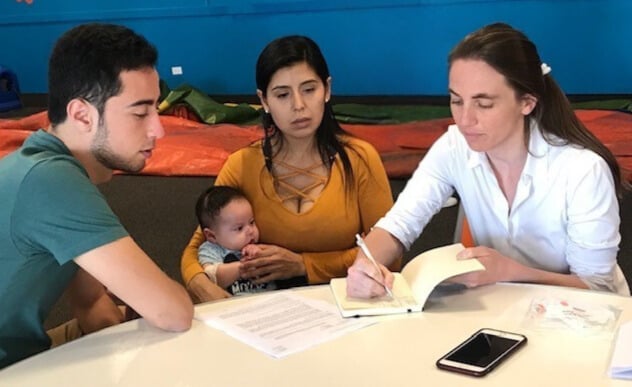
Top photo: Emily Warshauer, MD, met with parents of a young patient with epidermolysis bullosa during a research trip to Monterrey, Mexico, in 2018.
.png)
.png)
-1.png)
.png)