<img height="1" width="1" style="display:none" src="https://www.facebook.com/tr?id=799546403794687&amp;ev=PageView&amp;noscript=1">

Fellowship Helps Support Next Generation of Scientists

Four Students Named NSF GRFP Fellows

minute read

by Kristin Goosen, MS | May 20, 2026
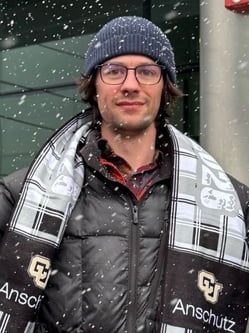
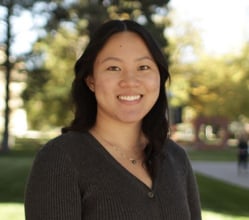
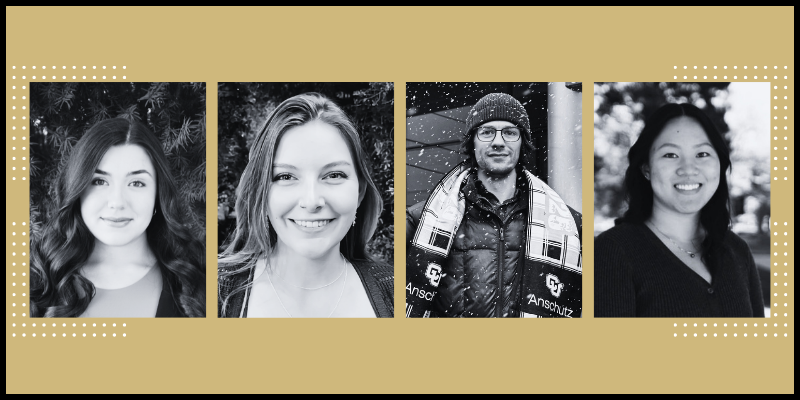
Headshots of the four GRFP fellows: Emily Ekstrum of the Computational Bioscience program, Colette Hopkins of the Cell Biology, Stem Cells and Development program; Robert Kidd of the Molecular Biology program, and Elizabeth Ung of the Cell Biology, Stem Cells and Development program.

Supporting the next generation of scientists has long been the goal of the National Science Foundation’s (NSF) Graduate Research Fellowship Program (GRFP). Since 1952, it has rewarded students in STEM fields who show exceptional promise to make a real impact through their research pursuits. This year, four University of Colorado Anschutz doctoral students have been named fellows of the prestigious program.

The fellows are Emily Ekstrum of the Computational Bioscience program, Colette Hopkins of the Cell Biology, Stem Cells and Development program; Robert Kidd of the Molecular Biology program, and Elizabeth Ung of the Cell Biology, Stem Cells and Development program. More information and a brief Q&A with each awardee can be found below. 

These early-career students will each receive three years of support over a five-year fellowship period, including a stipend and Cost of Education allowance payment to cover tuition and fees.

“It’s really supporting people as they’re transitioning to this graduate training. It’s hitting at a time where there’s a lot of enthusiasm but maybe under-formed ideas,” Dr. Jeffrey Moore, associate professor and director of the Cell Biology, Stem Cells and Development program; said. “It’s an encouragement for that raw enthusiasm and potential.”

The application was open to students who have completed less than one academic year in a graduate degree program, a new requirement that meant second-year doctoral students were no longer eligible to apply as in previous years.

There were 2,500 awardees chosen from over 14,000 applicants nationwide according to NSF. They represent disciplines ranging from economics to biological sciences and everything in between.

“This is really an incredible accomplishment and victory,” Moore said. “We came back strong and I think that’s great. The eligibility requirements were rewritten two months before proposals were due. Rather than stepping back, we had a lot of students step up. It’s just an incredible accomplishment, not only by the folks who got these awards but by everybody who even got these submitted in the first place.”

To support students in preparing strong applications, the Graduate School hosts an information session and workshop each fall facilitated by Moore. Two of the CU Anschutz awardees, Ekstrum and Kidd, participated in the workshop.

The application structure is different than the traditional grant writing students are trained to do and adds in a broader impact emphasis that is a unique aspect of the fellowship. Applicants are asked to think about how important their work and activities can be to society.

“It motivates students to think about things that they do away from the bench like mentoring, like science communication, like getting out and really interacting with people who are not in their lab or in their graduate program, and trying to bring science to them,” Moore said. “This [fellowship] is NSF saying this is important. And I think for a lot of students, whether they get the GRFP funded or not, that's a great motivation to say these things may be part of your core values and why you want to be a scientist.”

Asking students to think about these big concepts so early in their graduate education, though, can be as daunting as it is rewarding and beneficial for professional development.

The first part of the hosted workshop focuses on teaching students to focus on their core questions and the broad importance of those questions for society. It’s how their science fits into the grand scheme of things and how they write about that.

Past CU Anschutz awardees will then share their successful proposals with workshop attendees, letting them see what they actually look like. These proposals come from a variety of programs on campus and showcase that there is more than one way to be successful.

Attendees are then welcome to submit their draft proposals by a certain date to ensure time for review and finalization before the NSF application deadline. Reviewers can be faculty, postdocs, or even upper-level students.

“The heroes in this program are the reviewers who, in a pretty tight timeline, read these documents and give feedback back to the applicants. It's a really nice team effort, and I think that has made a big difference and made this not only a more approachable fellowship application for students but improved our success,” Moore said.

He and the Graduate School plan to host another workshop for prospective applicants this fall. The workshop is always looking for additional reviewers, and those who are interested in volunteering their time may reach out directly to Moore.
2026 CU Anschutz GRFP Fellows

Headshot_Ekstrum

Emily Ekstrum
BS in Biology from Creighton University

CU Anschutz Program
Computational Bioscience

What got you interested in pursuing research?
My high school biology teacher! He shared some of his research related to cardiac vascular repair in response to heart attacks, which lead me to shadow PhD students, join a research lab during my undergraduate education, and pursue a PhD.

Why did you choose to continue your education at CU Anschutz?
I find the students here to be genuinely curious, not only about their own work, but also others’ work. I believe this creates a strong sense of community at CU Anschutz, which was a major factor that drew me here.

What are your current research goals? 
Currently, I am interested in modeling brain activity using a computational approach to investigate neural circuit recruitment patterns across time and space. Beyond my PhD training, I would like to work somewhere within the interface between science and business!

What was your reaction to finding out you were named a GRFP Fellow?
At first, disbelief! Also, very excited.


Colette HopkinsColette Hopkins
B.A. in Biology from Metropolitan State University of Denver

CU Anschutz Program
Cells, Stem Cells and Development

What got you interested in pursuing research?
When I was in college, I worked in a genetics lab on projects related to snail conservation and the evolution of monogamy, using fish as a model. I had originally entered my degree interested in ecology, not cells.   Working on these projects sparked my curiosity and fascination around genetics. Once I saw the world through that lens, I could never go back. Unexpectedly, I found my place in the lab rather than the field.  

Why did you choose to continue your education at CU Anschutz? 
I worked at CU Anschutz as a lab technician for three years before grad school, during which I absolutely fell in love with the community. Not only is CU Anschutz a world class research institution, but it is also a second home for me. I knew that in coming here, I would acquire the training and skills to succeed after my degree while being surrounded by the best group of people. 

What are your current research goals?  
My biggest goal right now is to finish my first first-author paper. While I was a technician, I started a project from scrap, and now I have the opportunity to develop it into my thesis project. I can't wait to work on it again and take it across the finish line. 


What was your reaction to finding out you were named a GRFP Fellow?  
When I found out I was awarded the GRFP, I screamed so loud my spouse thought a serious medical emergency was underway. I couldn't believe it and felt weak in the knees for hours. I immediately called my mentor and lab members who had supported me in writing it. It took several days for it to really settle in that it was real. I am grateful to the village of people who rallied around me both in writing the grant and celebrating it.

Robert Kidd

Robert Kidd
McGill University (class of 2021), Honours Microbiology and Immunology

CU Anschutz Program
Molecular Biology Doctoral program

What got you interested in pursuing research?
My parents were both lawyers and they told me not to be a lawyer.

Why did you choose to continue your education at CU Anschutz?
Really excited by the research here plus the opportunity to live in Colorado!

What are your current research goals?
I have just joined Dr. Olivia Rissland’s lab where I will be working on the mysterious 2A peptide, a viral replication strategy that enables the production of two different proteins from one mRNA molecule via a translational skipping mechanism. I am interested in exploring its mechanism of action, applications, and ways to engineer it.

What was your reaction to finding out you were named a GRFP Fellow?
Shock followed by yelling. I was alone at home at the time so immediately called my mom to share the news. Then I yelled some more.

ElizabethUng headshot

Elizabeth Ung
B.A. in Molecular, Cellular, and Developmental Biology from University of Colorado Boulder

CU Anschutz Program
Cell Biology, Stem Cells, and Development

What got you interested in pursuing research?
I became interested in pursuing research in undergrad when I learned about the molecular and cellular processes of the body and seeing that professors are dedicated to pursing the unknowns of science. I was inspired and excited at the thought of being a part of the group of scientists exploring those unknowns, taking me beyond what my professors had taught me in class. I was sitting in one of my classes learning about motor neurons and I was amazed at how they work so quickly so I can write my notes and cross my legs - it led me to joining my undergraduate research lab.

Why did you choose to continue your education at CU Anschutz?  
I chose to continue my education at CU Anschutz because of the environment and breadth of research being conducted on campus. The CSD program has so many faculty conducting really interesting research, and I was drawn to how strong the developmental biology field is here. Additionally, the CSD program is extremely welcoming and has a strong sense of community. I knew that being on the campus and in the program was where I was going to receive the training and growth I wanted to experience in this time.

What are your current research goals
My current research goals lie in developmental neurobiology and the cellular crosstalk that occurs in development. In joining my thesis lab, I will focus on the meninges, the supportive and protective structure surrounding the brain, and its associated cell types.

What was your reaction to finding out you were named a GRFP Fellow?  
I couldn’t believe it. I had to re-read the email multiple times and even set my phone down for a couple of hours before re-reading it a few more times. After processing the news, I was so grateful and honored that I could go into graduate school with this fellowship in such a crucial time for funding.  

Topics: Stories