For most of Jaime Belkind-Gerson’s career in medicine, he was keeping a secret.
As a trainee in Boston in the ’90s, the pediatric neuro-gastroenterologist, now a professor of pediatrics at the University of Colorado Anschutz School of Medicine, would keep small canvases, paint, and brushes in his backpack. While he was waiting on lab results to return for his patients, he’d lock himself away in a break room and practice his other passion, art.
Belkind-Gerson feared he would face judgment and criticism from colleagues that he could be doing more with the time he spent painting away from medicine.
“I was so scared I’d be found out,” Belkind-Gerson, MD, MsC, recalls of those early days. “If I had even the smallest bit of paint under my fingernails, I was scrubbing them so there’d be no trace of my double life.”
Keeping his art under wraps was easy to do, but it was harder to keep his passion quiet.
Even when life at the hospital got hectic and Belkind-Gerson stepped away from his art, it would call him back. “The art has to come out eventually,” he says.
Now, Belkind-Gerson doesn’t have to hide. He has an online presence for his artwork, and he’s surrounded by supportive colleagues who see the value in him pursuing his creative passion. After so many years of keeping his two lives separate, they’ve finally blended together.
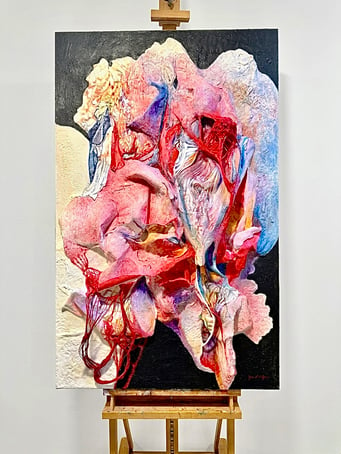
“Flower” is a mixed media work featuring lots of texture. Bodies or body parts make up the petals of the flower. Photos courtesy of Jaime Belkind-Gerson, MD, MSc.
Belkind-Gerson’s work has been featured in more than 30 art exhibitions, including last year’s “Migrants: A Tale of Two Hearts” at the Museo De Las Americas in Denver, and now is the subject of a documentary of the same name, directed by Colorado filmmaker Trevr Merchant.
The film “A Tale of Two Hearts” chronicles Belkind-Gerson’s personal journey to bridge science and art despite the pressure and anxiety that often existed between the two.
“My goal was to make a quiet, intimate film that reflects that same tension, showing how art can make the invisible parts of our lives visible,” Merchant says in his director’s statement.
The immigrant experience
Raised by his maternal grandparents who had immigrated to Mexico City from Poland in the 1930s because Ellis Island in New York had stopped accepting newcomers, Belkind-Gerson suspected it would be heartbreaking for them if he pursued art as a career.
“So, I did the second-best thing I could think of,” he says. “I became a doctor.”
After attending medical school in Mexico, Belkind-Gerson took his training to the U.S. Later, he’d return to Mexico with his wife, who he met in Boston, and their children. For more than a decade, he worked as a physician there, until gang violence sent the family fleeing for safety, again to the U.S. east coast.
While most of the physician’s art represents the human body in some form, he also leans into his experience as an immigrant.
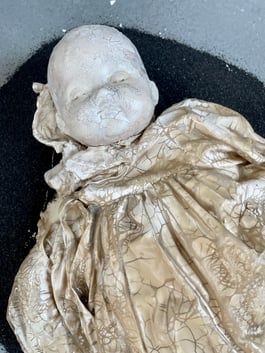
"Hope" — part of an installation about immigrants exhibited at the Museo De Las Americas in Denver — is a doll treated with porcelain, resin oil, and acrylic paint.
In the exhibition “Migrants: Tale of Two Hearts,” Belkind-Gerson turned items left behind near the U.S-Mexico border into sculptures. His art pieces included dolls, pieces of found clothing embedded with memories, such as a wedding dress and intimate apparel, and furniture such as a baby chair, a school desk and children’s toys all dipped in porcelain and resin, fossilizing their existence.
“I put a lot of focus on the ‘saying goodbye’ aspect of migration because you do leave a lot behind,” he says of the pieces in the show.
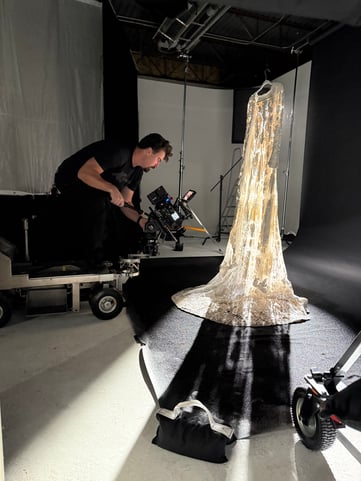
Filming of the "Tale of Two Hearts" documentary.
‘It’s made me a better doctor’
A job offer at Children’s Hospital Colorado brought Belkind-Gerson and his family to Colorado, where he sees young patients who are desperate for answers about gastrointestinal issues. As a neuro-gastroenterologist, Belkind-Gerson specializes in the brain-gut connection.
While the work is challenging and rewarding, it can also take a mental toll, Belkind-Gerson says. Art helps.
“Sometimes my patients have seen multiple other specialists, and they get to me after everything else has failed,” he says. “When it’s difficult for my patients, it can also be difficult for me.”
As a visual artist, Belkind-Gerson sees the beauty in medicine and especially the human body, which is often at the center of his artwork. He describes the body as the “perfect machine,” but it's also ever-changing and susceptible to injury and illness.
In his most recent art pieces, he reimagines the human anatomy in metalwork, adapting machinery metal parts he finds and transforms to look reminiscent of human organs and bodies.
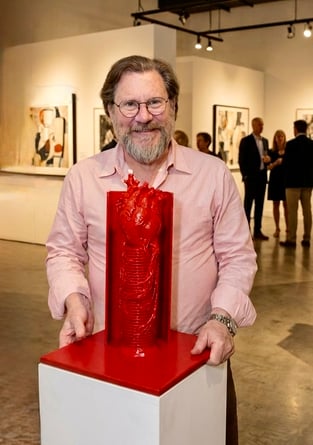
"Heart of Steel" combines welded steel, ceramic, and enamel into a 35-inch sculpture.
Human form has always been a focus of art, he says, but for most of history artists have concentrated on the outside of the body, Belkind-Gerson likes focusing on the inside.
“I think it’s made me a better doctor,” Belkind-Gerson says of his art. “It makes me happier and more whole.”
His young patients seem to like it, too. Some have admired the art and asked Belkind-Gerson if it's their stomach he painted on the canvas.
“I tell them, ‘Well, it’s not literally your stomach, but I was thinking about your stomach a lot when I painted it because I want you to feel better,’” he says. “It’s therapeutic for me to have this outlet and what I care about so much is helping my patients. It comes out in the art.”
See the film: A screening of "Tale of Two Hearts" will take place at Children’s Hospital Colorado Conference Center Thursday, August 20, from 3–5 p.m. in the Mt. Oxford room with a Q/A featuring Jamie Belkind-Gerson, MD, MSc, afterward. Register for the event here.
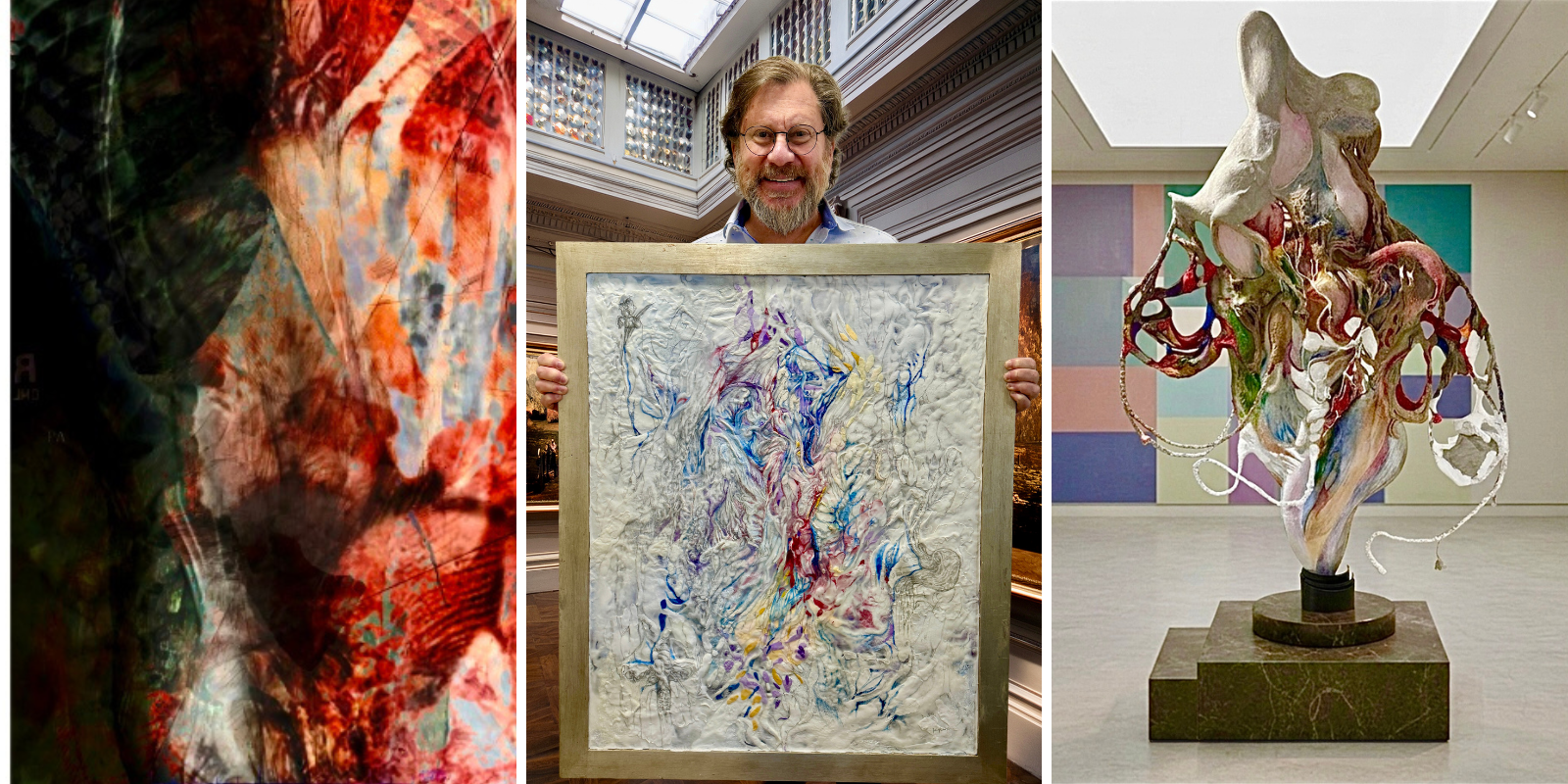
Photos above: Left: “Changes” is a mixed media on canvas painting that originated from body CT scans and X-rays; center: Belkind-Gerson poses with a piece of art; right: "Gaia" is a 7-foot tall mixed media piece.