

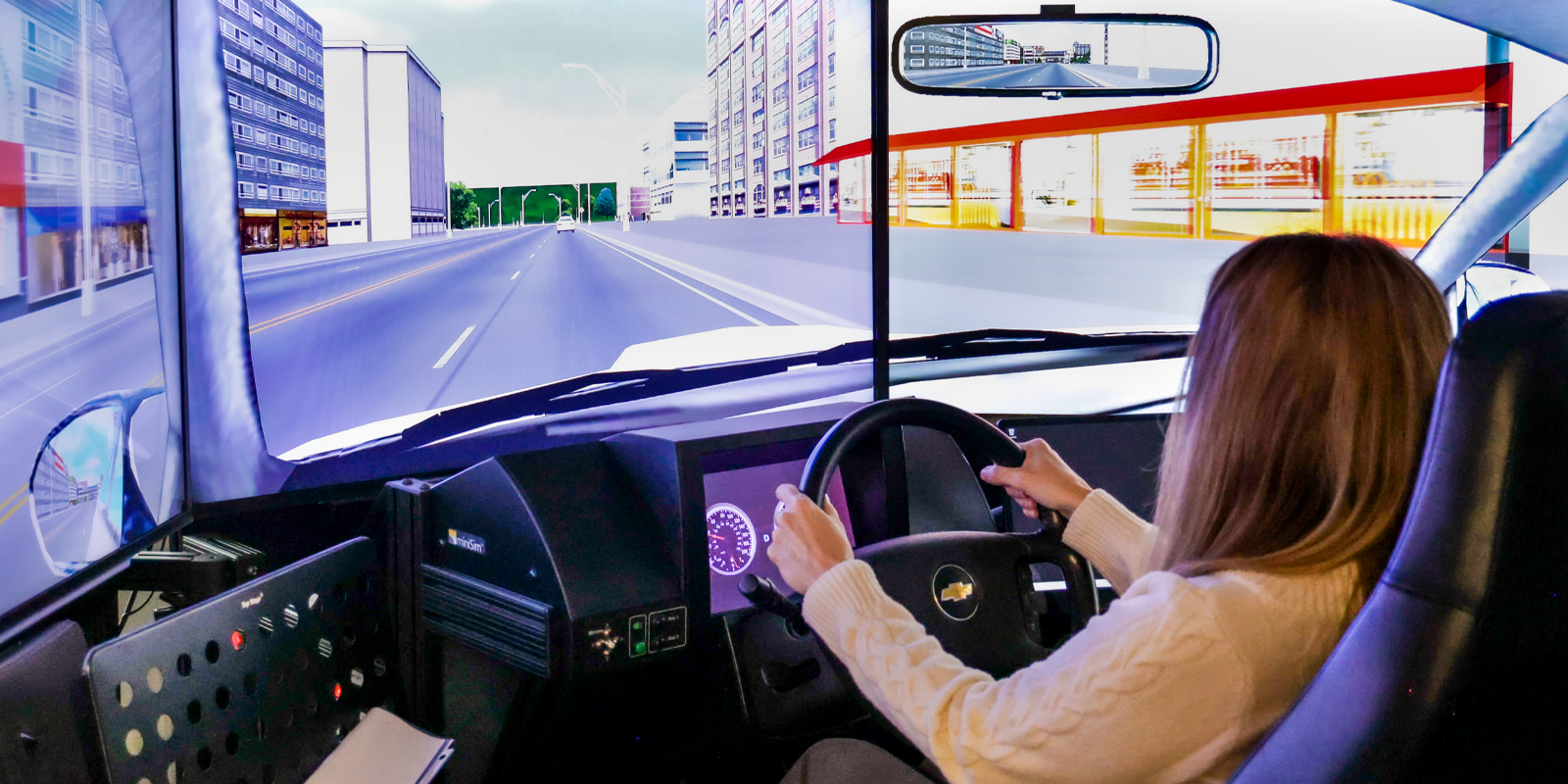
Researchers at the Colorado School of Public Health (CSPH) are studying how cannabis use affects driving performance. Using a “video game-like” simulator, they measure how people drive before and after consuming cannabis.
Ashley Brooks-Russell, PhD, MPH, associate professor at CSPH, studies how cannabis use affects a person’s ability to safely operate a vehicle – specifically products containing tetrahydrocannabinol (THC). THC is the primary psychoactive compound in cannabis that can affect perception, coordination and reaction time.
About one in five Coloradans report using cannabis in the past 30 days, and roughly half of those individuals use cannabis daily.
How does cannabis affect older adults? CSPH is seeking healthy adults ages 65–89 who drive and have used cannabis at least once a month for the past two months to participate in a new study. Learn more.
Considering this 2024 data from the Colorado Department of Public Health, cannabis use is contributing to risk on the road:
- 16.3% of Colorado drivers who used cannabis in the past 30 days reported driving within two to three hours of use.
- 45 people died due to an at-fault driver being impaired by cannabis.
- The rates of combined drug and alcohol fatalities have increased since 2017, from 26% to 32%.
“Given that a substantial part of the population is using cannabis, we should have concerns about road safety,” Brooks-Russell said.
Cannabis doesn’t affect drivers the same way alcohol does.
“Alcohol-impaired drivers tend to be aggressive,” she said. “We don’t see that same pattern with cannabis drivers, but even so, cannabis use can still increase risk.”
Key points:
Cannabis use was associated with changes in driving performance, especially in lane-control measures like weaving and lane departures.
Inhaled cannabis showed smaller and less consistent changes in driving behavior compared to edibles.
Edible cannabis led to more noticeable impairment, including slower speeds and increased lane variability and departures.
Occasional use was associated with greater impairment than daily use, suggesting tolerance plays a role.
Differences in driving performance became more pronounced at higher speeds, where maintaining lane position was more difficult.
How inhaled cannabis and edibles affect the body
Brooks-Russell’s team has conducted studies on different forms of cannabis, including inhaled products and edibles. Inhaled cannabis, such as smoked “flower” and concentrates like vape oils, tends to produce effects almost immediately.
Edibles are metabolized differently.
“Edibles are processed through the digestive system, so the onset is slower, and the effects last longer,” Brooks-Russell said.
The delayed effects can introduce additional risks. When people don’t feel impaired right away, they may consume more than intended or may begin to drive before the effects kick in. Impairment from edibles can last several hours.
Brooks-Russell's research was also designed with the understanding that people can develop a tolerance to cannabis. In each study, researchers examined three groups: a control group that had not used cannabis in the past 30 days; an “occasional” group that used at least twice per month but fewer than three times per week; and a “daily” group of people who use cannabis every day.
Participants in the occasional and daily groups used their own cannabis at the doses they typically consume.
“We didn’t tell people what to use because there’s a really big continuum of how people use and how they respond to that dosage,” Brooks-Russell said, explaining that they wanted these studies to reflect how people use cannabis outside of the lab.
Creating a 'real world' environment in a driving simulator
Participants got behind the wheel of a driving simulator equipped with everything you’d find in a real car – from the steering wheel to the pedals and dashboard. A large touchscreen, similar to those found in newer vehicles, allows for music to play and text messages to come through. Three oversized monitors provide 180 degrees of visual coverage to create a realistic, immersive driving environment.
The drives started in an urban setting, with traffic lights, a 35-mile-per-hour speed limit, and other drivers. After about 10 minutes, the drive shifts to a rural two-lane divided highway with higher speeds.
There are no “gotcha” moments, but drivers must monitor their surroundings, which include merging vehicles, changing conditions and typical roadway activity. They are also instructed to use the touchscreen to change the radio station and field text messages.
Each participant took the wheel for a baseline, sober drive. After consuming cannabis, they took two additional drives.
Risky behaviors emerge, particularly for people who use 'occasionally'
The researchers looked at specific indicators of risky driving. One key measure is lane position or “weaving.” This reflects how well a driver maintains their position within a lane and is measured using the standard deviation of lane position – a common metric in driving research.
They also tracked lane departures, or how often a vehicle crosses lane lines. While crashes are rare and difficult to simulate realistically, these measures serve as strong proxies for crash risk.
“You can’t really study crashes in a simulator as they’re rare events,” Brooks-Russell said. “So we focus on behaviors that are clearly linked to increased risk, like leaving your lane.”
The inhaled cannabis cohort had limited changes in their behaviors. The occasional group showed some increase in lane departures, while the daily group exhibited little decline in performance.
The drivers consuming edibles demonstrated reduced speed and increased lane weaving and departures.
“It’s simply more challenging to maintain performance when you’re going faster,” she said. “At those higher speeds, we tend to see more pronounced differences.”
Again, the occasional use group was more impaired than the daily use group, showing the role tolerance plays.
Overall, driving impairment was relatively modest across inhaled cannabis groups, but the delayed and longer-lasting effects of edibles highlight a greater concern for road safety and the need for clearer public awareness.
Studying the impact of cannabis on driving as people age
CSPH Professor Carolyn DiGuiseppi, PhD, MD, MPH, is currently studying older adults to learn how cannabis use impacts the driving behaviors of people 65 and older.
“We’re specifically looking at people who don’t have dementia but may have some mild cognitive decline that can be a normal part of aging,” said DiGuiseppi. Her team is also studying older drivers without any declines in thinking and memory, to see if these two groups differ when it comes to effects of cannabis.
The aim is to learn how cannabis use in older adults, whose use of cannabis has grown in recent years, affects their driving. It’s a harder population to recruit as conditions and medications may require exclusion from the study, but DiGuiseppi said it’s important.
“Whether they are using cannabis medicinally or recreationally, we need to know the risks,” DiGuiseppi said.
Clear guidelines for cannabis impairment are still lacking, and unlike alcohol, there is no widely accepted roadside test to measure it. As cannabis use becomes more common and more socially accepted, understanding its impact on driving is increasingly important. It also makes personal decision-making even more critical, Brooks-Russell said.
“We each have a responsibility to drive safely. If you feel impaired, you shouldn’t drive,” she said.


%20(1).png)

.jpg)