

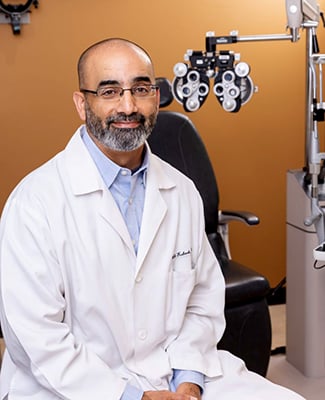
Over a decade ago, Malik Y. Kahook, MD, spotted a problem: The adherence rate of glaucoma patients using eye-drop medication to treat their condition was an abysmal 50%. He wondered if the drug could be delivered from inside the eye without the patient having to do anything.
That idea kicked off a journey of invention for Kahook, professor of ophthalmology and the Slater Family Endowed Chair in Ophthalmology at the CU Anschutz School of Medicine, and his team at the Sue Anschutz-Rodgers Eye Center.
Their breakthrough solution was the Bimatoprost Drug Pad-IOL (BIM-IOL) System, which is now in Phase 3 clinical trials and moving closer to U.S. Food and Drug Administration (FDA) approval. In 2019, the innovation was spun off to become SpyGlass Pharma, Inc., which, through the BIM-IOL System, provides sustained drug delivery for the care of chronic eye disease, including glaucoma, the world’s leading cause of irreversible blindness.
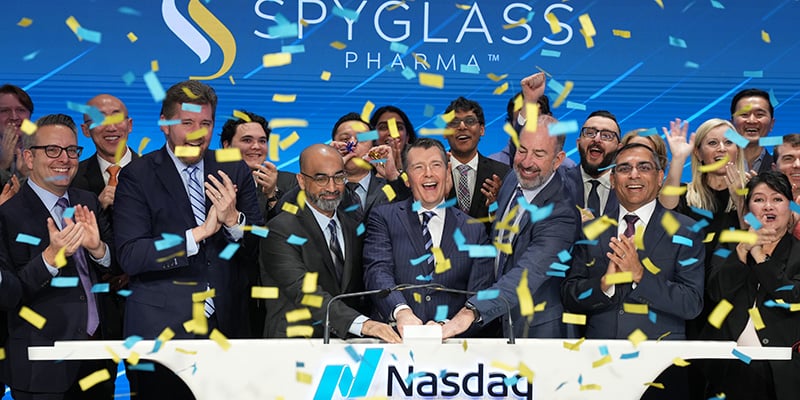
Ringing the bell on Wall Street
The company, which collaborated with CU Anschutz Innovations throughout its development, reached a milestone on Feb. 6 when it went public and joined the Nasdaq composite. “We found out the day before that we were ringing the (opening) bell,” Kahook said. “It was an extraordinary moment to both celebrate how far the idea has come and to propel its development forward.”
Key points:
- SpyGlass Pharma, Inc., co-founded by CU Anschutz ophthalmologist Malik Y. Kahook, MD, went public on Feb. 6 when it joined the Nasdaq composite under the ticker symbol SGP. The company spun off from CU Anschutz in 2019.
- The SpyGlass drug delivery system integrates lasting delivery of glaucoma medication with an intraocular lens that is implanted during routine cataract surgery.
- CU Anschutz Innovations has collaborated with Kahook and SpyGlass at every step, including patents, IP protection, potential external partners and the complex processes of negotiating licensing agreements and tapping venture capital funding.
While that was a momentous occasion, Kahook, also the inventor behind the Kahook Dual Blade, one of the most commonly used surgical tools for glaucoma treatment globally, gets the most satisfaction from the end result of his team’s innovations – improved patient outcomes.
Solution for an unmet patient need
Glaucoma is treated, he said, by reducing the intraocular pressure (IOP) on the optic nerve at the back of the eye. The most common treatment is an eye drop that a patient uses up to several times a day.
“The problem with that is that the drops themselves cause a lot of side effects – redness, stinging, burning, decreased vision,” Kahook said. “And the patient, especially early in glaucoma, doesn’t actually recognize that they have an issue because their vision seems OK to them, even though we can do measurements that are quite sensitive to show that it’s not OK.”
Many patients just stop taking the drops, he said, meaning the solution was to take adherence to therapy out of the patient’s hand.
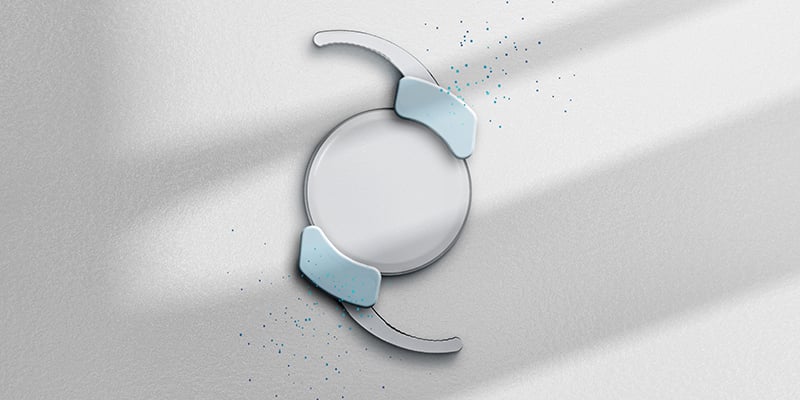
“Seven years ago, we started looking at delivery techniques, different ways to deliver the IOP lowering drug from within the eye to the targeted tissue without the patient having to do anything,” Kahook said. “With our product, we have two drug-delivery pads that are connected to an intraocular lens that goes into the eye after removing a cataract. The pads deliver the IOP lowering drugs for a period of three years. So far in our clinical trials, the overwhelming majority of patients do not have to use a topical drop after implantation of the BIM-IOL system. And after three years, they have options to everything else we do to treat glaucoma.”
Those options include going back on an eye drop, laser therapy or using a next-generation drug-delivery system that SpyGlass has in the works.
Two eye diseases treated at once
Another key advantage of the BIM-IOL System is its seamless integration into regular care for cataracts. Cataract surgery is the most common outpatient surgical procedure in the United States.
“We've had a lot of success in the Department of Ophthalmology with different devices that have spun off campus and products that are leading globally and treating glaucoma and other diseases. A very important part of that is our partnership with CU Anschutz Innovations.”
– Malik Y. Kahook, MD, co-founder of SypGlass Pharma, Inc.
“Out of five million cataract surgery procedures, approximately one million are in eyes with glaucoma,” Kahook said. “Cataracts are the number one cause of reversible blindness. Vision loss is reversible because we can do cataract surgery to restore clear vision by implanting an intraocular lens. Since the roughly one million cataract patients also have glaucoma, or high pressure in the eye, they can then receive our solution for treating both of these diseases at the same time.”
A winning on-campus collaboration
Mary Tapolsky, PhD, director of licensing at CU Anschutz Innovations, has worked closely with Kahook during the BIM-IOL System development journey. She said SpyGlass’s original intellectual property had been established when she began collaborating a few years ago, “but they’re always trying to build out the portfolio, so we’ve been, as we say in the field, building the picket fence around the IP to protect it, to minimize competitor products.”
Kahook said the Sue Anschutz-Rodgers Eye Center enjoys a “direct line” to CU Anschutz Innovations whenever it has questions about patents, IP protection, potential external partners and the complex processes of negotiating licensing agreements and tapping venture capital funding.
“In each phase of the innovation process, they’ve been sitting by our side,” he said. “I’ve been on campus for 20 years, and to watch the evolution of the tech-transfer office to CU Anschutz Innovations, it’s just become so streamlined. They’ve made it very easy for the inventor to know who their point of access is.
“We’ve had a lot of success in the Department of Ophthalmology with different devices that have spun off campus and products that are leading globally and treating glaucoma and other diseases. A very important part of that is our partnership with CU Anschutz Innovations.”
Tapolsky said she holds “a special place in my heart” for the tireless work of Kahook. “I love everything he’s doing,” she said. “I do focus on being responsive, so that Dr. Kahook can go out and create the things he does and help bring them to market.”
Photo at top: In the center, SpyGlass CEO Patrick Mooney rings the bell on Feb. 6, 2026, at the Nasdaq composite. Standing at his right is Malik Y. Kahook, co-founder, president and chief medical officer, and to his left is Glenn Sussman, co-founder and chief technology advisor.


%20(1).png)

.jpg)