

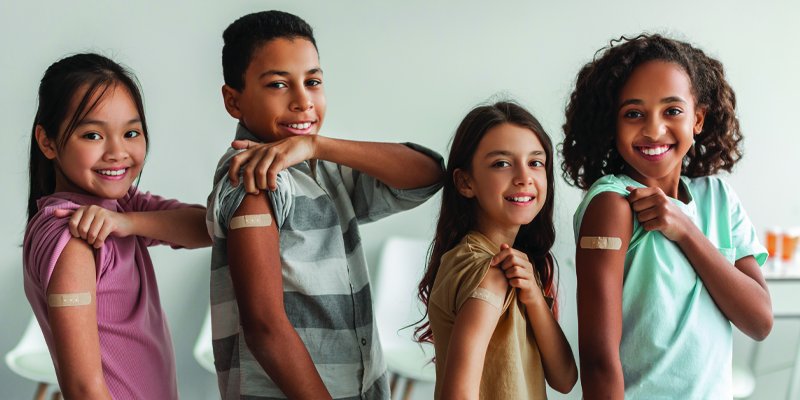
Q: What vaccines should parents consider getting for their children at the beginning of the school year?
The most important thing for parents is to make sure their child or children are up to date on vaccines that are required by schools, which typically include:
- MMR: measles, mumps, and rubella
- TDAP: tetanus, diphtheria, and pertussis (whooping cough)
- Polio
- Varicella: chickenpox
- Meningococcal (meningitis)
- Others
Depending on your child’s age, they may need boosters for those or additional vaccines, like meningococcal (meningitis) or HPV.
Q: Does my child need the flu or a COVID shot?
Now that we’re heading into flu season, that’s another vaccine parents should consider getting for their children. It’s not mandatory in all schools, but we as healthcare professionals encourage children to get it every year.
Children can get the COVID vaccine if they’re eligible [As of June 2025, the Centers for Disease Control recommends the vaccine for people 18 and older. Parents with children should talk to their healthcare provider].
Q: Where can I take my child to get vaccinated?
Your child’s pediatrician or your family’s primary care provider can give vaccines. You can also go to public health departments and some pharmacies.
Community Health Clinic also offers some childhood vaccines, including the MMR, TDAP, polio, varicella, and HPV vaccines. We also offer flu shots for children and adults. We provide vaccines to adults and children ages 3 and up.
Q: How often should my child have vision or screening tests?
Ideally, it should happen every one to two years. Most schools do these tests at least yearly throughout the school year, but if your child is experiencing difficulty seeing the chalkboard in school or hearing, get them screened sooner rather than later.
Q: How can I communicate my child’s health needs to school staff?
Parents should make sure school administrators are aware of any health concerns, including medications. A lot of schools have their own forms for parents to fill out, including authorization forms and asthma/seizure/allergy action plans.
Q: What about physicals?
It’s recommended that a child have a physical every year. If the child is healthy and doesn’t have any concerns, they can probably have one every two years, but only after reaching certain milestones, like walking, talking, puberty, and things like that. So, it’s very child-dependent.
When children get physicals, they get a head-to-toe assessment, including select blood work such as a cholesterol profile. A sports physical is a little different because it makes sure a child can participate in those specific sports activities without any repercussions. Sports physicals are required for children to participate in school-sanctioned sports. They focus on heart and lung function, joint mobility, flexibility, and screenings for underlying conditions and injury risk.
Children can get physicals at a pediatrician’s office, primary care provider, or here at Community Health Clinic.
If a parent has any concerns about their child’s health, don’t wait to take them to a healthcare provider. Screening, including physicals, is a form of prevention. We want to make sure your child is healthy so we can avoid any health issues in the future.


.png)