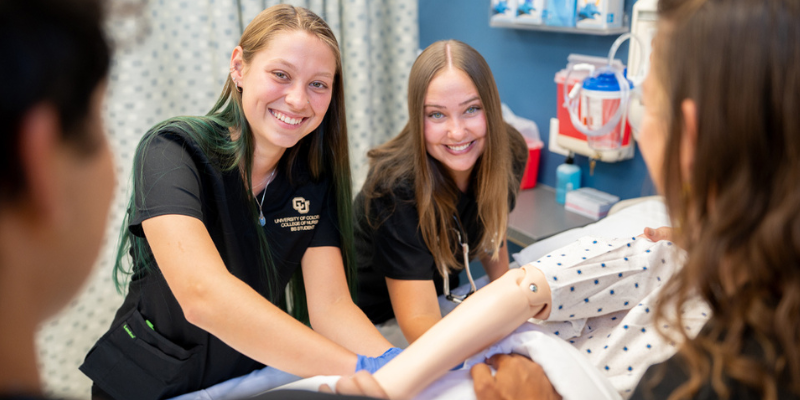

Imagine you are a bedside nurse in a busy hospital. You identify a recurring issue: catheter-related infection. Motivated to improve patient outcomes, you begin exploring strategies to reduce the risk of infection. You share your ideas with your supervisor, and they encourage you to pursue this as a research initiative. Two years later, your efforts lead to a reduction in catheter-related infections on your floor. Your research influenced the standard of care and improved patient outcomes.
A recent publication in the American Journal of Critical Care by Mary Beth Makic, PhD, APRN, CCNS, CCRN, Professor at the University of Colorado College of Nursing at the Anschutz Medical Campus, emphasizes the need for evidence-based practice to guide patient care, and the importance of fostering work environments that encourage nurses to ask questions and present solutions.
What is Evidence-Based Practice?
Evidence-based practice (EBP) is a way of making healthcare decisions that combines three key elements: the latest research findings, a healthcare provider's professional experience, and what matters most to the patient. This approach helps ensure patients receive the most effective care possible. Early in her career, Makic was encouraged by her supervisors and mentors to ask questions and conduct research to drive practice change. Her early experiences and spirit of inquiry fueled her passion for research to advance nursing science and embrace EBP.
Generate Knowledge to Improve Practice
Nurses are uniquely positioned in health care to provide feedback and identify problems in patient care. Some of the barriers to nurse involvement in research include lack of time, resources, support, and opportunities. Makic’s research focus is on understanding ways in which nurses independently influence patient care.
“I have listened to bedside nurses’ questions about practice and sought answers through research or EBP translation,” says Makic in her publication.
Makic progressed in her career from bedside nurse to clinical nurse specialist to hospital-based research nurse scientist. Driven by her mentors to challenge practice norms, she was encouraged to accept leadership roles to influence health care systems.
Fostering a Spirit of Clinical Inquiry
The role of a hospital-based research nurse scientist has evolved over the past 20 years. Today, the role is more defined and understood within the hospital-based environment. Magnet designation of hospitals increased awareness and support for PhD-prepared nurses.
Hospital-based research nurse scientists translate research findings to advance system wide health care improvements. Makic wants to foster an environment in which nurses can provide exceptional care every day and hopes to create a space for nurses and nursing students to seek answers to inform nursing practice.
“Through embracing a spirit of inquiry, we build a stronger body of nursing science supporting practice excellence,” she says.
Applying Evidence-Based Practice
Makic’s research and publications have led to changes in burn wound care, esophageal temperature probe (ETP) monitoring, practices to hospital-acquired conditions, and to the creation of the EBP Champions of Change Committees to build a culture of EBP to guide practice initiatives.
Mentoring Future Nurses
Makic hopes to continue challenging nurses at the bedside to embrace EBP and translate evidence into their daily practice. She notes in her publication that she was encouraged early in her career to share her research so that others can learn from and build on her work.
She hopes to continue to be a mentor to nurses who ask questions and to be a resource to the next generation of nursing scientists.
“Keep asking why and why not,” says Makic. “I truly believe in the power of questions.”