

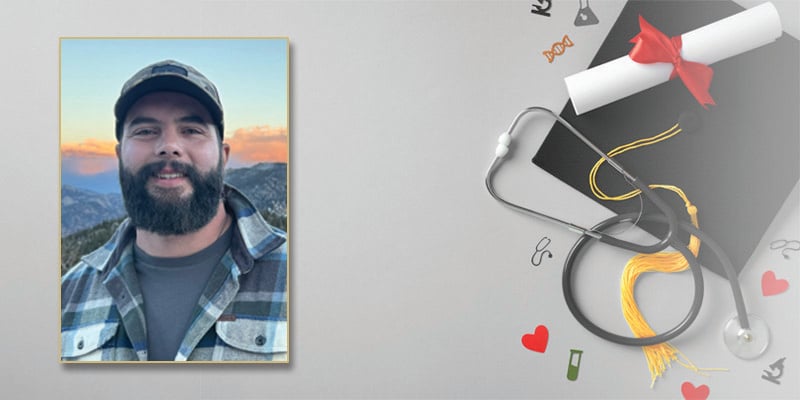
Giuseppe Catanzaro’s path to nursing proves the American Dream is possible.
When Giuseppe Catanzaro became a US citizen in 2017, he was already years into reimagining his future. The medical school path he'd started in Italy had morphed into something different in America—something that would take a global pandemic to fully reveal.
Now, as he prepares to graduate from the University of Colorado Anschutz College of Nursing's accelerated BS in Nursing program, he's living proof that the American Dream isn't just about arrival—it's about transformation.
He acknowledges that "the idea of following your dreams and becoming the person you want to be is more feasible here than in Europe."
“There are so many opportunities here,” he adds. “You can open a business; you can do multiple jobs at the same time.”
For Catanzaro, that opportunity meant the freedom to change course entirely—to walk away from a decade of medical training and choose a different path to patient care.
A New World of Opportunities
Catanzaro came to the US on a spousal visa and earned his bachelor’s and master’s degrees in microbiology in Florida with plans to continue his path to medical school. He was accepted to medical school twice, including in Puerto Rico, but couldn't attend due to the pandemic and other unforeseen life circumstances.
It was during the pandemic when Catanzaro worked as a medical assistant and at a health clinic, where he was able to learn the US healthcare system and the role of nurses.
“In Italy, nurses are seen as assistants to physicians. They’re less able to advocate for their patients in determining the appropriate interventions,” he says. “But in the US, nurses have such an important role in determining the best interventions and advocating for patients. They’re the ones who act quickly and notice changes in patients. They are fundamental in determining positive patient outcomes.”
“I feel incredibly lucky,” he says. “The US offers so many opportunities to grow, specialize, and follow your dreams. Nursing is my vocation.”
Catanzaro realized he wanted to be a nurse after finishing his degree because he wanted to focus on patient care.
“My decision to do nursing was driven by the fact that I consider healthcare to be a vocation and decided that this would be the best way to exercise the vocational aspect of nursing and help people potentially during the most difficult times of their lives,” he says.
His desire to become a nurse led him to CU Anschutz Nursing.
“I was extremely lucky to end up in Colorado because CU Anschutz Nursing is a top university when it comes to nursing,” he says. “The college established the first nurse practitioner program, so there’s a lot of history here.”
Learning in a Fast-Paced Program
Catanzaro says the fast pace of the UCAN program isn’t for everyone, but says he was able to manage school and working part-time teaching LPN nurses at Emily Griffith Technical College in Denver because he found a study method that worked for him.
“The goal of the UCAN program is to let you do the program quickly, but it’s also to wire your brain in a way so you can handle a good amount of work effectively,” he says. “Students need to plan early and make sure they find a good way to study and learn all of this information.”
He also found getting hands-on experience during clinicals was critical, and taking the time to ask questions and say “yes” to every opportunity.
“New students shouldn’t be shy; they need to understand clinicals are their time to learn,” he says. “I created opportunities for myself. There are always opportunities, so make sure you volunteer to do things. If you have the spirit, you’ll learn a lot.”
Pieces of a Puzzle
Catanzaro compares nursing to a puzzle because every patient is different and has different symptoms. He also says it keeps his intellect engaged because nurses are constantly thinking about the best courses of action and intervention for patients.
“I think this is mostly related to the scientific, evidence-based aspect of nursing,” he says. “I also enjoy the fact that nurses rely on their intuition—we have a spider sense and as soon as we see situations that could go negative really fast, we’re able to act quickly and help the patient.”
That intuition, paired with his love of neuroscience and behavioral health, is already shaping his next chapter. After graduation, Catanzaro plans to become a psychiatric mental health nurse practitioner and eventually open his own mental health clinic—an entrepreneurial dream that embodies the opportunities he found in America.
“I think there’s so much growth within mental health,” he says. “If we embrace the scientific aspect of it with brain imaging and brain function, we can help a lot of patients. Behavioral sciences and neurosciences are so fascinating, so working in mental health is a way for me to work in a field I’m interested in.”
From citizenship ceremony to nursing school graduation, Giuseppe Catanzaro's American story is still being written. But each chapter proves what he believed when he arrived twelve years ago: that in America, transformation isn't just possible—it's part of the promise.

.png)