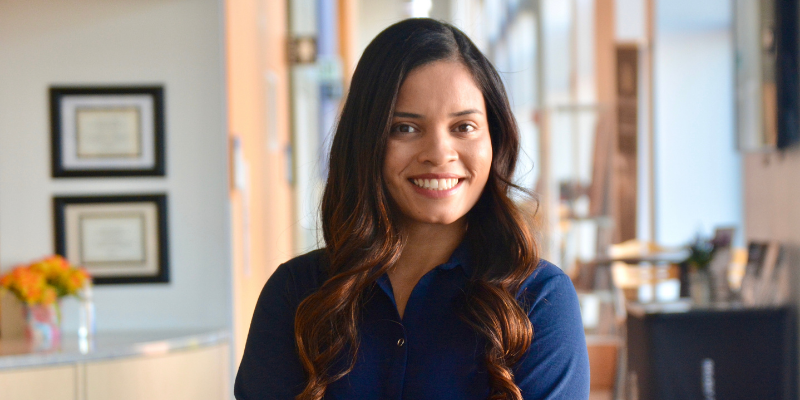
Before Julia McGrath decided to become a nurse, she was planning to be an educator. She completed a bachelor’s degree in education in her home country of Brazil. In her early twenties, she worked at a preschool in Brazil, where she watched a mother fall while holding her child – and saw the child’s leg bend too far.
While other teachers brushed it off, McGrath’s instincts told her something was wrong. She urged the mother to take the child to the hospital, drawing pushback from her colleagues for disagreeing with them. The following week, she learned the child’s leg had broken. She’d been right.
“In moments of a lot of pressure, I was calm. I was able to be calm in emergencies and could help people, especially kids,” she says.
That moment set her on the path to nursing.
“You have to advocate for the patient, even though no one else might believe in you, and you have to go against the tides. So that was one of the things that made me want to come to nursing school,” she says.
McGrath came to the US in 2020 and worked as an au pair with young children. She didn’t plan on staying in the US long-term.
“When I first came to the United States, I originally thought it was going to be a one-year temporary exchange program which ended up becoming my life here, and I discovered nursing and realized it was a path I wanted to follow,” she says.
McGrath completed her nursing prerequisites at the Community College of Aurora before starting the two-year Bachelor of Science in Nursing (BSN) program at the University of Colorado Anschutz College of Nursing.
“The BSN program challenges you academically, and that is something that I was looking for. And you get a lot of different clinical experience and I love that,” she says. “It really gives you an idea of all the different areas that nursing has to offer.”
McGrath is a first-generation nursing student. She says she feels grateful for the opportunities that allowed her to follow her dream of becoming a nurse.
Staying calm during emergencies has led McGrath to an interest in being a critical care nurse, and enjoys the team aspect of working in the intensive care unit (ICU).
“I was a teacher's assistant before, and we always had to work as a team,” she says. “In the ICU, it’s not just one nurse, but the whole team of nurses admitting this patient and working as a team, so I'm looking forward to learning more of that.”
Using Language to Make Connections
McGrath is trilingual: her native language is Portuguese, and she can speak English and Spanish. She faced the large challenge of learning new nursing content in a secondary language.
“Medical terminology and vocabulary were completely unfamiliar to me. Looking around and having almost nothing feel familiar can be very scary, especially in the beginning.”
Her advice to other students who may face struggles of their own, is to ask questions and use the tools around you.
“Use the resources that are available to you. Sometimes students might not even be aware that they are available, because there are just so many resources in school,” she says. “Don’t be embarrassed to ask questions, that's why you're here.”
But she also wants English-Language Learner students to find joy in the process and know that it does get easier.
“Enjoy and embrace the learning curve, even when it feels uncomfortable, because eventually the things that once felt completely unfamiliar when you take it one step at a time begin to make sense,” she says.
Despite its challenges, being trilingual has helped McGrath become a better nurse. Speaking Portuguese and Spanish have allowed her to connect with patients on a deeper level. She’s been able to support patients and explain medication schedules and other critical health details in their native language. She says sometimes interpreters aren’t able to express emotions and build connections as well as someone who is from the same culture or is a native speaker.
“There can be very tiny details and misunderstandings, and it can shake the trust between the nurse and the patient. And I'm always coming from the point of maybe people don't have enough information, and they always have the best intentions of helping each other. So let's try to understand this,” she says.
McGrath’s advocacy and involvement carries over to her student life as well. She is a College of Nursing student representative for the Center for Interprofessional Practice & Education and is the social media coordinator for the College of Nursing Student Council. She is also the Attendance & Outreach Lead for the DAWN Clinic in Aurora.
She says her motivation to get involved came from wanting to make a positive impact on her community.
“I had a lot of different ideas for change and wanted to do as much as I could. So, to make the changes that you want to see happen, you have to be a part of it,” she says. “Your voice matters!”