

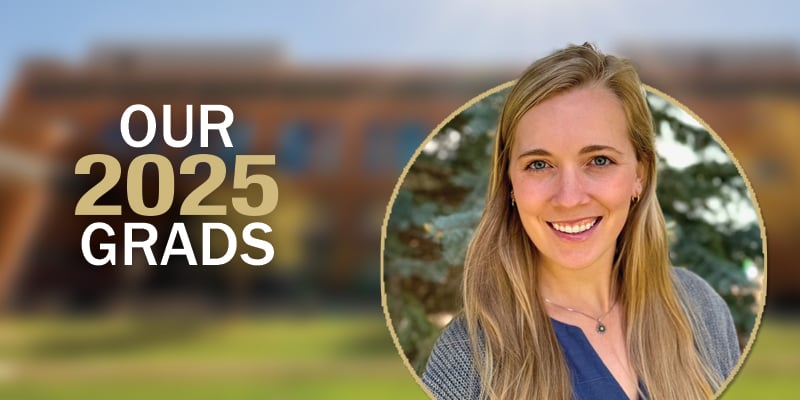
The path that led Wisconsin native Marais Kimmel to Boulder, Colorado, and eventually to the University of Colorado College of Nursing at Anschutz Medical Campus, began with a profound realization about purpose. While pursuing her undergraduate studies in a non-nursing field, Kimmel confronted a question that haunts many young professionals: Would her work matter?
“When I was an undergrad [earning a non-nursing degree], I realized I wanted a career where I felt I was truly making a difference,” she says. “In some jobs, you go to work and feel like nothing significant happened, and I didn’t want that. I wanted a role that would allow me to make a meaningful impact each day—whether in nursing or another profession.”
That desire for significance drew her to the medical-surgical floor at Boulder Community Health, where she witnessed both the triumphs and tragedies of acute care. Yet even as she excelled in her role, Kimmel recognized that her impact could extend far beyond the hospital walls. She envisioned herself not just treating illness, but preventing it—not just caring for patients in crisis, but helping them before they ended up in the hospital.
This vision propelled her toward earning her MS in Nursing with a Family Nurse Practitioner (FNP) specialty, a decision rooted in her understanding of healthcare's most pressing need.
“My main goal in going back to school was to experience a different side of healthcare,” she says. “When I worked in the hospital, many of the patients I cared for had conditions that might have been prevented with better access to preventive care. I want to support patients through their health challenges and provide care across all stages of life.”
The Classroom Meets Reality
Kimmel got a feel for working in different healthcare settings through shadowing and the FNP program’s required clinicals —experiences that transformed theoretical knowledge into practical wisdom.
“Building connections is so important,” she says. “Shadowing helped me form relationships for clinical rotations, exposed me to different healthcare settings, and made coursework more meaningful.”
These clinical experiences became the bridge between academic theory and real-world application, where textbook concepts found their voice in patient interactions and treatment plans. For Kimmel, clinicals were the most valuable part of her education. She was placed at two to three different sites each semester, allowing her to get an understanding of the different styles providers have and the opportunity to care for different patient populations.
“Clinicals really helped classroom knowledge click,” she says. “Seeing the material applied in real scenarios over and over again helped to solidify the understanding.”
Each rotation offered Kimmel a window into different provider styles and patient populations, building her confidence while expanding her understanding of healthcare's diverse landscape. More than skill-building exercises, these experiences forged the professional relationships that would shape her future opportunities.
“I’m grateful for the strong connections I’ve made during my clinical rotations,” she says. “One thing I love about this profession is the flexibility. We can focus on a specialty or work in general practice. It offers so many opportunities to grow and evolve throughout our career.”

.png)