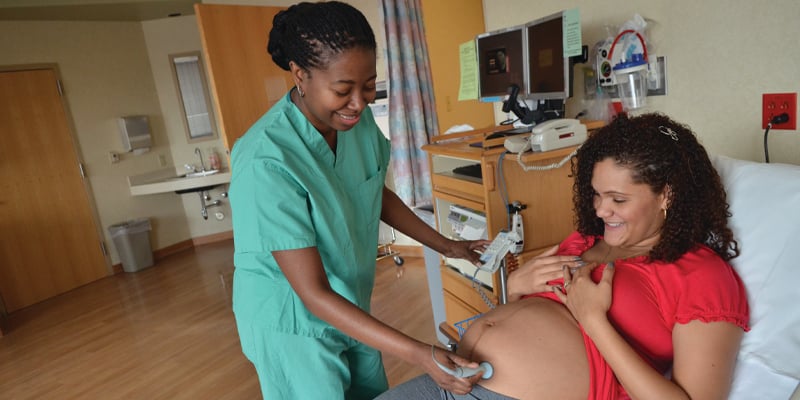
The US has one of the highest cesarean birth rates and higher mortality rates than most other developed countries. One third of births in the United States are via cesarean delivery, and the US ranks #1 in mortality rates worldwide. While some cesarean births are necessary to protect both mother and/or baby, the high rate of cesarean births in the US reveals that the procedure is largely overused. Reducing rates of cesarean birth is an important goal in improving the health of women during and after childbirth.
Traditionally, midwives have tended to pregnant women and, in most developed countries with lower cesarean birth rates than the US, midwives still attend a large portion of labor and births. The United States lags significantly behind in its integration of midwives. However, midwives are seen as a solution for reducing maternal and infant mortality rates.
It prompts an important question: Does midwifery-led care reduce the likelihood of cesarean birth?
A promising new study sought to answer this question, with findings that could reshape how we approach labor and birth in America.
University of Colorado Anschutz College of Nursing faculty, Professor Jessica Anderson, DNP, CNM, and Assistant Professor Denise Smith, PhD, CNM, joined a collaborative research team from the University of Colorado Anschutz School of Medicine and the University of Washington in a study evaluating cesarean births. The purpose of the study was to evaluate the rate of unplanned cesarean births (cesarean births that occurred after the start of labor) when cared for by midwives compared to obstetricians. The study, published in Birth, reveals that women receiving midwife-led care during labor had 25% lower rates of unplanned cesarean deliveries compared to those under obstetrician care. These findings are valuable in supporting the safety and effectiveness of midwifery-led care for hospital-based births. However, midwifery care in the US is not widely available.
Midwifery in the United States
To understand where we are today, we must understand where we come from. Historically, midwives, who were women, attended women during birth. But in the early 20th century, labor management changed in the United States, and by 1950, labor and birth management was characterized by routine administrations of heavy doses of narcotics or amnestics, along with the use of obstetric forceps, to facilitate delivery. These routine and often unnecessary interventions were introduced as standard of care by prominent physicians like Dr. Joseph B. DeLee.
During this same period, midwifery care in the US was nearly eliminated as a routine part of pregnancy care. The number of midwives rapidly decreased between 1900 and 1970, until a resurgence of midwifery care began and has continued over the last 50 years. Today, most midwives in the US are trained with master’s degrees in nursing or midwifery. Midwifery training is comprehensive and places high value on person-centered care and optimizing physiologic processes in childbearing. At the same time, midwives are also trained to recognize and collaborate with other members of the health care team, specifically with physicians, when the women's health status requires it.
Many health care advocates see midwives as a potential solution to the country’s maternal healthcare crisis, especially in rural communities. The researchers in this study proposed that the effectiveness of midwives in reducing cesarean birth rates was attributed to how they are trained: “certified nurse-midwives' training focuses on physiologic labor in low-risk patients, and OBs are trained for higher-risk patients and surgical interventions, provider decisions may be ingrained by education and training.”
Midwives in Other Developed Countries
In other countries, midwives play an essential role in perinatal care. In European countries, midwives often have a broad scope of practice. In Malaysia, an expectant mother with an uncomplicated pregnancy has at least seven visits to midwives and two routine visits where they are seen by the doctor. Many South American countries integrate traditional practices with university-level education to serve their diverse communities.
Many countries have long recognized the benefits of midwifery care, and the United States is gradually moving in the same direction. Under the Affordable Care Act, Medicaid is now required to cover midwifery services, although access to providers can still be limited. A growing number of states have updated their licensing laws to support midwives in practicing independently.
A Breakdown of the Study
The study evaluated a sample of births at the same institution, with 46% of care provided by an obstetrician and 54% by a midwife, and where midwifery and physician care were available 24 hours a day. The study evaluated women having their first baby and women who had previously given birth and included both induced and spontaneous labor. Of note, the sample also included patients with mixed-risk, meaning that some women in the study had common complications of pregnancy, such as high blood pressure.
The overall cesarean birth rate was 11.8%. The cesarean birth rate was 15.2% for the obstetrician group compared to 8.9% for the midwifery group. The data also showed that there was no significant difference by provider type for either maternal or neonatal morbidity.
The study concluded that midwifery care was associated with lower rates of unplanned cesarean birth in this mixed-risk cohort and that wider integration of midwives for intrapartum care could increase vaginal delivery rates. The authors of the publication agree that additional studies are needed to support these findings.
The study was NIH grant-funded and funded by the Pregnancy Related Care Research Network grant.
Research Supports Midwives
Multiple studies, including this one, validate that integrating midwifery and obstetric care can lower cesarean delivery rates in the United States. Additional research should be conducted to evaluate how to implement practice-based changes in the US that incorporate midwifery into the larger health care system. Public health organizations should continue their work to change public perception of midwives by highlighting their proven benefits, using research findings to substantiate their messaging.
Dr. Anderson and her coauthors conclude: “Our findings are consistent with other studies in the US and suggest health system changes to incorporate more midwives could improve labor and delivery outcomes and decrease unplanned cesarean births.”