

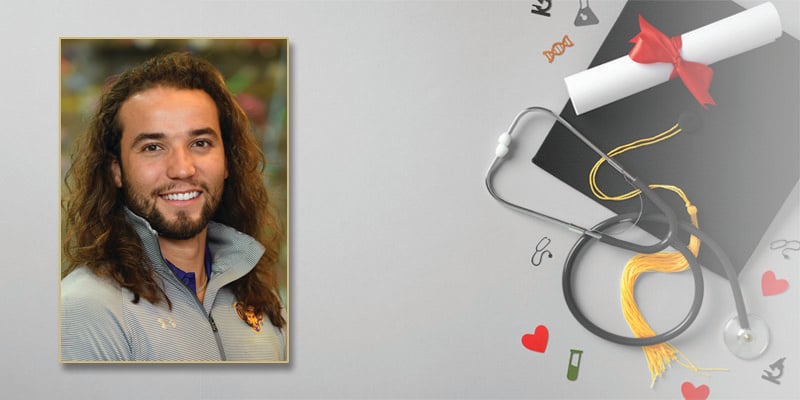
It's 3 a.m., and Nico Galvis is deep in conversation with an elderly patient who's about to be discharged. His preceptors have started calling him "Chatty Cathy" because he can't help himself; he wants to hear people's stories.
"I didn't realize there was a certain amount of time you're supposed to spend discharging patients," he says with a laugh. "But especially with older patients, I pick their brains. I like to hear their stories."
That instinct to connect—to see patients as people, not numbers—is what drew Galvis to nursing in the first place. And it's a longer journey than most.
A Winding Journey to Nursing
Nico Galvis has a bachelor’s degree (in molecular biology) and a master’s degree (in public health) He's worked as a bartender, a server, and a campus recreation manager.
With all that education and experience, he was still searching for something more.
“I knew I wanted a fulfilling career instead of just going to work and make money,” he says. “I wanted something where I would feel worthy going to work while helping people.”
His two degrees taught him complementary lessons: molecular biology showed him what happens inside the body, while public health revealed the social factors that determine whether someone can truly thrive. But neither field gave him what he was really looking for—direct patient care.
“With my degrees, I learned about what happens inside someone’s body and the social determinants of health and how that affects someone’s ability to thrive,” he says. “And the combination of those two drew me to nursing. I realized that with nursing, I can do both and care for someone so they feel better.”
That realization led him to the University of Colorado Anschutz College of Nursing, where he's about to earn his nursing degree through the college's accelerated BS in Nursing (UCAN) program.
Building Bridges
Growing up with immigrant parents, Galvis has both Colombian and Canadian heritage. He witnessed firsthand how language barriers can create anxiety and miscommunication in healthcare settings. It's shaped how he approaches every patient interaction.
“In Colombia’s healthcare system, there’s more of an emphasis on connecting and explaining things,” he says. “So, I want to make that connection with patients here so they don’t feel like they’re another number.”
During one clinical rotation, he cared for a Spanish-speaking patient and their family. Simply being able to communicate in their native language transformed the entire experience.
“In one of my clinicals, I was talking to a Spanish-speaking patient, and I could communicate with them so they and their family felt comfortable,” he says. “It’s gratifying because speaking the same language as them helped release tension in the room. When I become a nurse, I want to continue having this positive impact on my patients.”
After graduation, Galvis plans to earn his medical interpreter certification so he can assist in treating Spanish-speaking patients.
Making an Impact
His chatty approach is working. Two patients have tried to nominate him for a DAISY Award, an honor given to nurses who go above and beyond while caring for a patient. Because he was still a student at the time, he couldn’t receive the nominations, but the gesture meant everything.
“Things like that warm my heart,” he says. “A lot of times, if people are writing a review, it’s usually a bad review. So when someone takes time out of their day to write something positive about you, it’s because you made an impact on them.”
For Galvis, that impact comes from a simple philosophy: take the time to connect. Ask questions. Listen to stories. Treat every patient like they matter—because they do.

.png)