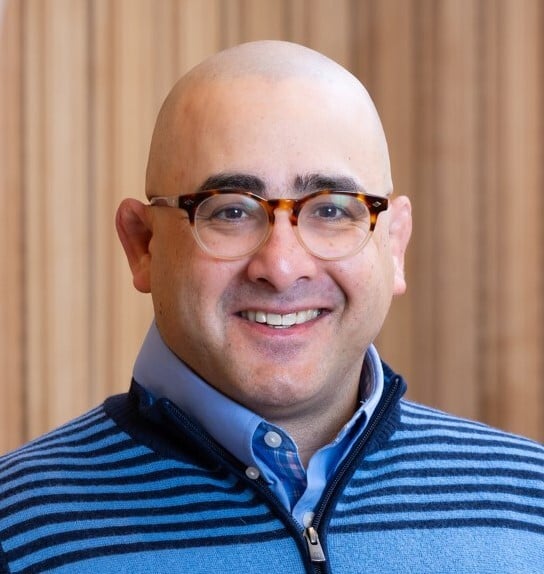


Daniel Goldberg, JD, PhD, is a scholar and educator who is passionate about legal epidemiology— the science of figuring out how rules and policies impact health outcomes. Laws can have both good and bad impacts on public health. Laws requiring seatbelts reduce injuries and deaths from crashes. Laws that restrict vaccine requirements can reduce public health officials’ ability to control outbreaks of infectious diseases.
Laws as exposure: revealing risks behind the rules
While some health researchers look for patterns of how bacteria, pollution, or diet affect sickness and health, scholars in legal epidemiology collect data and ask, “Does this law make people healthier or sicker? Are some communities helped while others are harmed?” It’s like public health detective work, but the “exposure” isn’t a toxin or a virus—it’s a law. Legal epidemiologists study laws and their ramifications on public health to help provide evidence to design better policies, so everyone has a fair shot at good health.
For Goldberg, the justification for treating laws as exposures is powerful.
“What would happen if we treated laws like an exposure to childhood lead or an exposure to unsafe housing?”
Putting the “legal” in “legal epidemiology”
Goldberg didn’t want to be a lawyer—he just wanted to think like one. His legal training and professional health law experience, along with a PhD in Medical Humanities, now anchors his work as Director of Education at the CU Anschutz Center for Bioethics and Humanities.
Legal epidemiology is still young as a recognized field of study, which is part of the appeal for Goldberg. There are only a handful of courses nationally, and the research infrastructure is still forming. Goldberg’s position as Education Director and faculty in the Bioethics and Humanities in Healthcare Graduate Certificate allows him to stay connected with learners and through his role as Program Director of the Public Health Ethics and Law Program. This program, founded in 2023, leverages interdisciplinary expertise to produce original research, teach and train population health learners at all career stages, and conduct community-oriented policy analysis to advance health for all.
The hidden link between policy and well-being
Why does studying laws matter for health? Because policies help shape the very conditions—housing, education, food access—that determine whether people thrive or struggle. Legal epidemiology zooms out from the clinic to ask how rules and systems create those realities. This makes it a natural partner to conversations about social determinants of health—the everyday conditions—like where you live, learn, work and play—that influence how healthy you are.
Goldberg sees real progress over the last several decades in how health professionals learn and talk about social determinants of health. In education, there is “a much deeper well of expertise and tools that have come about in the last 15 or 20 years," he explained, “and it's also now considered a clinical standard of care to screen for social determinants of health whereas it wasn't before.”
While screening for food insecurity or housing instability may now be common, the hard part isn’t finding the problems—it’s building systems to solve them. Evidence-informed insights from screenings need to be turned into actionable laws and policies that help patients and improve public health at the structural level.
“We've built health care systems—or non-systems as I call them—in ways that really don't equip health care professionals with the tools to do things on a structural level. The focus is on making individual choices for individual sick people,” Goldberg said.
While helping individuals is important, if and laws are put into place upstream on a larger societal scale, it could help protect and reduce the potential harm to individuals becoming sick at the outset.
In designing these systems, Goldberg cautions against using data at the population level to indiscriminately inform assumptions about individuals, a core distinction in public health ethics that CU Anschutz learners are trained to keep front and center.
Pain and stigma: an enduring entanglement
In addition to his passion for the impact of law on health, Goldberg is interested in the social contexts of health, especially the relationships between pain, stigma, and bias.
“We have a much longer and deeper history in the west of stigmatizing people in pain than most people realize,” he says. The consequences are profound—doubt, denial, and diminished access to appropriate care. “I think as a society that we tend to minimize, ignore, deny, and question the experiences of people in pain.”
For clinicians and systems, Goldberg argues that solutions must be of a structural, not moral, nature.
“No one says, ‘I’m going to stigmatize six to eight of my patients today, it’s going to be an awesome day for stigma.’ And yet, stigma from health care professionals to people in pain is extraordinarily common."
It isn’t about “good” versus “bad” providers; it’s about redesigning environments so this type of ethical practice becomes the norm.
When you’re the one who’s stigmatized
Goldberg sees the root of stigma as a function of power difference. To be stigmatized, you have to have less power than whoever is stigmatizing you.
“People who are sick are often disempowered, just by virtue of being sick,” he said. “Sickness robs a lot of us of agency and power.”
That’s where advocacy can help. This can involve taking advantage of patient advocacy resources or stating what you observe and reframing what is going on. Saying, “Look, this is what I think is happening right now. Can we come at this a different way?” Goldberg also acknowledges that challenging those providing care may not feel safe or productive, and it shouldn’t be the responsibility of individuals to fight stigma when structural changes are needed to affect widespread change.
The joy of teaching engaged learners
The Center for Bioethics and Humanities is a leading center for public health ethics, with an unusually strong concentration of faculty expertise across ethics and policy. This distinction is in part because of the opportunity CU Anschutz offers to work in close collaboration with accomplished partners like Farley Health Policy Center, the Colorado School of Public Health, the CU School of Medicine, and others. Goldberg is especially proud of the Center’s rise over the last decade as a nationally recognized clearinghouse for public health ethics.
Goldberg is also looking keenly to the future. His wish list for the next five years centers on expansion—integrating ethics education into clinical rotations, strengthening ethics opportunities in the public health curriculum, and building flexible offerings for residents whose schedules rarely align. “There’s almost no question that there is increasing demand for thinking about ethics by residents,” he says, pointing to frontline encounters with social determinants and the ethical questions they raise.
Goldberg teaches courses such as “Public Health Ethics” and “Health Stigma in Social Contexts,” part of the Bioethics and Humanities in Health Graduate Certificate. He enjoys guiding learners into these ever-evolving spaces. “It’s fun to be in this relatively young subfield and try to figure things out, mentor students and also learn from others who are doing it,” he said.
His favorite thing about working with students at CU Anschutz? “I think the professionalism is really just amazing. The students are going to do the work. That’s not something educators should take for granted.”
Want to learn more? Explore the Center for Bioethics and Humanities and discover how faculty like Daniel Goldberg are shaping the future of health ethics and health humanities.