A grant from the Alex’s Lemonade Stand Foundation for Childhood Cancer will provide University of Colorado Cancer Center researchers Todd Hankinson, MD, and Siddhartha Mitra, PhD, with funding to explore new treatment options for adamantinomatous craniopharyngioma, a rare pediatric brain tumor that can have a disastrous effect on a patient’s quality of life.
Compromising the body’s control hubs
“There are just under two cases per million patients each year, so it's not a common tumor, but the big issue with this tumor is the morbidity and the neurological damage that it causes,” Hankinson says. “The reason for that is that they cause damage to critical structures, including the pituitary gland, which controls many of your body’s basic functions. Craniopharyngioma often obliterates those functions, including the body's ability to balance water inside of itself appropriately, which can be a dangerous problem.”
The tumors also can compress the nerves that control vision, causing blindness, and they can affect the hypothalamus, another signaling hub for the body that controls metabolic functions, sleep-wake cycles, and memory, among other basic functions.
“You can have a child who is hormone-deficient, who can't balance fluid right, and who never knows when they're full, so they're always trying to eat,” Hankinson says. “Often these children are morbidly obese, and blind on top of that, which can be a pretty rough existence.”
Targeting specific pathways
Because they are slow-growing tumors, craniopharyngiomas can be difficult to treat with traditional chemotherapy. With the Alex’s Lemonade Stand grant, Hankinson and Mitra are exploring other treatment options, most promisingly, a combination of two drugs that treat two different pathways that tumor cells use to grow and spread.
“One of the problems is that nobody wants to develop a new drug for a very small patient population,” Mitra says. “Our best bet is to use something that is already available, so we are trying to find the best way to combine two drugs that are already on the market.”
Winning combination
Hankinson has conducted previous research on the effectiveness of the drug tocilizumab, which targets the interleukin 6 pathway, for treating craniopharyngiomas, with some success.
“We did an initial study where we gave tocilizumab to patients who needed to have surgery, then assayed whether the drug actually got to the tumor,” he says. “In most brain tumors, there's reason to believe that tocilizumab couldn't treat them, because it couldn't cross the blood-brain barrier, but we thought that craniopharyngioma might be different because of where it grows in the body.”
That initial trial expanded to an international trial that is currently underway; as part of the Alex’s Lemonade Stand-funded research, Hankinson and Mitra hope to analyze specimens of craniopharyngiomas from children who were treated with tocilizumab so they can study the effects the drug had on the tumor.
“We've had a handful of patients who have been treated off-label with the combination of tocilizumab and bevacizumab, which is a monoclonal antibody that targets the VEGF pathway,” Hankinson says. “We are seeing good responses there, but we have less basic biology data to explain that bevacizumab response. The other part of this grant is studying that drug combination in tumor specimens and animal models.”
Eventually, the researchers hope to establish enough data to start a clinical trial of the two-drug combination — a treatment that, if successful, could have life-changing effects on patients and their families, Hankinson says.
“I think it would drastically improve the quality of life of the children who get this tumor,” he says. “Adults get this tumor, too, and we'll be able to translate our findings into the adult population. This tumor is such a huge burden for the whole family because of the way it manifests and the problems it causes — obesity, aggressive and incessant food-seeking, behavior alterations, memory problems. There are a lot of things that families have to contend with, so a better treatment could mean a dramatic improvement in their quality of life.”
With much federal funding for pediatric cancer research on hold, Mitra and Hankison are grateful for foundations like Alex’s Lemonade Stand — particularly its willingness to fund research on a relatively rare cancer type.
“This is one of the tumors that is the hardest to get funding for, because a company is not interested in developing a new drug for something that you see in a two-in-a-million population,” Mitra says. “When the grant from Alex's Lemonade Stand came in, we were so surprised, and we were excited. They recognize the complexity of the problem and have chosen to fund it.”
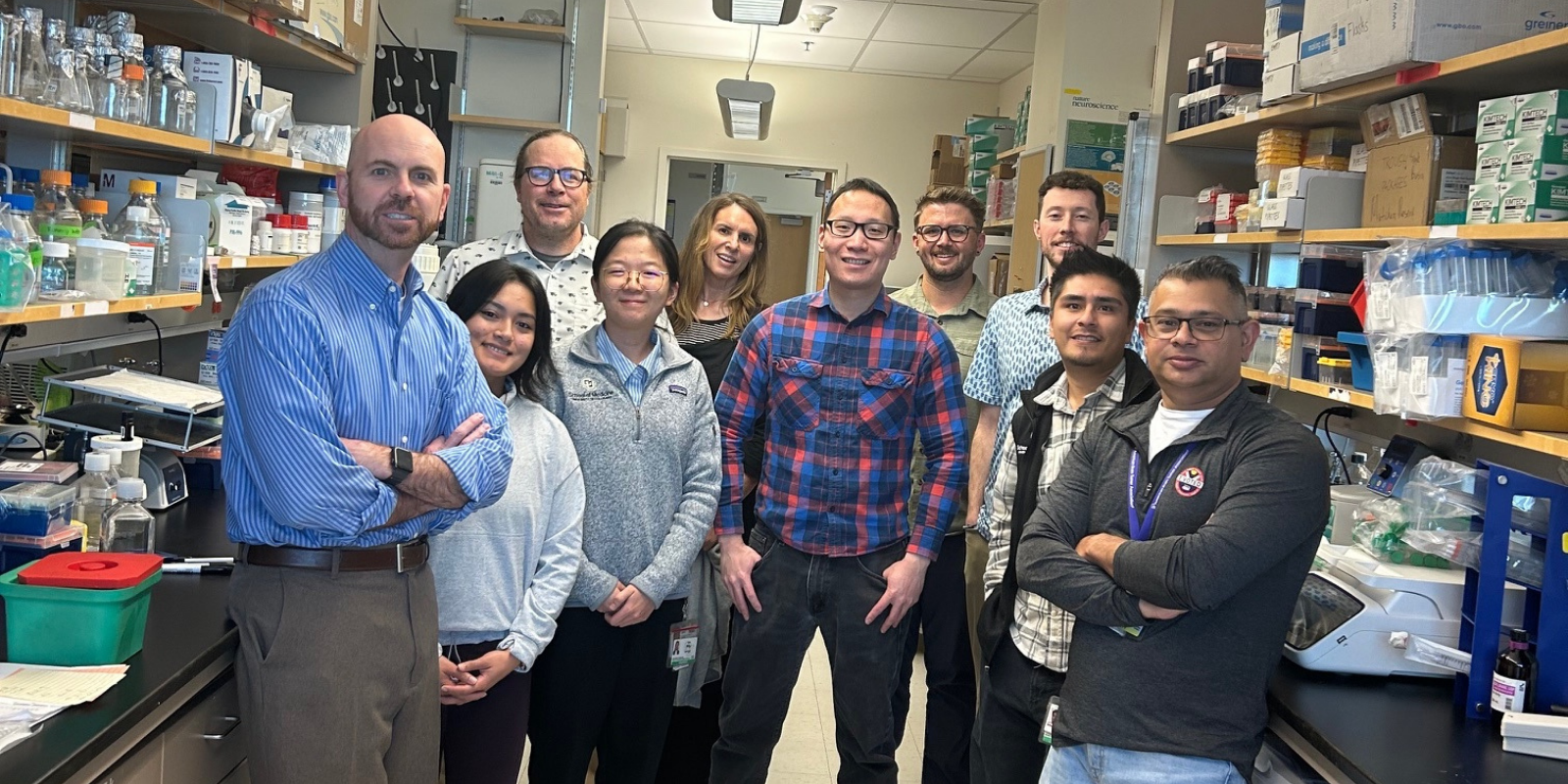
Featured image: Todd Hankinson, MD, far left, and Siddhartha Mitra, PhD, far right, with members of their lab.