Four science teachers from area high schools assembled in a lab on the University of Colorado Anschutz Medical Campus on a recent Thursday morning, their worktables prepared with test tubes, pipettes, scales — and tubs of fresh strawberries.
The teachers were on campus as part of the two-day BEST (Bioscience Educator Support and Training) Teacher Professional Development class, an annual training event, hosted by the Cancer Research Training and Education Coordination (CRTEC) office at the CU Cancer Center, designed to spur students’ interest in becoming medical and cancer researchers.
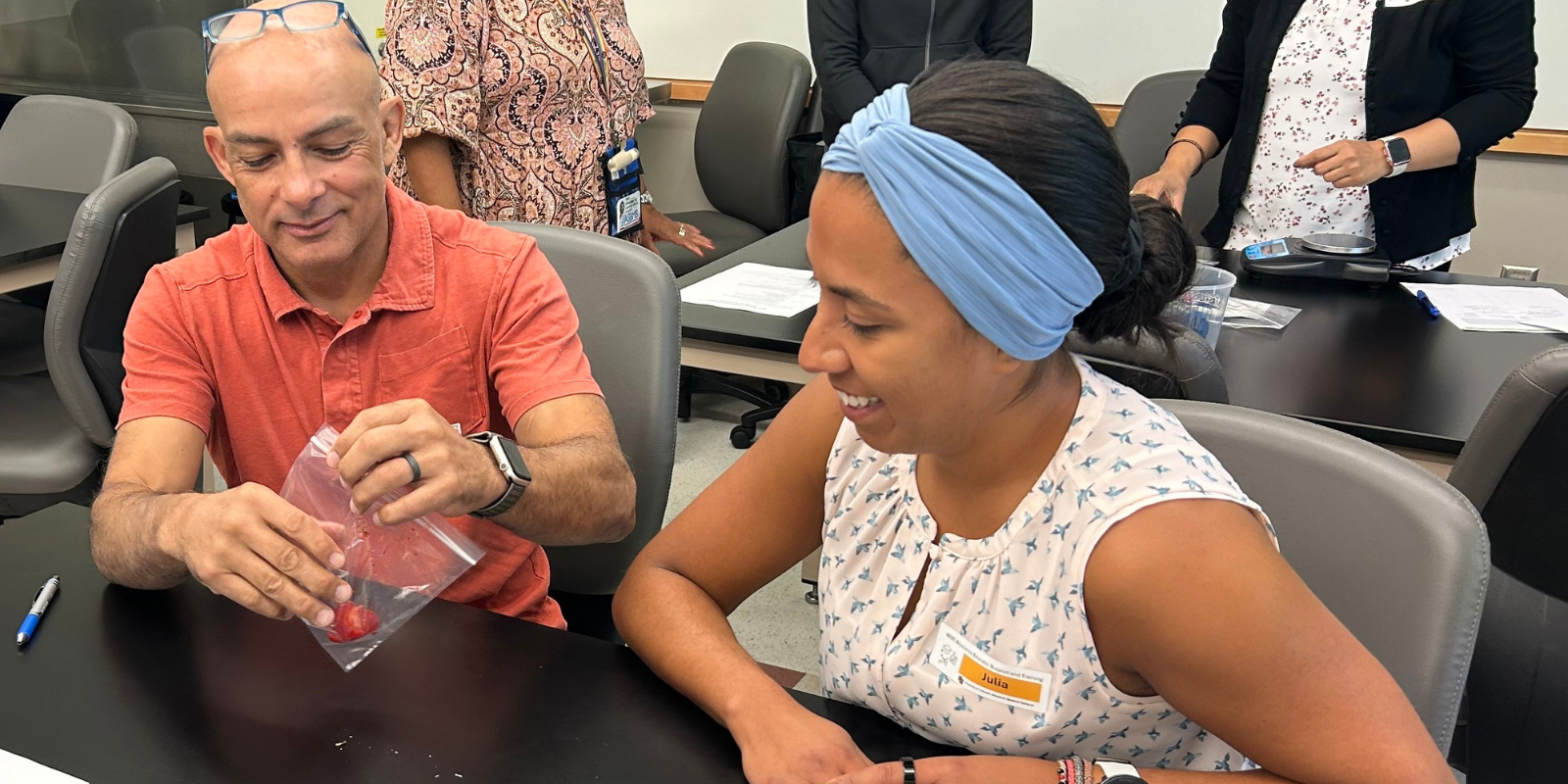
Among the experiments the educators learned how to lead was one in which students have to design a protocol, using reagents such as vinegar and salt, to extract DNA from strawberries.
“I’ve been teaching a genetics class for the past couple of years, and when we get into the biomedical part of the genetics, I wanted a more hands-on activity for the students to do,” said Julia Lopez Whitehall, a science teacher at William Smith High School in Aurora who attended the training. “We do the strawberry DNA extraction lab every year, but I've never done it this way, where they have to create their own protocol. This will give them more of a challenge, which I think they need.”
Scientific access
Led by Adela Cota-Gomez, PhD, CRTEC’s assistant director for education administration, and Meredith Tennis, PhD member of the Cancer Center’s Molecular and Cellular Oncology Program, the BEST training also gave the teachers experience with micropipetting, the BioBits protein synthesis lab, DNA profiling and gel electrophoresis, and the polymerase chain reaction kit. Participating teachers may check out lab kits for their students at any time over the next year. Teachers also have access to an online dashboard with more information and resources.
“Our mission in the CRTEC office is to create these programs to bring science out to the community, especially to the education community around our campus and throughout all of Colorado,” Cota-Gomez said in her introduction to the program. “We run a good number of active programs, and this one has quickly become one of my favorites because it's really novel. There aren’t many other places around the country that do this.”
Getting hands-on
Suchi Panda, a science teacher at Aurora Central High School, was already familiar with the Anschutz Campus from CRTEC’s annual Learn About Cancer Day, which brings teachers and students to campus to hear from researchers and tour their labs, but she signed up for the BEST training to get new ideas on activities to engage students.
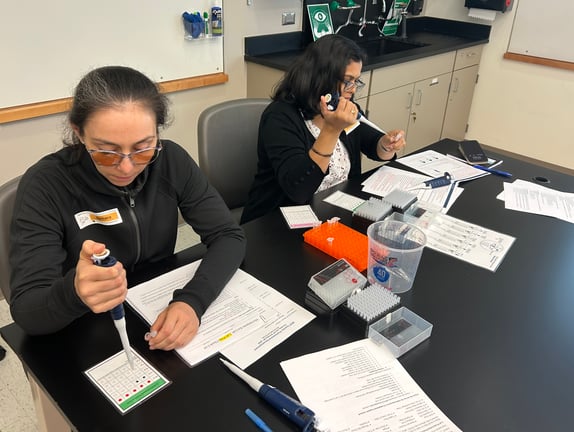 Barbara Steward and Suchi Panda practice micropipetting at the BEST training.
“It's about getting teachers acquainted with what they need to know prior to the students doing the experiments,” she said of BEST. “It's a hands-on experience for teachers, to prepare them well enough so that they can do the same thing with the students and make the class more interactive and fun, rather than just sitting and learning.”
Panda said she also appreciated that BEST is making the lab kits available to students in schools that may not otherwise have the resources to provide a large amount of hands-on training materials.
“Right now, if their experiment fails, they struggle with how to start over again,” she said. “I think the kids will like the kits we are going to get from this program. They will allow them to practice more and make it more accessible and fun with collaboration.”
The July BEST event marked the second time CRTEC has offered the training to teachers in high schools in the Denver metro area. In addition to the training materials, Cota-Gomez says, participants have access to a social media platform on which they can communicate with one another and share tips and tricks. Participating teachers are asked to check out at least two lab kits in the 12 months following the training.
New opportunities
Barbara Steward, a science teacher at Arvada West High School who attended the training, said her background in scientific research made the BEST training “right up my alley.”
“I’m also a career and technical education teacher, so I thought this would be good for my pathophysiology class, which is a medical tech class,” she said. “I don’t have a medical background, per se, more of a science background, so I wanted to come to a medical campus to learn about the research going on and what can be brought into a high school classroom.”
Being in the Anschutz lab showed her not the just the possibilities of the hand-on activities, Steward said, “but also the potential for collaboration, field trips, summer programs, things like that. I'm excited to bring it to my students because I want them to see the possibility of going to college or coming here for grad school or med school. I like to bring opportunities to my students.”
Featured image: BEST participants Wael Amara and Julia Lopez Whitehall work on an experiment to extract DNA from strawberries.