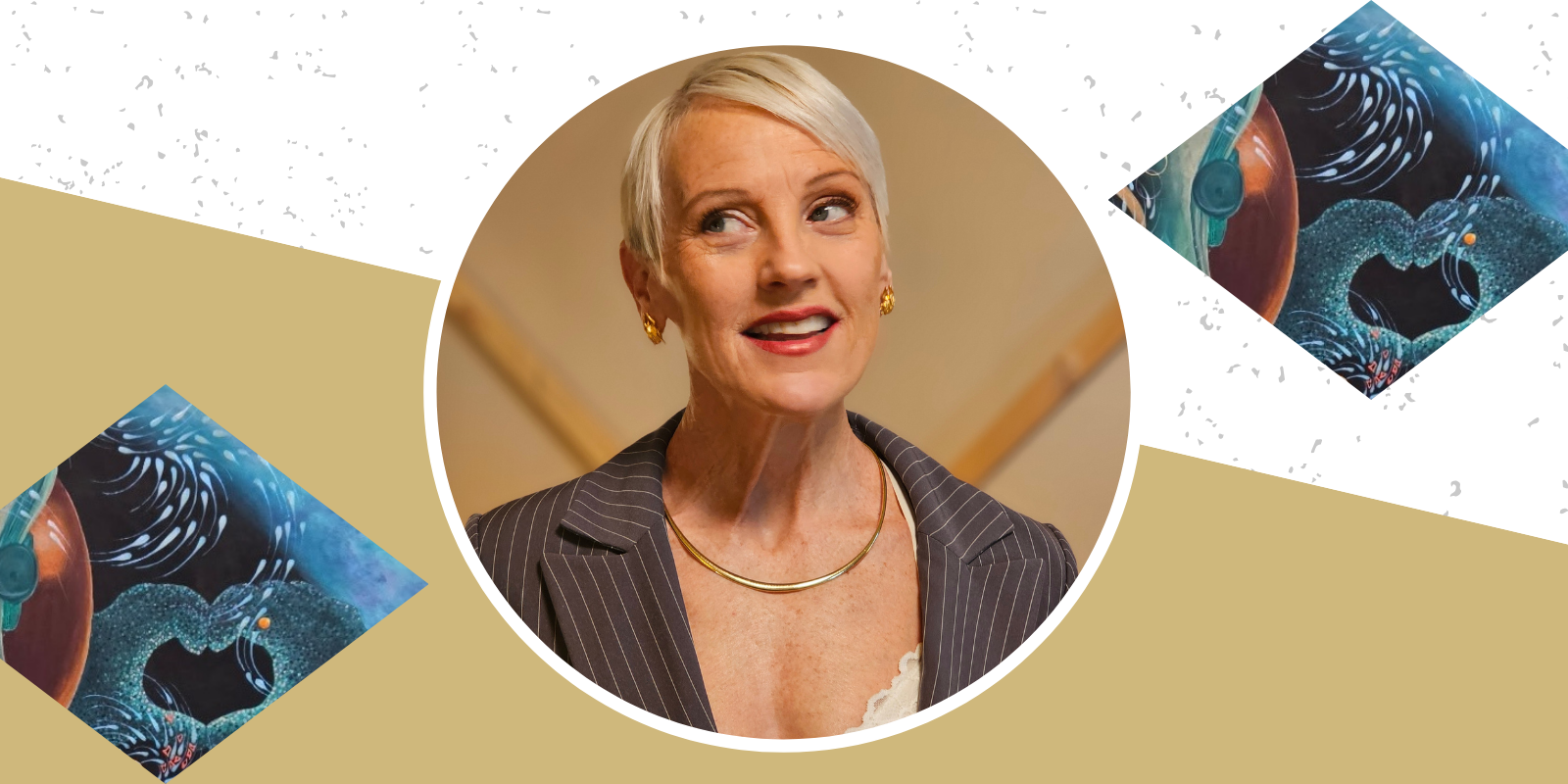
Teresa Anne Volgenau was struggling.
Eight months after she had finished intense treatment and complex surgery for stage III uterine cancer, the disease had returned. Back in the infusion center at UCHealth University of Colorado Hospital, she felt like she was at the end of her rope.
“My infusion nurse asked me how I was doing, and I told her, ‘I’m having a tough time,’” Volgenau remembers. “I had just started treatment again.”
Coincidentally, University of Colorado Anschutz Cancer Center researchers were in the infusion center that day, looking for cancer patients who might want to take part in a clinical trial evaluating the effectiveness of the psychedelic drug psilocybin, combined with talk therapy, for treating psychiatric and existential distress in people with late-stage cancer.
“I lean into holistic health and natural medicine,” says Volgenau, 53, who lives in Westminster, Colorado. “One of my heartbreaks with my cancer journey was that because of time and finances, I had to lean into western medicine protocols. I kept craving integrative medicine, and as soon as they told me about this trial, I said, ‘I’m all in.’”
Power of psychedelics
Conceived and overseen by Stacy Fischer, MD, co-leader of cancer prevention and control at the CU Anschutz Cancer Center, along with Jim Grigsby, PhD, a professor of psychology at CU Denver, and researchers at New York University, the randomized, double-blind study has funding support from the National Cancer Institute.
Now in its fourth year, the trial randomizes participants into study drug and placebo groups, with participants in the study drug group receiving one 25 mg dose of psilocybin delivered in conjunction with psychotherapy. Participants in the placebo group receive a dose of niacin, which is clinically non-therapeutic, in addition to the same psychotherapy intervention. Fischer says around 60 participants have been enrolled to date.
→ Studying Psychedelics to Treat Psychiatric Distress in Late-Stage Cancer
“We are aiming to help their anxiety, help their depression,” she says. “Many patients with cancer reach a point of demoralization, thinking, ‘Well, if I'm facing the end of my life, what's the point anyhow?’ There’s this existential distress, this loss of meaning. The idea is that this existential approach to therapy can help resolve some of these feelings and help people just be in the moment, be more fully present, and not feel a sense of anxiety or depression around their circumstances.”
Fischer and her fellow researchers see psilocybin, which in 2022 was decriminalized by Colorado voters for medical use, as an ideal agent for helping that process along.
“We know that when a dosing happens, there is a period of neuroplasticity,” she says. “People report greater openness, greater cognitive flexibility, greater self-compassion. It’s like we're priming the brain to be more open to therapy.”
The journey begins
Participants in the study go through three preparatory psychotherapy sessions, then come in for their dosing day, where they receive either psilocybin or a placebo.
“Regardless of what they ingest on the dosing day, we ask that everyone puts on an eye mask and lies down on a couch,” Fischer says. “We give them headphones and a curated playlist of trippy instrumental music, and trained facilitators guide them through the experience. After the dosing session, they receive an additional eight hours of psychotherapy.”
For Volgenau, who within an hour into her dosing session could tell she had received psilocybin, the experience was revelatory.
“I'd never experienced anything like that,” she says. “I did a lot of purging — I just saw conveyor belts of chaos being removed from my psyche. As time went on, there was a lot of crying, nervous laughter — insecurities came through. But in the end, it was so good for me.”
Volgenau says that her eight-hour psychedelic journey helped rid her of past lives and negative energy, beginning with intensity and chaos that slowly transitioned into joy and acceptance.
“I bawled my eyes out during the journey itself, but then you step into the world and you see the world from all these new perspectives,” she says. “You deal with life stresses in a different way. I am showing up in the world in a better way because of this trial. I'm living my life with less anxiety than before, and I'm more Zen than ever before.”
While the researchers are still gathering data, Fischer says that other participants in the trial have described experiences similar to Volgenau’s.
“Many participants have told us this has been life-changing,” says Fischer, who is also conducting research with breast and ovarian cancer patients on the effectiveness of psilocybin in reducing worry about cancer returning. “One of our participants said, ‘When I got home, everywhere I look, all I see is love.’ It's like nothing I've experienced in my 25 years of research.”
Future therapy
Fischer hopes the results of her study will eventually lead to cancer centers offering palliative psychedelic care for those who qualify.
“Unfortunately, we know that traditional medications for anxiety and depression, such as selective serotonin reuptake inhibitors, are not very effective for people who are dealing with a cancer diagnosis. Existential distress is even harder to treat,” she says. “While therapy is an important modality, it can take a long time to make the kind of gains that people are looking for. This is a potential pathway that might accelerate that.”
That was certainly the case for Volgenau, who says the dosing experience, coupled with the talk therapy she went through before and afterward, has led to her viewing her diagnosis in a more accepting way.
“The clinical trial was a beautiful game-changer for me,” she says. “No one is just dealing with cancer — things are surfacing from other areas of their life and relationships. The psilocybin journey facilitated me getting to places I know in my heart I can get to through meditation, but get to them very easily.”
Featured image: Teresa Ann Volgenau surrounded by sections of one of her recent paintings.