Andy Haffele is no stranger to pain or hospitals after a near fatal gunshot wound almost took his life during a Navy SEAL training exercise. When debilitating nerve pain landed him in the ER years later, he and his wife, Kristina, received a spine tumor diagnosis that led to John Berry-Candelario, MD, at the University of Colorado Anschutz School of Medicine.
After Andy and Kristina left the emergency room, they searched online for specialists all over the country. They were on the clock. The longer they looked, the greater the likelihood that the damage could remain permanent.
Their research led them to Berry-Candelario at the UCHealth Spine Center – Anschutz Outpatient Pavillion.
During the initial consultation, Berry-Candelario noted the Haffeles were understandably devastated by the seriousness of Andy’s diagnosis. “He survived death and then he comes in and has this unusual type of tumor that can paralyze him and impact his life,” says CU Anschutz Cancer Center member Berry-Candelario. Andy recalls that after leaving the office, he and Kristina decided not to get a second opinion. They wanted Berry-Candelario to do his surgery.
Today, Andy is back to work and back at his gym. He credits his recovery to Kristina, who served as his primary caretaker during his recovery, and to the dedicated work by Berry-Candelario.
“I’ve rarely met a great surgeon and a great person,” says Andy. “That combination is rare. Dr. Berry-Candelario is the complete package. He’s a phenomenal surgeon, but an even better human being.”
Facing uncertainty head-on
Andy beat impossible odds in his 20’s when a gunshot wound to the chest sustained during a Naval training exercise almost killed him. The accident caused him to lose 58 units of blood and required seven different surgeries. He was not expected to survive the accident that ended his career as a Navy Seal.
When Berry-Candelario met with Andy, he could see the discipline and determination in him refined over years of military training. As a Navy Reservist, Berry-Candelario can speak to the intense Navy SEAL training for service men and women. He also knows the physical and mental resilience required to be selected as a member of the Navy’s premier elite special operations force.
Andy was diagnosed with a benign, giant schwannoma, a primary tumor of the spinal cord, that lives inside the space of the spinal cord and intradural space.
“It had grown in a space which continued to compress the spinal cord and exited out along the nerve,” says Berry-Candelario. “It was growing inwards and compressing the rest of the nerves."
During the consultation with Berry-Candelario and Lawrence Cloutier, PA-C, Andy was told a resection surgery was necessary to remove the tumor. Because of the tumor’s proximity to many of the nerves, there was no way to predict the long-term effects, the extent of nerve damage, or the recovery time.
Andy’s symptoms worsened the following weekend while on a trip taking his eldest son to college. Not wanting to wait any longer, he called and scheduled his surgery.
Andy went in for a laminectomy and intradural tumor resection to remove the tumor. To access it, Berry-Candelario had to remove part of the bone, then perform a spine fusion to close it back up.
“It can be challenging because it is the type of spinal tumor that can really cause a lot of damage to the spinal cord if you are not careful,” says Berry-Candelario. “But we were able to get all of the tumor out.”
The entire surgery lasted six hours.
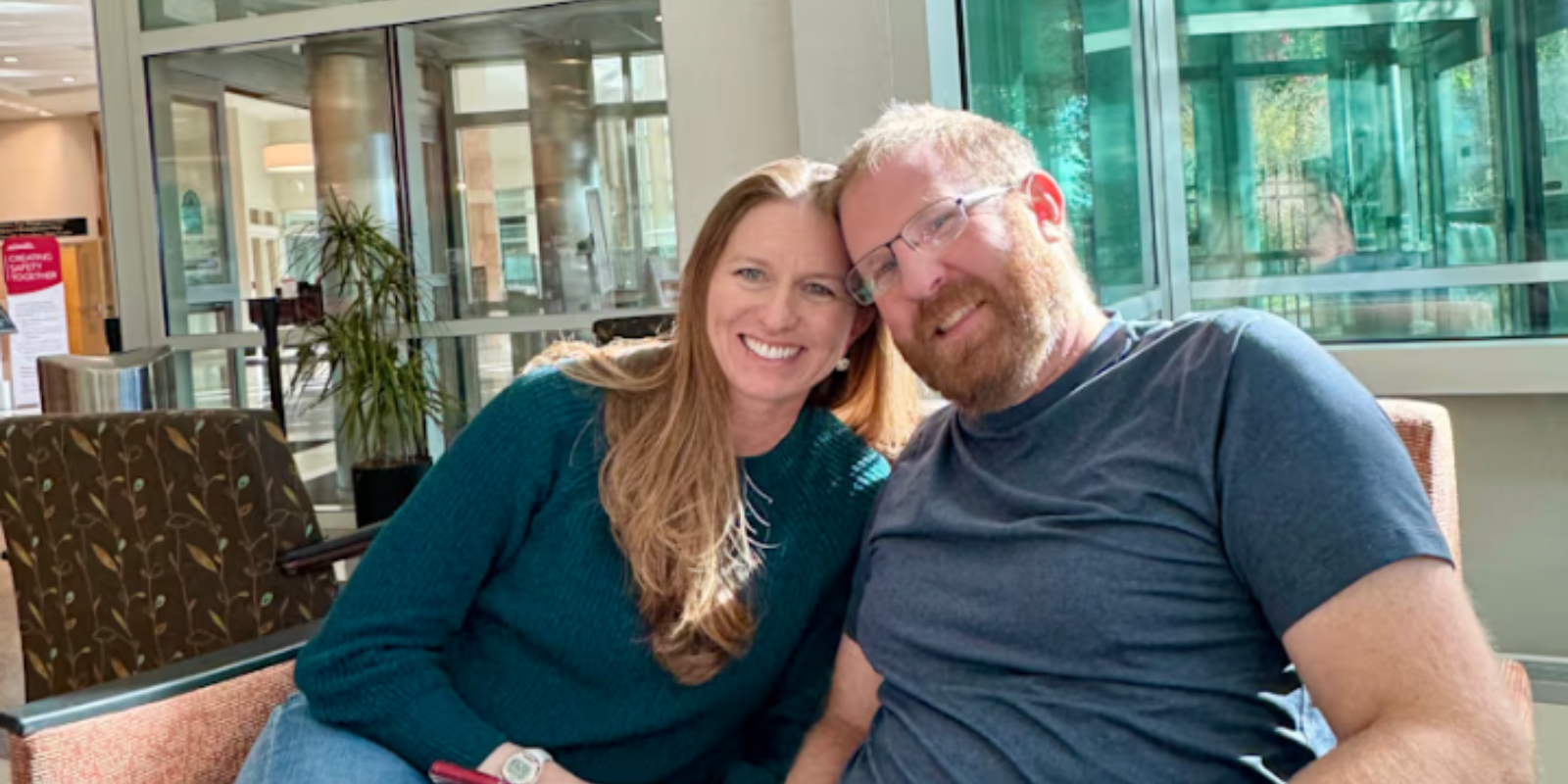
Andy and Kristina Haffele. Photo provided by Andy Haffele.
CSF leak diagnosis
Relieved to be home, the Haffeles thought the hard part was over. Andy remained sedentary to help his body recover. "I've had enough experience in recovery to appreciate that when docs tell you to do something, it is for a reason."
But four weeks post-surgery, Andy experienced severe headaches and trouble walking when leaving his son’s football game. A visit to the ER confirmed he had a cerebrospinal fluid leak.
A cerebral spinal fluid leak is rare, occurring in roughly 10% of spine tumor surgery patients. After consulting with his care team over the phone, it was decided Berry-Candelario needed to go back in to repair the leak.
“The first surgery I felt fear, and the second surgery I felt frustration,” says Andy. As part of the surgery, a lumbar drain was placed to manage the leak. For Dr. Berry-Candelario to place the drain, Andy sat up and leaned forward onto him for support. He says his frustration with the situation eased while conversing with Berry-Candelario in this position.
“We talked about the Navy and football,” said Andy. “That was the most special moment for me. You have this super neurosurgeon at the top of his craft being a human being and a friend in a very raw moment.”
For Berry-Candelario, the brief exchange in the operating room was equally memorable. “We talked about impactful things in both our lives,” he says.
Once Andy was fully sedated, Berry-Candelario went in and patched up the leak. Andy then spent five days straight on his back without moving in the hospital. Complications caused by his prior military accident led to a longer hospital stay before discharge.
The road to recovery
Once Andy returned home, he spent six weeks recovering in a recliner in his living room, requiring assistance to complete basic functions. To pass the time, he returned to the online community of veterans that he developed following the end of his military service.
He took to blogging, sharing daily updates on his recovery. Once he could start moving again, he began the long road to recovery.
“I underestimated the significance of the surgery,” says Andy. “It’s a long, slow, deliberate recovery after the surgery.”
He acknowledges the help of family members and friends who provided meals, financial support, visits, and transportation for the kids to and from school and sports. He also expressed his deep gratitude for his wife who served as his primary caretaker during his recovery. Andy describes Kristina as a natural caregiver—Berry-Candelario describes her as Andy’s rock.
“Kristina was a rock to him,” says Berry-Candelario. “You can see this connection between two partners who really value and understand one another.”
Andy also acknowledges the role of Cloutier in his care, and the significance of his consistent presence throughout both surgeries and recovery. “Lawrence was such an integral part of my journey from appointments to pre op, post op, recovery, and all the moments in between. His steady presence, attentiveness, and support made a meaningful difference for my family.”
The damage to the nerves in Andy’s abdomen requires daily wear of what he light-heartedly calls his “man girdle” for additional support while he heals. While he still has a way to go in his recovery, he remains optimistic about his future.
For Berry-Candelario, watching Andy make progress in his recovery brings him immense joy. “Andy is made of something that a lot of people should hope to be made of. His determination and unwillingness to give up really helped him get through his recovery.”
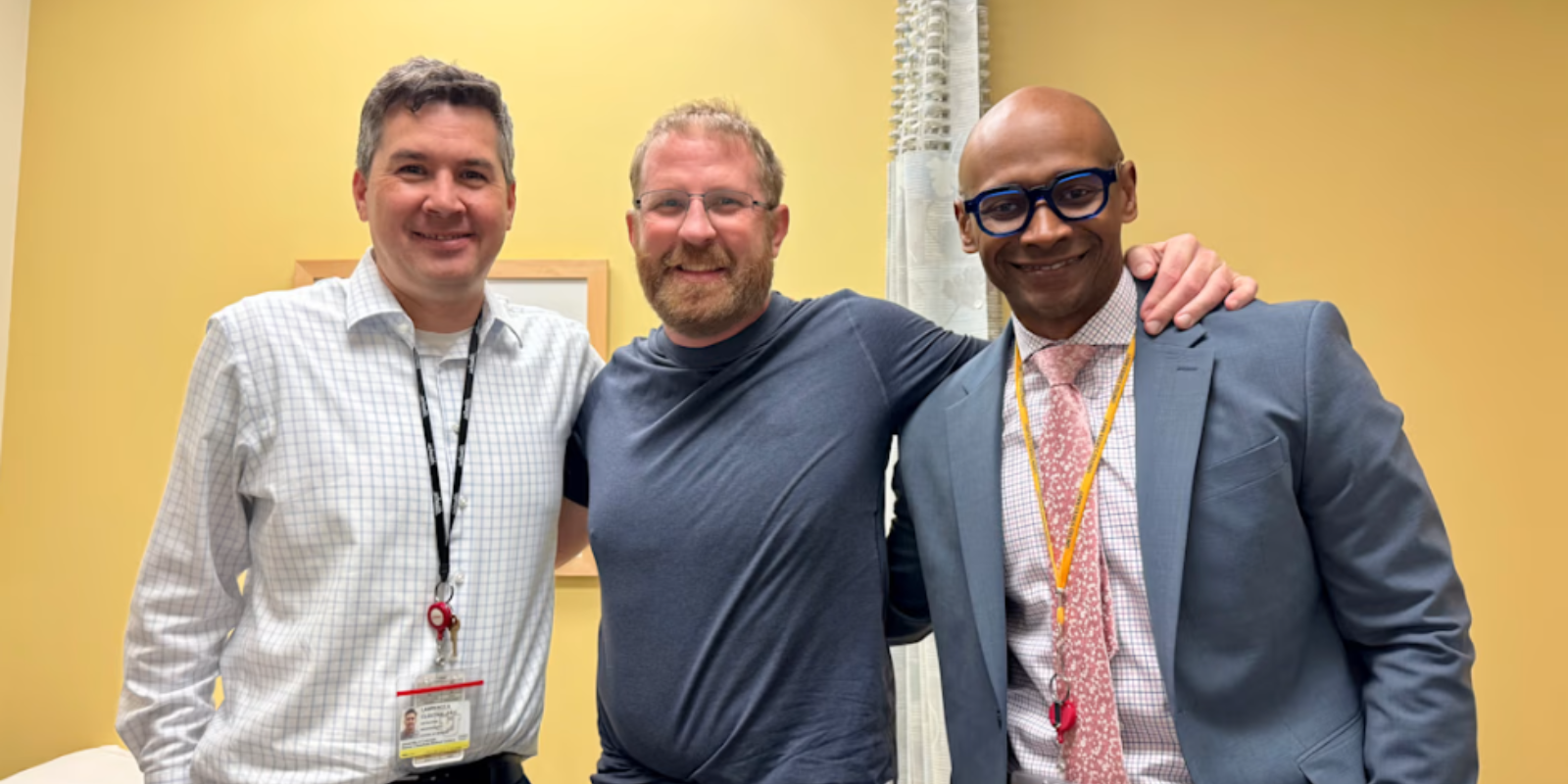
Featured photo of Andy Haffele with John Berry-Candelario, MD and Lawrence Cloutier, PA-C. Photo provided by Andy Haffele.