

Standing at the podium in the packed Elliman Conference Center in the Anschutz Health Sciences Building, Amanda Piquet, MD, told a story about her work to treat those living with stiff person syndrome, a rare autoimmune neurological disorder. Piquet leads a clinical trial using a personalized therapy in which a patient’s own T cells are removed, modified in the lab to target overactive B cells that drive autoimmune disease, and then re-infused into the patient. The treatment is called CAR T-cell therapy.
Piquet said, “I could show you all the graphs on my poster,” gesturing toward the back of the room where the data and study results were printed out. “But I think a video is worth a thousand words.”
She showed videos of the participant before and after treatment. The contrast was astonishing.
Before treatment, the participant struggled to walk and had a stiff gait with decreased movement in the hips. After the treatment, the participant’s gait appeared normal as she nearly sprinted down the hall.
Piquet explained that there are no FDA-approved therapies for stiff person syndrome, which causes painful muscle spasms and progressive stiffness, leading to disability and mobility issues.
“This clinical trial has shown reversible neurologic disability in this patient population,” Piquet continued. “It is a therapy you can give a patient one time to have a huge impact, not only preventing progression of the disease but reversing that disability."
A conference with a mission
Piquet’s presentation was just one example of the innovative research showcased during the daylong CCTSI CU-CSU Summit on August 13 at CU Anschutz. The topic was Advancing Neurosciences: From Molecules to Mind.
For 14 years, the Colorado Clinical and Translational Sciences Institute (CCTSI) has been bringing together physicians, scientists and trainees from CU Anschutz, CU Boulder, CU Denver and Colorado State University for the Summit. The goal is to attract and build collaborations between investigators ranging from those in the basic sciences to those who study naturally occurring diseases in companion animals and those who conduct studies with patients in a clinical setting. Both early-career scholars and senior scientists, as well as students and trainees, are encouraged to attend.
“It provides a unique opportunity to network and connect with colleagues outside of our bubbles to establish new collaborations and build new bridges between disciplines and campuses,” said Kevin Messacar, MD, PhD, who chaired the 2026 program committee.
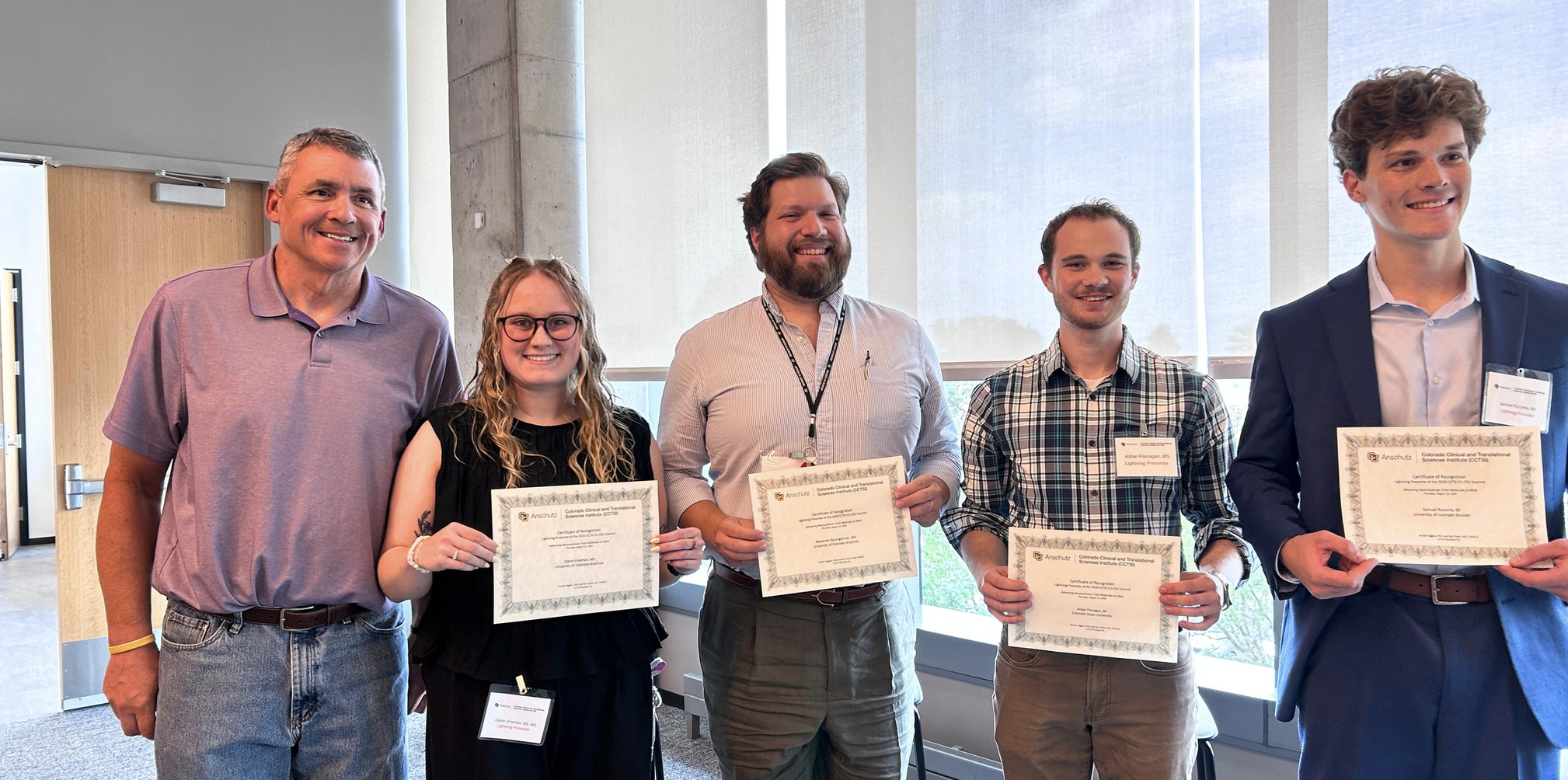
To that end, four individuals were chosen from among those who submitted poster abstracts to present their work in a five-minute lightning talk from the podium. Claire Vrooman, an MS candidate at CU Anschutz, said giving the talk was a fun challenge. “This was the first time I've been chosen to give a podium talk at a conference! I was able to chat with lots of new people.”
Aidan Flanagan from Colorado State University gave a lightning talk on aging cats as a model for neurodegeneration. Flanagan said, “I liked how every talk was on the shorter side so I could see what research is going on in Colorado.” Hoping to continue onto graduate school at CU Boulder or CU Anschutz, Flanagan networked with faculty from both institutions.
A broad range of inspirational research
During the course of the day, the topics of talks ranged from the neuroinflammatory mechanism of SARS-CoV-2 to the cognitive health of those with obesity and diabetes, the effects of alcohol and cannabis on brain function, the effects of physical activity on stress and the brain, the gut’s connection to brain health, and neurodegeneration in geriatric dogs with cognitive dysfunction.
“It was so exciting to hear innovative advances from lab models helping us provide new insights into aging, to translational models of neurodegenerative disease in companion animals, to hot-off-the-press successful clinical trials in humans,” Messacar said.
He continued, “Seeing Dr. Piquet's CAR T-cell clinical trial results for stiff person syndrome really drove home that interventions targeting and modulating our immune response could have implications and impact far beyond stiff person syndrome, extending to other immune mediated neurologic diseases.”
Pictured at top: Professor Chris DeSouza from CU Boulder with the four lightning presenters, from left to right, Claire Vrooman, Alexander Baumgartner, Aidan Flanagan, and Samuel Ruzzene.


