As science pushes boundaries, technology races to keep pace, transforming how we understand, diagnose and treat disease. At the University of Colorado Anschutz (CU Anschutz), this technology includes advanced datasets and software tools that can help researchers and clinicians personalize care and improve patient outcomes. Researchers at the CU Anschutz Department of Biomedical Informatics (DBMI) are leading the charge by developing a variety of technologies—ranging from datasets of the human genome and microbiome to tools that help review electronic health records (EHR) and even improve the outcomes of sepsis.
“Pediatric sepsis is a huge concern, killing more than 3 million children each year worldwide. When our team started to develop the Phoenix Criteria, it was important to me that other data analysts didn’t end up in the same situation I was in, re-implementing organ dysfunction criteria,” says Peter DeWitt, PhD, assistant research professor of biomedical informatics at the CU Anschutz School of Medicine. “I wanted them to just be able to use this piece of software. The software eliminates problems of researchers re-implementing something over and over again—copying code from one place to another. It assures it’s already done for them.”
DeWitt’s R package and Python module, phoenix, supports researchers in identifying pediatric sepsis according to organ dysfunction–based criteria. Although the tool was started to support DeWitt’s own research, he realized that it could be leveraged by other researchers, developers, and data analysts alike. So, DeWitt packaged his code and made it available for people across the globe.
DeWitt is not the only researcher or developer who has experienced this phenomenon, though. Biomedical discoveries are driven by software. But too often innovative tools remain hidden—buried in papers and local repositories, only known about by a handful of researchers. Yet many of these tools can be leveraged by others working with data. This is why DBMI developed the Wall of Software, a centralized site of open-source tools designed to make discovery easier and collaboration more powerful.
The Wall of Software originally began as an idea from Casey Greene, PhD, founding chair of DBMI. Greene wanted to create a visual way to organize and recognize the wide range of software tools being developed by researchers and developers in the department.
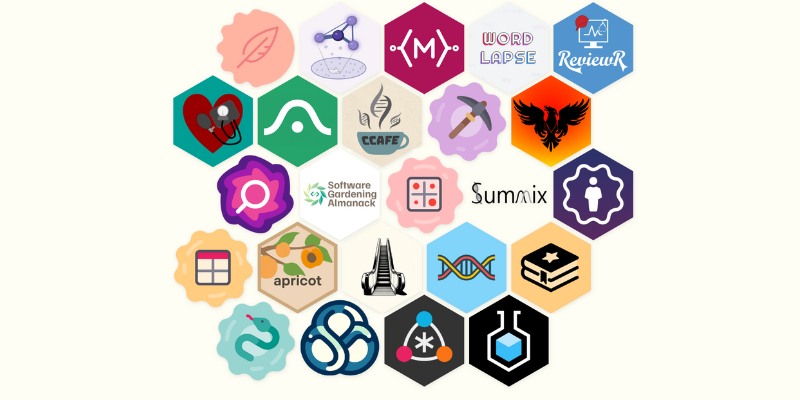
Originally imagined as a type of “software registry,” the concept evolved into a virtual ‘wall’ filled with hexagon graphics—with each hexagon representing a different tool. The hexagon design was inspired by hexbin graphics, a data visualization approach that allows shapes to fit together neatly.
This is the first installment in our ongoing series spotlighting the DBMI Wall of Software, an interactive online hub showcasing the latest open-source software and data tools for researchers. View the Wall of Software here.
The wall launched in 2023 with just eight tools. Since then, it has grown to showcase 24 projects created at or in collaboration with DBMI.
The Wall of Software is maintained by DBMI software engineers Faisal Alquaddoomi, Dave Bunten, Vince Rubinetti and David Mayer. We sat down with the software engineering team to learn more about the wall and the tools within it.

How do tools end up on the Wall of Software?
The Wall of Software is a tapestry of all the work being done in the department. Most of the tools are developed by DBMI researchers, and some of them are developed by the DBMI software team. Each addition is then reviewed by the software team and added to the wall.
Any researchers can submit tools for approval. If someone in the department has a tool that they think could be beneficial to other researchers, they can submit it on the Wall of Software repository by following the instructions in the README.md. They submit the tool, the name of the tool, a short description of it, and the graphics for the website and print. After it’s submitted, the software team works to get it approved and up on the wall.
What are some of the tools on the Wall of Software?
There are currently 24 tools on the Wall of Software.
The Software Gardening Almanack is one tool that Bunten developed. This tool is an open-source software handbook and Python package that helps researchers with sustainable software development practices. For example, the Almanack assures that researchers have a DOI associated with research tools, that the tools are accessible to other researchers and that the research itself is replicable.
Another tool is Lab Website Template. Lab Website Template is an open-source, code-based tool that automates citation generation, repo configuration and more. This tool allows labs to focus more on research and less on web development and grunt work.
Manubot is a workflow and set of tools for writing manuscripts. You write content in Markdown, track changes with git, and Manubot automatically deploys it as a live web page, handling the most tedious parts like citation generation, bibliography section, format conversion and more. This helps the process of authoring papers be more open, reproducible, and collaborative.
Clustermatch Correlation Coefficient (CCC) and CCC-GPU are high-performance tools for uncovering complex relationships in data. Unlike traditional correlation measures that mainly capture linear patterns, CCC can detect both linear and non-linear associations across numerical and categorical features. This tool helps uncover patterns and correlations that might not be revealed in simpler correlation associations. The GPU-accelerated version—CCC-GPU—dramatically speeds up these computations, making it practical to apply on large-scale datasets.
All of these tools and more are easily accessible through the Wall of Software webpage.
Who can benefit most from the tools on the Wall of Software?
The tools hosted on the Wall of Software can be used by anyone: data scientists, biologists, researchers, clinicians, the list goes on. Although the Wall is developed for DBMI, most of the tools could theoretically be used by people across the globe.
One of the largest benefits of the wall is that it increases the visibility of these tools. A lot of times in research it appears that the tools being used are very niche and specific to a particular area of research, but many researchers actually have overlapping needs. Increasing the visibility of a specific method or tool set can be helpful for other researchers.
Why is the Wall of Software important to the department?
It's vital that researchers and software developers don't work in silos. Having a public gallery of the technologies of the department fosters cross-collaboration. Additionally, it reduces the chances that anyone reinvents the wheel and duplicates software that has already been created. The tool someone is looking for might already exist right on the Wall of Software. The Wall of Software also motivates and inspires people in their work, making them feel like a part of something larger.