.png)
For most of her life, Angela Harkoff, a 46-year-old mother of three, feared that her lungs would kill her. With an asthma condition that kept her in the hospital for much of her childhood, she never expected the opposite would come true — it was because of her asthma that she got a computed tomography (CT) scan that detected a rare, aggressive cancer in the adrenal gland on the top of her right kidney.
“My lungs saved my life, because that one CT scan found the tumor,” says Harkoff, a surgical technologist at the UCHealth Poudre Valley Hospital in Fort Collins, Colorado.
The cancer, called adrenocortical carcinoma or ACC, is a cancer of the adrenal glands that is diagnosed in an estimated one in a million people in the United States, according to the National Cancer Institute. The adrenal glands are two small endocrine organs, one located on top of each kidney, that produce important hormones, like cortisol and adrenaline, and help regulate bodily functions like metabolism, blood pressure, and response to stress.
The CT scan was the start of a complicated and often discouraging journey for Harkoff, who was told she likely had only months to live. But hope was restored when she connected with endocrinologist Katja Kiseljak-Vassiliades, DO, an associate professor in the Division of Endocrinology, Metabolism, and Diabetes in the University of Colorado Department of Medicine. As a member of the CU Adrenal Tumor Team, Kiseljak-Vassiliades is part of an innovative research team that is advancing ACC knowledge on an international scale.
“When I started seeing patients clinically for adrenal cancer, I realized there really was nothing for these patients other than a drug that was approved 50 years ago. This is where I thought I could make the biggest impact,” says CU Cancer Center member Kiseljak-Vassiliades.
After multiple unsuccessful attempts at treating Harkoff’s cancer, the research efforts by Kiseljak-Vassiliades and her team sparked an idea for an innovative treatment approach that proved effective. Now, nearly two years after diagnosis, Harkoff’s tumors have shrunk in size, and she continues to live a life of adventure.
“Researchers like Katja are hungry to help patients. They’ve given me my life because of their ideas, and I am proud to be the evidence of Katja’s brain,” Harkoff says. “I thank God every day for Katja. When we first met her, my husband said, ‘She's going to be our quarterback, honey.’ And he was right. She is my quarterback.”
An incidental finding
Born and raised in New Zealand, Harkoff had acute asthma, eczema, and allergies that often required her to go to the hospital. When she permanently moved to Colorado in 2008, she mostly had no symptoms except that every winter, she would get sick with a type of respiratory infection. In 2018, she decided to go to National Jewish Health for testing and a CT scan, which she continued to do on a mostly annual basis to monitor and assess her health.
In June of 2023, after completing the annual tests, Harkoff recalls her doctor telling her that her lungs looked the strongest he had ever seen them. It brought tears to her eyes. Two days later, on a Friday, she got a CT scan that changed her life.
The radiologist noticed a shadow on the scan. That Monday, on her 43rd birthday, she got another scan that confirmed there was a mass growing out of her adrenal gland on her right kidney. She was ultimately diagnosed with Stage 4 ACC, a type of cancer she had never heard of before.
“When I was diagnosed, it was such a shock. I felt total devastation, and I was so angry,” she says. “I was told I wouldn’t see Christmas. It was July 6, and I was totally asymptomatic. How is that possible?”
An understudied cancer with limited treatments
ACC often is an incidental finding, explains Kiseljak-Vassiliades, with roughly 30% to 40% of people getting diagnosed because of hormone secretion, 30% due to structural issues or pain, and 30% because of an incidental finding on a CT scan or MRI.
“Usually, our patients get a CT scan for something else and then, due to the detection of an adrenal mass, they are referred to us. I’ve had several patients who had back pain and an MRI revealed their adrenal tumor,” Kiseljak-Vassiliades says.
Since the tumors are on the adrenal gland, they can secrete too many hormones in the body and cause additional issues like high blood pressure, diabetes, acne, and weight gain.
“Once in a while, we’ve had female patients who came in because of excess hair or acne and they got a CT scan to see if there was a hormonal issue, and that’s when we found adrenal cancer,” she says.
The cause of ACC is unknown, she notes. Researchers suspect it may be due to a cell that deviates in a layer of the adrenal gland. What is known is that the cancer develops and grows quickly, and by the time the tumor is detected, it is usually large — sometimes reaching 20 centimeters in size.
Because ACC is rare, there are not many treatment options. The first step is performing surgery to remove the tumor, but the cancer may come back. There is only one drug — mitotane — that has been approved by the Food and Drug Administration as a treatment for ACC, and it was approved in 1970. Kiseljak-Vassiliades describes the drug as having “limited action,” because although many patients will have an initial positive response, it typically does not last long. Patients usually have to take three or four capsules twice a day, and many experience side effects.
For patients with advanced ACC, their treatments can vary, Kiseljak-Vassiliades explains. One option involves several chemotherapy drugs and mitotane. Recently, however, she and her colleagues have been using targeted therapy approaches, giving patients multi-kinase inhibitors like lenvatinib and cabozantinib, or immunotherapy drugs.
 Angela Harkoff, a surgical technologist at the UCHealth Poudre Valley Hospital, smiles while sitting outside in her scrubs. Image taken by Stacy Abernathy.
‘All I prayed for was time’
After several surgeons refused to operate on Harkoff’s tumor because of its size and complexity, she found hope when she met with CU Director of Endocrine Surgery Robert McIntyre, MD. He told Harkoff that he was confident he would be able to remove the tumor, and during that appointment, he introduced Harkoff to Kiseljak-Vassiliades.
Within that first meeting, Harkoff remembers Kiseljak-Vassiliades saying there are limited funds for research on ACC primarily due to disease rarity and a lack of research models, leading to limited information on it. But Kiseljak-Vassiliades also told Harkoff that she would do everything she could to keep Harkoff alive.
“They became my medical team that day. I have a very special relationship with them both, which I treasure, and I consider Katja to be one of my closest friends today,” Harkoff says.
McIntyre performed surgery on Harkoff, who recalls that her cancer had expanded from her adrenal gland to her liver, and so the surgeons removed the tumor and resected about two-thirds of her liver. However, not long after the surgery, the cancer recurred “very aggressively,” says Kiseljak-Vassiliades.
“We tried mitotane, which Angela didn’t tolerate very well, so then we tried chemotherapy,” Kiseljak-Vassiliades says.
Harkoff, who was planning a wedding when the tumor was discovered, asked that they not start chemotherapy until after she got married. After tying the knot on a Thursday in early October, she began chemotherapy the following Monday. Unfortunately, she did not respond well, and her cancer only worsened, so her care team decided to stop the treatment after two unsuccessful rounds.
“It was very tough for her, and for us, to try to manage this aggressively growing cancer,” Kiseljak-Vassiliades says. “She was not doing well, was bedbound, in a lot of pain, and had lost a lot of weight.”
Harkoff says she had lost and gained about 50 pounds since starting the treatments, and at one point, she began losing hope.
“All I prayed for was time,” Harkoff says. “Every cell inside of me wanted to heal.”
In January of 2024, Harkoff met with her oncologist, Corbin Eule, MD, McIntyre, and Kiseljak-Vassiliades, and they asked her if she wanted to continue with treatments or to stop.
“I said to them, ‘I want a chance to fight this cancer. I want to put my gloves on,’” Harkoff recalls. “They came up with a new protocol that we started soon after.”
 Angela Harkoff, left, walks alongside Katja Kiseljak-Vassiliades, DO, at the CU Anschutz Medical Campus. Image taken by Justin LeVett Photography.
How innovation unlocked new treatment potential
For the past decade, Kiseljak-Vassiliades and her colleagues have developed new ACC cell lines. Cell lines are collections of cancer cells that are used in research to study their biology and to test different treatments.
“Previously, there was a single cell line that we had for adrenal cancer. So, I partnered with other researchers to develop new cell lines, and we have developed three new cell lines and about nine patient-derived xenograft models,” Kiseljak-Vassiliades says, explaining these cancer models have been shared with researchers across the globe to help advance ACC research. “Every cell line is basically a different molecular signature, and it's coming directly from the patient profile.”
With her ACC patients, Kiseljak-Vassiliades will attempt to transfer their cancer cells into an animal model and a dish to create cell lines. The first cell line that Kiseljak-Vassiliades was able to make directly from a human into a dish was with Harkoff.
“We sent her cell lines to our collaborators at the National Cancer Institute so they could run a research screen on her cell line with thousands of drug compounds. We looked to see if any of those compounds would kill the cancer in the dish,” Kiseljak-Vassiliades says.
After one unsuccessful attempt at using one of the compounds that was effective in the dish, but ultimately not successful for treating Harkoff, Kiseljak-Vassiliades began reviewing literature to find other options. One of the compounds that she saw in the literature review — and that also seemed like it may be effective based on the research screen — was lenvatinib.
Kiseljak-Vassiliades worried that lenvatinib as a treatment on its own would result in the tumor developing resistance to it, so she proposed that Harkoff use it in combination with an immunotherapy drug called pembrolizumab.
“We decided to try that, and it basically changed the course of her disease. In just four weeks, we started seeing some mild decreases in the tumors, and then by six months, we saw a significant decrease in size,” Kiseljak-Vassiliades says. “It was surreal and such an amazing feeling to be able to do this for Angela.”
‘I couldn't be in a better place in the country’
When Harkoff learned that her tumors were shrinking, she was in disbelief, saying it “felt like the biggest hug.”
“Seeing the resources that CU has made available to me, I wouldn’t want to be sick anywhere else,” Harkoff says. “And for my particular condition, I couldn't be in a better place in the country.”
The treatment process has not been invasive, she says, as she takes two pills every night and gets her immunotherapy treatment every three weeks — luckily, with no major side effects. As of May, Harkoff has had “11 months of shrinkage, two tumors have disappeared, and I’ve got a semblance of my life back,” she says.
With her improved health, she has traveled to New Zealand and Europe in the last year, and she has plans to travel with her three adult children to Australia this fall. After having to leave work due to her diagnosis, Harkoff returned to UCHealth in September 2024, saying her experience as a cancer patient has changed how she approaches her work as a surgical technologist.
“I feel honored to work in health care. When patients come into the operating room and I see the fear they have, if I can, I go up and hold their hand as they are put to sleep,” Harkoff says. “I think, ‘We have got you, and I will do my best for you during this operation — because I have begged for the same.’”
Harkoff still has multiple tumors, including in her liver, abdomen, pelvis, and near her renal vein. The plan is to maintain the same treatment plan that has been working for her unless something changes.
“I’ve had to find a way to cohabitate with my cancer. I know I’ll never be in remission, but I don’t know that I’ve fully accepted my diagnosis,” she says. “How do I share everything that I want my kids to know?
“My plan, now that I have some time, is to record myself reading the books I used to read to them for their kids,” she continues, tears forming in her eyes. “I’ve tried to channel my stubbornness into my motivation. I tell myself, ‘I can do this.’ I’m going to live this life that Katja is helping make possible for me.”
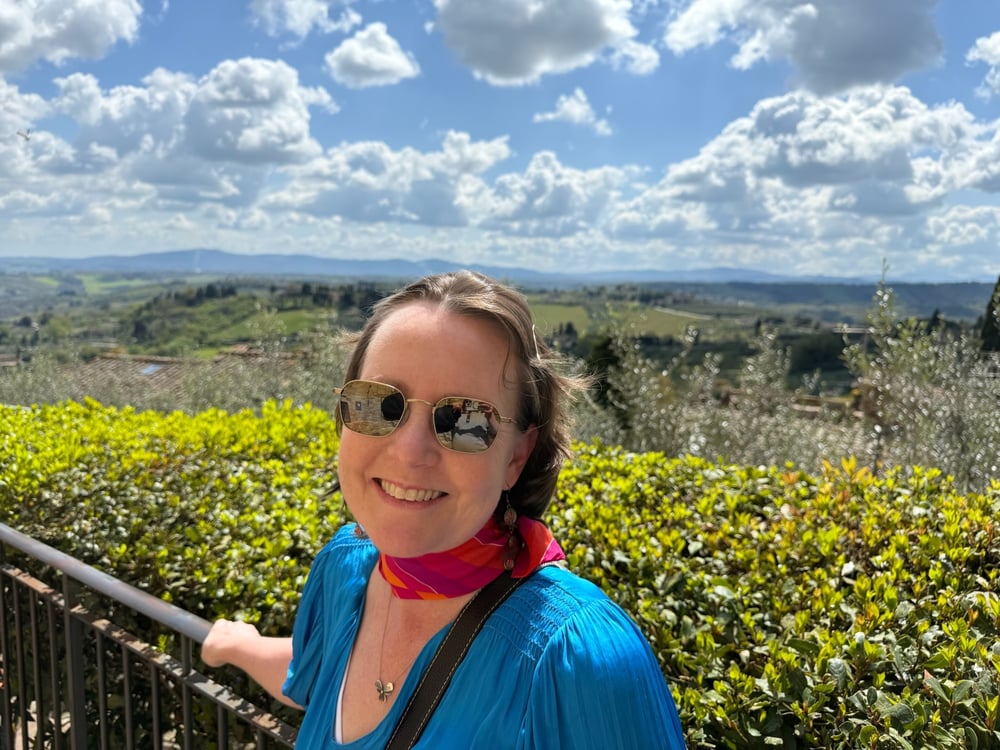 Angela Harkoff smiling while in Italy in April 2025. Image courtesy of Harkoff.
‘The big question’
The reason why the combination of pembrolizumab and lenvatinib has been effective so far for Harkoff, when the other treatments were unsuccessful, is unknown.
“That’s the big question,” Kiseljak-Vassiliades says, explaining that she and her colleagues are applying for research funding to test some of their theories. “It’s very important to remember that the cancer tumors are heterogenous. The point of our research is to identify which tumors will respond best to this sort of combination.
“We have other patients whose tumors have different molecular signatures that may respond well to chemotherapy instead, for instance. I had one patient who did chemotherapy, and she's been in remission for years,” she adds. “We need to figure out how to tailor treatment based on the patient’s molecular signature of their tumor.”
Research is also needed to improve the ACC prognosis, she explains. Given that the tumors are variable, a better prognosticator toolkit is needed to help physicians know how aggressive their treatment should be.
“There is a lot of research needed,” Kiseljak-Vassiliades says. “Even though our strides have been small, they still achieve important things. I hope that we will continue to have research support for rare diseases.”
Harkoff hopes to see greater awareness of ACC and support for endocrinologists like Kiseljak-Vassiliades who are working to make a difference, saying: “Katja has watched so many of her patients pass away, and I can’t imagine the frustration she’s felt of wanting to help but not being able to. She’s like a salmon swimming upstream.
“But I think she is miraculous, humble, and a mental force to be reckoned with,” Harkoff adds. “She wants to make a difference — and for me to win this fight.”