From teenagers to adults in their 50s, athletes of all ages are competing in the Milano Cortina 2026 Olympic Winter Games. Of this year’s roughly 2,900 competitors, the youngest member of Team USA is 15-year-old skier Abby Winterberger, and the oldest is 54-year-old curler Rich Ruohonen. At age 52, Austrian snowboarder Claudia Riegler made history at this year’s Games as the oldest female Winter Olympian.
They are among many athletes who are proving age is just a number, especially as more Olympians in their 30s, 40s, and 50s are competing now than in previous decades. But with aging comes hormonal changes that can impact a person’s health in unique ways, particularly when it comes to bone health. It raises the question: Could the hormonal changes people experience as they age potentially affect their athletic performance?
Managing hormonal changes is common for Aubrey Armento, MD, an assistant professor of orthopedics at the University of Colorado Anschutz and medical director of Children’s Hospital Colorado Running Athlete Clinic and Female Athlete Program. As a pediatric sports medicine physician, Armento helps care for young children through collegiate athletes who have sports-related injuries. Her specialty is working with female athletes who struggle with bone stress injuries, nutrition concerns, and menstrual disturbances.
“How hormones affect male athletes is very different from how hormones affect female athletes, and puberty is a pivotal point,” Armento says. “The body changes that happen during puberty can be challenging for some female athletes, and unfortunately, it’s when we see a lot of female athletes drop out of sports.”
Discussions about hormonal changes also come up in the work of Wendy Kohrt, PhD, a distinguished professor of geriatric medicine in the CU Anschutz Department of Medicine. A nationally recognized researcher, Kohrt focuses much of her studies on age-related changes in metabolism, sex steroids, and body composition — particularly examining changes that are triggered by menopause in women.
“We know that athletic performance typically deteriorates as people get older, but is that because of hormonal changes?” Kohrt says. “Research suggests that hormonal changes may not have a direct influence on athletic performance, but we do know that hormonal status can influence factors that may lead to a bone injury, such as a stress fracture, which can affect performance by limiting the ability to train and compete.”
How sex hormones affect bones, muscles
For men, the predominant sex hormone is testosterone, which is why men typically have more muscle mass than women. For women, the predominant sex hormone is estrogen.
“Both estrogen and testosterone have very potent effects on bone metabolism. When those levels go down, the skeleton can start to lose bone, which makes the bone susceptible to an injury like a stress fracture,” Kohrt says. “In that respect, a fluctuation in hormone levels can cause a change in bone metabolism that puts an athlete at risk.”
Adolescence is the time period when people accrue the majority of their bone mass for their lifetime, Armento explains.
“If we are not optimizing bone health in that adolescent period, we can see increased risk of poor bone health in adulthood. I always tell my patients, ‘What we do for your bone health now really matters in the long term,’” she says. “When you reach your mid-20s or so, that window of opportunity to continue to increase your bone mass closes. From then on, it’s all about trying to preserve the bone density you have.”
Though testosterone is known for helping build muscle, estrogen may also play a key role. Kohrt says early research has found that when ovarian function is suppressed in women — effectively reducing their estrogen levels and temporarily making them post-menopausal — women lose both bone mass and lean mass. Further studies indicate that the size of women’s muscles may shrink due to a lack of estrogen.
“People don’t think of estrogen as a muscle-building hormone, and it’s not — but it might be a muscle-preserving hormone,” she says. “When you remove estrogen, you may lose muscle faster. Further studies among larger cohorts are needed to confirm this.”
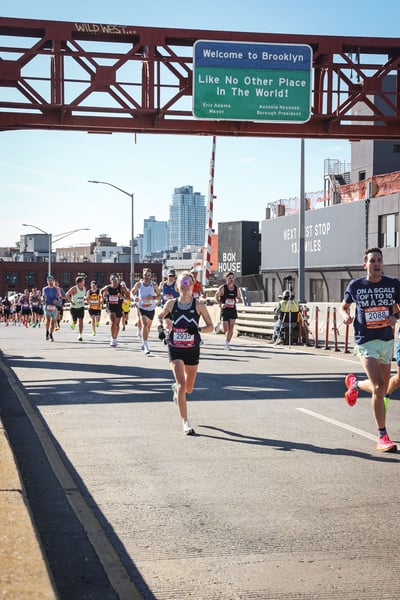 In addition to being a pediatric sports medicine physician, Aubrey Armento, MD, has extensive experience as an athlete, and she has ran in 13 marathons. Image courtesy of Armento.
Puberty’s impact
One of Armento’s goals in her clinic is to normalize the changes that come with puberty, particularly for young female athletes. It is typical for females to gain weight and potentially experience a temporary decline in their sports performance during puberty as they adjust to their changing body, she explains.
“In my clinic, I see female athletes come in and share that they struggle with how their body is changing, and they feel like it’s affecting their relationship with their sport,” she says. “We want girls to progress through puberty regularly, because estrogen is especially important in relation to bone health.”
Male athletes, on the other hand, often “reap the benefits” of puberty, given that testosterone “really is a performance enhancer,” Armento says.
“For male athletes, when they go through puberty, they have rising levels of testosterone and tend to get bigger, leaner, and stronger, and that helps them become better athletes,” she says.
However, if a prepubescent athlete, male or female, is training at high levels and is not properly fueling themselves, it can stunt their growth and lead to a delay in puberty.
“That’s certainly a risk of that in these high-level, young athletes in middle school and high school, such as elite gymnasts,” Armento says. “We can help prevent delayed puberty by ensuring a person gets adequate nutrition, rest, and recovery.”
Can menstrual cycles affect athletic performance?
It’s common for Armento’s patients to ask her about how their menstrual cycle may affect their sports performance and risk of injury. However, because there is so much variability in how people experience menstrual cycles, there is no consensus.
“Some people have significant premenstrual symptoms that interfere with their quality of life, which can affect athletes. But others don’t struggle with those symptoms and are not affected by their cycle,” she says.
Research has not shown a definitive link between certain menstrual cycle phases and an increased injury risk, she notes, though additional research is needed on the issue.
“Overall, we don’t have enough evidence to definitively say that a certain phase of a menstrual cycle will impair sports performance or increase injury risk,” she says.
A frequent misconception Armento hears from young female athletes is that they think it is normal to miss their menstrual cycle, believing that it can be a side effect of intense training. This is not typical, she warns, and it is a sign that there may be an energy imbalance where a person is not properly fueling their body.
“You can train really hard, and if you’re nutritionally supporting yourself, you should maintain a regular menstrual cycle,” she says. “It’s something we should pay attention to. If you are missing your period, then it warrants further investigation and potential treatment.”
Research shows that when young female athletes do not get regular periods and have low estrogen levels, they often have low bone density, Armento explains.
“If we don’t do something to address that, their risk of osteoporosis as an adult is higher. It can also increase the risk of fractures,” she says. “That’s why a lot of our work has an emphasis on restoring regular menstrual periods.”
Aging and athletic performance
From early adulthood to the age of about 40, there are no sweeping hormonal changes in people, Kohrt says. But as people reach their early or mid-40s, their sex hormones may start to decline.
“I think, in some ways, that drop can negatively influence sports performance, especially when we think about declines in testosterone since testosterone helps us maintain muscle mass,” Armento says. “For older athletes, there may be an increased risk of injury and it may be harder to recover.”
Just as women’s experience with menstrual cycles are highly variable, the impact of menopause can widely vary, Kohrt explains.
“When women go through menopause, some have debilitating hot flashes, depression, and sleeplessness. Others do not,” Kohrt says. “The effects of fluctuating hormone levels can be highly individualistic, so while some athletes may report that their performance is influenced by menopause and hormonal changes, others will not.”
Researchers are still unsure if there is an equivalent of menopause in men, which is sometimes referred to as “manopause” or “andropause,” Kohrt explains. However, studies have shown that increases and decreases in fat mass can suppress testosterone.
“In male athletes — just like among female athletes — if they do not eat enough, then their testosterone levels can be suppressed,” Kohrt says. “That can affect bone metabolism and muscle mass.”
Although younger athletes are often seen as having the upper hand when it comes to competitions like the Olympics, there are advantages to being an older athlete.
“With age comes experience. The gained experience and fitness built over time can be a benefit, especially for skill-based sports,” Armento says. “Whether you are younger or older, there are pros and cons to both stages of being an athlete. I wouldn’t equate aging as an athlete as bad because there is good that comes from the cumulative experience and fitness gained in the sport.”