.png)
As a child growing up in Accra, the capital city of Ghana in West Africa, Isaac Acquah, MD, MPH, spent many of his mornings and nights working in his family’s bakery. The workday often started by 5 a.m. with Acquah helping bake and deliver bread to customers, all before heading off to school. Now, as a first-year cardiovascular disease fellow at the University of Colorado Anschutz Department of Medicine, he spends his days and nights honing his skills to deliver life-saving care to patients.
In the years between working at the bakery and the CU Anschutz campus, Acquah has built an impressive resume. He became class president at his medical school, earned a master’s degree at Harvard University, conducted research aimed at improving cardiovascular care and addressing health disparities, and provided care to patients with a vast array of cardiovascular issues — to name a few accomplishments.
During his three-year fellowship training within the CU Anschutz Division of Cardiology, he strives to advance his expertise to be the exceptional clinician, researcher, and leader he’s worked for years to become.
“This is what I’ve always wanted to do,” Acquah says. “As an international medical graduate, to have trained at some of the top institutions in the United States and worked alongside some of the best people is something I’m deeply proud of. It’s a full-circle moment for me.”
Though only in his first year of training, Acquah is already having an impact on his patients, colleagues, and mentors. Alexis Tumolo, MD, director of the cardiovascular disease fellowship program, describes him as incredibly hardworking and thoughtful.
“What impresses me the most about Dr. Acquah is his kindness, resilience, and commitment to his mission of service,” Tumolo says. “He is always eager to improve and advance his knowledge, and he is incredibly determined to achieve his goals.”
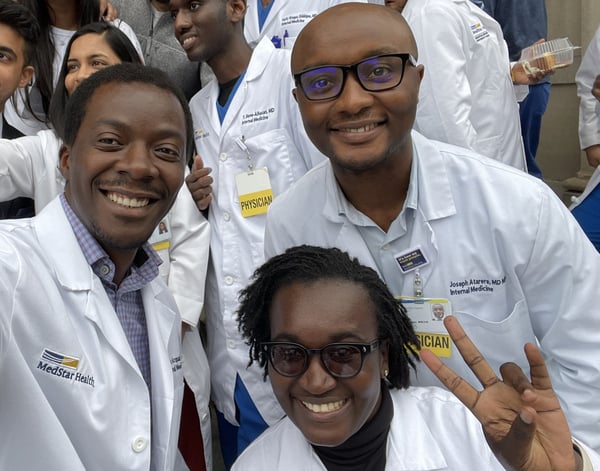 Isaac Acquah, MD, MPH, far left, smiling with colleagues at MedStar Health, where he completed his residency training. All images courtesy of Acquah.
‘Meant to do this’
Acquah discovered a love for biology at a young age, fascinated with learning about the inner workings of the body. He was so captivated by the subject that any free moment he had was spent poring over biology textbooks. By the time he was in middle school, he knew he wanted to become the first doctor in his family.
After completing high school, he applied to the only school he wanted to attend, the University of Ghana, where he received his medical school training. He graduated medical school in 2014 and then completed a two-year mandatory service called a housemanship, which is required by the government for new doctors and medical professionals in Ghana. He trained in four medical rotations: internal medicine, pediatrics, obstetrics and gynecology (OB-GYN), and surgery.
He spent the first year of his training at the Korle Bu teaching hospital, the leading referral center in Ghana and one of the largest in Africa. Early on, he was assigned to work on the cardiology floor, where he met an influential professor who explained complicated aspects of cardiovascular disease in a way that resonated with him.
“That’s when my interest in cardiology started. I ended up spending more time during my clerkship on the cardiology floors than anywhere else,” he says. “I started to think, ‘Maybe I’m meant to do this.’ That's how the journey began.”
Wanting exposure to ‘the best’
Following Acquah’s housemanship, he spent about seven months working at a facility where he provided general medical care, such as helping patients in emergency situations or during surgical procedures.
“By that time, I knew I wanted to pursue cardiology and was very interested in research at the same time. I wanted to be exposed to the best resources and training available,” he says. “I figured that traveling to the U.S. was the right path to get there.”
With a long-term goal of becoming a physician-scientist, Acquah decided to pursue a master’s degree in public health as a deliberate step toward building a strong research foundation. The opportunity to deepen his research expertise while also strengthening his candidacy for specialty training in cardiology made it a natural fit. Though it was not easy, Acquah’s hard work paid off. He was accepted into the master’s program at the Harvard T.H. Chan School of Public Health, a one-year program he completed in 2019.
“It was a tough decision to make, to leave what I was doing in Ghana behind and come to the U.S.,” he says. “But at the same time, I was looking at the end goal of what I wanted to do and what I wanted my career to be like.”
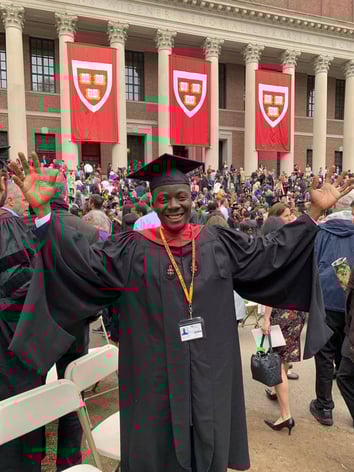 In 2019, Isaac Acquah, MD, MPH, completed a master’s program at the Harvard T.H. Chan School of Public Health.
Choosing CU Anschutz
During his master’s program, Acquah gained skills in epidemiology and biostatistics, as well as leadership skills in health management, describing the combination as “the best of both worlds.”
He put his newfound expertise into action in 2020 when he began working as a postdoctoral fellow at Houston Methodist Center for Outcomes Research. Much of his research focused on how different social determinants of health — non-medical factors that influence health, such as a person’s housing, education, income, and transportation — and health disparities affect people with cardiovascular issues. His research also involved the use of imaging, such as using coronary artery calcium scans for cardiovascular disease risk stratification.
In 2022, Acquah began his three-year internal medicine residency training at MedStar Health in Baltimore, Maryland. As he approached the end of his residency training, he began searching for cardiology fellowship programs that offered opportunities to further develop his clinical and research skills. After much research and conversations with mentors, CU Anschutz emerged as a clear standout.
“CU Anschutz checked every box,” he says.
The fellowship training at CU Anschuz offers ample opportunities for trainees to become well-rounded cardiologists. For instance, trainees see a variety of patient populations and cardiology needs by training at three clinical sites: the UCHealth University of Colorado Hospital, Rocky Mountain Regional Veterans Affairs Medical Center, and Denver Health. Trainees also have ample opportunities to advance their research skills. Although these were all important elements to Acquah, ultimately, it was the people who stood out the most.
“As an international medical graduate, it’s harder because you often feel a step behind others and have to put your best foot forward,” he says. “Finding a place where it feels like the people actually want you there is important.”
“CU Anschutz was the first program I interviewed at, and I remember it felt like such a supportive environment that would offer what I needed to advance my career,” he adds. “I’m happy to say that my colleagues have been wonderful. We are like a family. And the faculty are the best at what they do. I feel very lucky to be here.”
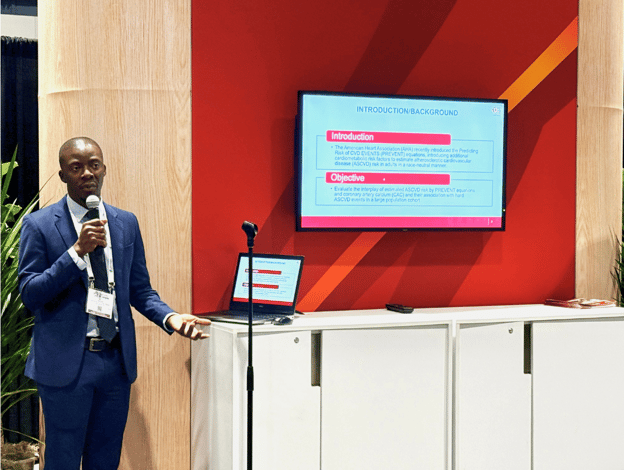 Isaac Acquah, MD, MPH, has presented research at national meetings for organizations like the American Heart Association.
‘We help empower them’
In his clinical care, Acquah aims to build trust with his patients and equip them with the information and resources they need. It’s a mission that continues to prove valuable, such as in the case of a recent patient at Denver Health with pulmonary hypertension, a condition where there is high blood pressure in the lung arteries.
“The patient knew bits and pieces of what was happening to them, but they didn’t fully understand how their condition was affecting their lungs and heart,” Acquah says. “I took a piece of paper and made drawings to show the patient how their condition was affecting their body. At the end, the patient was very grateful and thanked me, saying no one else had fully explained it like that before.
“It made me realize that, as physicians, we sometimes use medical terms that patients may not understand, leaving a communication gap. We need to be deliberate about making the time to explain to patients what is happening to them,” he adds. “By helping them understand their condition, we help empower them, and that’s really important to me. Those little moments matter.”
‘Proud of how far I’ve come’
Though he is still early in his cardiology career, when Acquah reflects on his journey from the young boy waking before dawn to help at the family bakery to now, it fills him with pride.
“The move from Ghana to the U.S. was not easy, and navigating the immigration system was difficult,” he says, explaining that it was often challenging to balance the requirements to work with his need to study. “There were moments where the path forward was unclear, but I made a conscious effort to keep going. There have been many sacrifices, and it’s taken a lot of hard work. I am proud of how far I’ve come despite the challenges.”
Looking ahead to his future career, Acquah is still exploring which subspecialty in cardiology he wants to pursue. Eventually, he hopes to blend his clinical and research interests with his passion for teaching and leadership.
“I’d like to work at an academic institution where I get to be involved in training the next generation of clinicians,” he says. “I also want to continue conducting research and further explore leadership opportunities, such as looking at ways to improve the health care system.”
Through navigating the hurdles of his medical journey, one of the greatest lessons Acquah has learned is the importance of asking for help and seeking support when needed. It’s this advice that he offers to others who are working to achieve goals that may seem out of reach.
“Keep your eye on the big picture,” he says. “There may be setbacks along the way, but it’s important to regroup, focus on your goal, and continue the journey. Resilience and determination are everything.”