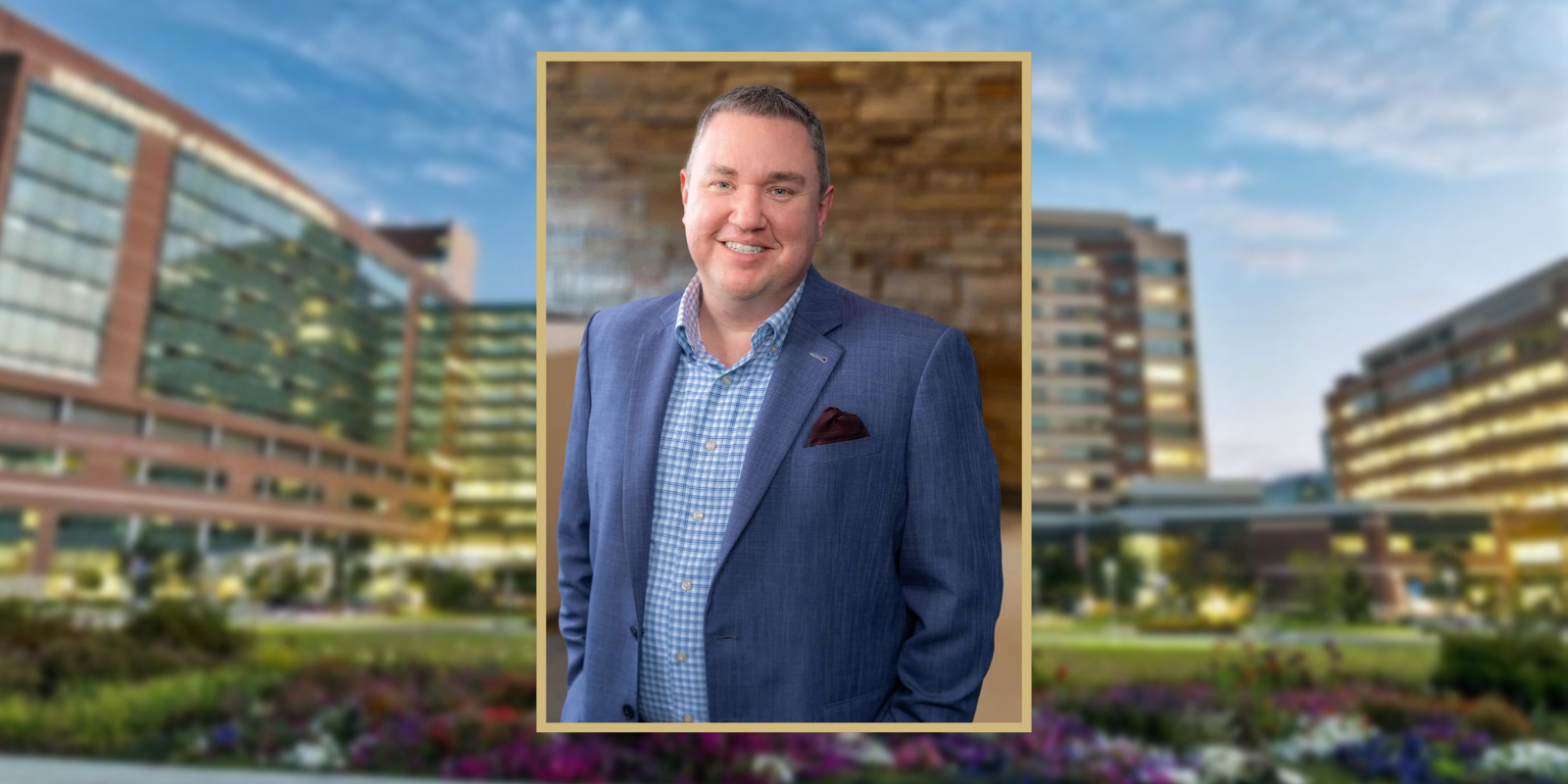
As president and CEO of UCHealth University of Colorado Hospital (UCH) since 2021, after serving as chief operating officer starting in 2014, Tom Gronow, EdD, MHA, has led the effort to expand the hospital’s facilities, services, and specialties, while strengthening its ties with the University of Colorado Department of Medicine.
In Gronow’s 11 years as a UCH leader, it has repeatedly been named the No. 1 hospital in Colorado by U.S. News & World Report, and several of its specialties have been ranked among the best in the nation.
Here, Gronow discusses UCH, its growth and goals, and its relationship with the CU Department of Medicine.
On UCH’s growth since Gronow arrived:
This hospital had two towers, and the second tower was only half activated, when I arrived. We’ve seen full activation of the second tower and we built a third tower. We’ve doubled the number of active beds in the last 11 years, and a lot of that has been because of the growing demand for services.
That growth has enabled us to recruit top talent, unlike some other academic medical centers (AMCs) that are either maintaining what they have or potentially having to shrink or jettison services because of saturation in larger urban markets that have multiple AMCs. We have the uniqueness of being the only AMC for a 500-mile radius.
We also recognize that we need to be competitive on the right services, which for us are sub-specialized, complex services that patients need from an AMC versus a community hospital. And we’re a large community asset to Aurora, while also building out our academic mission and putting our stake in the ground as a preeminent AMC.
On UCH as part of UCHealth:
We have an imperative to make sure that we are there for our patients when they need us, here and across the UCHealth system. We owe it to them to ensure that they have appropriate, timely access to services in the right location at the right time. That means we can’t operate as an isolated AMC. UCHealth has several campuses, and we have a lot of CU presence at those campuses, which is a chance to grow faculty from a community-presence perspective. We offer a front door closer to home with the same access to care, but if you need the resources of this campus, you have access.
This enables us to have space at UCH to continue to grow that complex subspecialty care that we need on this campus. We say, “right place, right care, right time.”
On UCH’s relationship with the CU Department of Medicine:
Since Vineet Chopra, MD, MSc, arrived as chair in 2021 and put in place his leadership structure, it’s been nice to see how the department has transformed. There have been lots of new leaders in the divisions, which has been very beneficial because it’s opened up outside perspectives. Great people have been promoted internally as well, but we’re getting new faces and importing new ideas from other AMCs that will help us continue to be relevant and understand what other folks are facing in the industry. It’s all about selecting the right leaders for where we need to be five years from now, not just today.
Dr. Chopra has a very forward-thinking approach. The work he’s done to promote faculty and clinical excellence within the department is spectacular. He’s been among the first to do that on this campus, and now the rest of the campus wants to emulate and work through that.
It’s really about identifying expertise in clinical care and continuing to recruit great talent. So the relationship is strong, because we are both motivated to bring the best and brightest to this campus.
On the education side, it’s important that we’re investing in our residents and fellows and training them to be the next generation of health providers, so it should be incumbent upon us to retain them here as much as we can, or, if they have a desire to go into the community, finding spots for them through our UCHealth Medical Group. That way we keep that relationship strong as they become referring providers who will send patients back to us at UCH as needed.
On transplant surgery and the future:
It goes to what we need on this campus to be relevant as a top national AMC. What do we want to be known for? What are marquee programs that come to mind when you think of CU?
I’d say we have several key clinical programs that are representative of what a top AMC should be great at: Transplants, cancer, neurosciences, complex orthopedics, musculoskeletal, spine deformity, and cardiovascular. If we can excel in those spaces, then what should we do really well in those spaces?
In transplant, the big things on the national front right now are normothermic regional profusion and normothermic machine perfusion. This involves organs that even a few years ago would have been rejected by transplant centers because the physiological function of the organ was subpar because of injury or an unhealthy donor. Now we can take that organ and put it on machine profusion, a pump that will push fluid and blood back through the organ to help rehab it and keep it preserved longer at a normal temperature. You spend less time in the hospital waiting for the organ and you have better graft function.
That’s the next generation, and transplant centers that do that well will be at the forefront of transplant nationally. That’s a big competency of ours. We’re going big in transplant because that’s our future. That's the type of investment that we want to make.
With that comes research and educational opportunities for fellows that may not be available at other transplant programs. It becomes a differentiator for us. We will continue to build out that expertise and draw the experts to teach it. It’s something we’re proud of and it’s something a top AMC should do.