For a person who needs a liver transplant, where they live has a major influence on how difficult it is for them to get a transplant. Patients living in Montana or New Mexico, for instance, do not have any liver transplant centers in their state, creating barriers in accessing care.
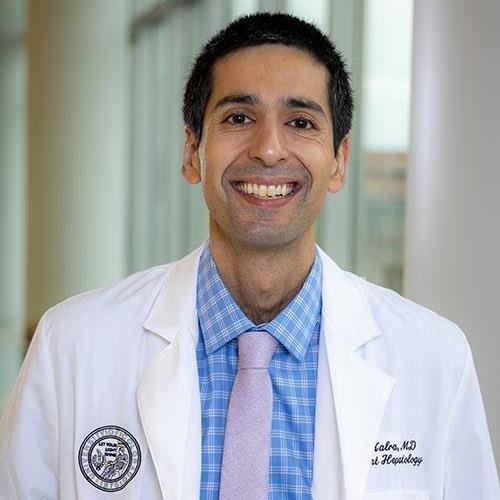
Transplant hepatologist Avash Kalra, MD, is working to remove such barriers as director of liver transplant outreach and strategic development at the University of Colorado Anschutz Department of Medicine. In this role, Kalra regularly travels to visit patients living in resource-limited areas that cannot offer specialized liver transplant care.
One of those patients was a man over the age of 70 in Albuquerque, New Mexico. Although there are no strict age restrictions for a liver transplant recipient, generally, there is more risk with age.
“On paper, a transplant team reviewing this man’s medical chart may have had concerns about whether he could survive a liver transplant. But our outreach program allowed me to visit him in Albuquerque and see that despite his age, he was physically fit and a good candidate,” Kalra says. “Now, he sends me a text every single year on the anniversary of his liver transplant to say thank you. It’s a reminder that this is really meaningful work.”
CU Anschutz is home to the only major, large volume academic liver transplant center in Colorado, Kalra explains. There are 10 states in the country that do not have liver transplant programs, and most of those states have the highest rates of liver-related deaths in the nation. Many of those states are near Colorado, including Wyoming, New Mexico, and Montana, which is why Kalra feels a responsibility to travel and meet patients where they are to help connect more of them to the care they need.
“A liver transplant gives a patient a second chance at life,” says Kalra, an assistant professor in the CU Anschutz Division of Gastroenterology and Hepatology. “If you draw a line from the Canadian border to the Mexican border, there is no other transplant center in the states directly north or south of us. This geography gives us a unique opportunity to help patients in nearby states, and we pride ourselves on helping both our community and our neighboring communities.”
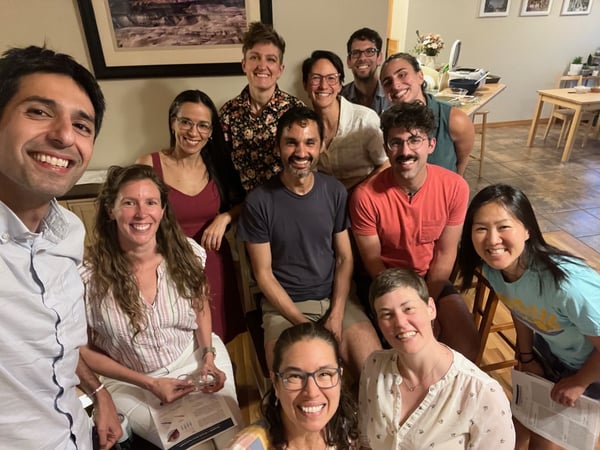 Avash Kalra, MD, far left, smiles alongside a group of medical providers in Gallup, New Mexico, who he visited as part of his work as director of liver transplant outreach and strategic development. Image courtesy of Kalra.
Developing the outreach program
Since assuming the outreach director role in 2021, Kalra has focused his efforts on building connections with patients and health care providers alike in Grand Junction, Colorado; Billings, Montana; and Albuquerque, New Mexico. He travels to Grand Junction and Billings every quarter, and he visits Albuquerque every other week to do an outreach clinic. Two additional providers — Meg O'Meara, NP, a transplant hepatology nurse practitioner, and Brittney Henderson, PA-C, a physician assistant — also travel to conduct outreach in these areas as part of this program.
“Last year, almost one-third of patients who we transplanted at CU Anschutz were New Mexico residents,” he says. “Our program has grown so much that we now have two providers who travel to New Mexico monthly to see post-transplant patients as well.”
During his trips, Kalra primarily sees new patients who have been referred for a liver transplant. A lot of the referrals come from primary care or general gastroenterology offices that are not specialized in liver transplant care. Kalra hosts local outreach clinics for these patients to attend, where he will discuss the transplant process with them, assess if they have any potential barriers to getting a transplant, and in some cases, let a patient know if a transplant may not be needed.
“It’s an opportunity to provide input to the patient while they are closer to their home,” he says.
These interactions have proven valuable in connecting patients to the care they need. For instance, a patient in Montana had a relatively rare form of liver disease, called Budd-Chiari Syndrome, that the local gastroenterology team felt uncomfortable managing. The patient was referred to Kalra, who was able to recognize that the patient needed a liver transplant.
If a patient needs a full liver transplant evaluation, they will come to CU Anschutz for a thorough evaluation. For patients who ultimately receive a transplant, they will stay locally in Colorado during the early recovery process.
“That patient from Montana got a transplant and has done very well. Now, they’ve started their own family and are happy,” he says. “Similar to many other transplant hepatologists, including my incredible colleagues, I’m very close with patients who’ve gone through the transplant process. It’s really rewarding for me.”
“We’ve also had patients from the outreach program go through our living donor liver transplant program, which provides an opportunity for patients in remote areas to get a liver transplant without having to wait on a list for a long period,” he adds. “That can be even better for patients because it allows transplant to occur before they become too sick.”
Connecting with providers
Beyond conducting patient care, a key component of Kalra’s outreach work is developing relationships with doctors and other providers in these communities.
“There are two main efforts with this relationship building. One is educating providers on the management of liver disease and reasons to refer a patient for a transplant. We’ve hosted lectures, and I’ve started a free webinar series,” he says. “The other is directly communicating with local referring providers. It’s really important to have that relationship because these providers are the ones who have known these patients for years.”
These collaborations are a two-way learning experience, he notes. Just as Kalra aims to teach the providers more about liver transplants, he also seeks to learn about how these providers approach providing care to patients with limited resources.
“It is important for us to understand the environment that these patients are being seen in and the barriers they have to overcome to even get to us for a liver transplant,” he says. “Also, liver transplants are so multidisciplinary, and the local community is part of that. We need to ensure there is good communication and relationships between all of these groups.”
‘Thanks for giving our patients a chance’
One of the medical centers that Kalra has connected with over the years is the Gallup Indian Health Medical Center, a hospital in Gallup, New Mexico, that is located on the border of the Navajo Reservation.
“We’ve developed a relationship with the physicians there, as they see a high burden of liver disease in their population for a variety of reasons. This year, they invited me there to give a lecture, and it turned into an amazing all-day event,” Kalra says.
The day began with an informative lecture Kalra gave to local providers in the hospital, and he answered their questions during a panel in the afternoon. In the evening, he was invited to have dinner with a group of physicians at one of their homes and join their journal club discussion.
During his visit, Kalra received a lot of positive feedback from the providers in Gallup, recalling that one physician said to him, “Thanks for giving our patients a chance.”
“I think that’s what the outreach program is all about,” Kalra says. “It gives these patients a chance to explore this possibility, and we know that this work really does improve end results.
“More patients who might not have been referred or have had the access to get a transplant are now able to get a transplant. That's the main point,” he continues. “As the highest volume transplant center in our region, we have a responsibility to make sure we’re helping as many patients as we possibly can. The more we’re able to offer, the more we should be doing that.”
.png)